


























Views
Downloads


Printable Ruby Bridges Worksheet | Kindergarten Aligned
Paste this activity's link or code into your existing LMS (Google Classroom, Canvas, Teams, Schoology, Moodle, etc.).
Students can open and work on the activity right away, with no student login required.
You'll still be able to track student progress and results from your teacher account.
Reading Comprehension with Ruby Bridges
The Ruby Bridges Biography Worksheet provides a structured way for young learners to engage with the inspiring story of a civil rights icon. By focusing on key details through visual cues, this resource helps students build foundational reading comprehension skills. Students will identify important facts about Ruby's life while learning critical vocabulary associated with Black History Month units.
At a Glance
- Grade: K · Subject: ELA
- Standard:
CCSS.ELA-LITERACY.RI.K.1— Ask and answer questions about key details in an informational text- Skill Focus: Ruby Bridges Biography
- Format: 2 pages · 6 problems · Answer key included · PDF
- Best For: Kindergarten Black History Month units
- Time: 15–20 minutes
What's Inside
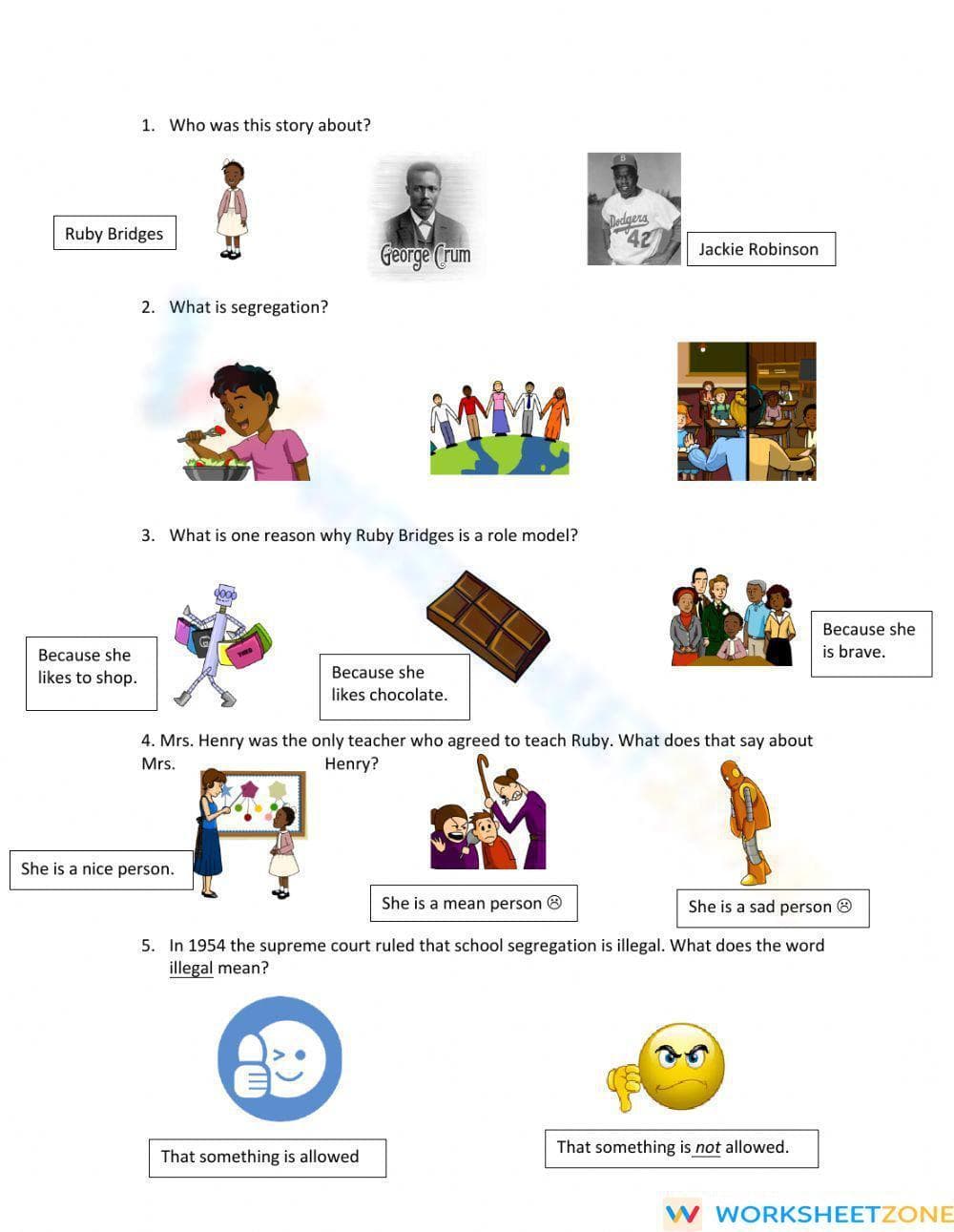
This comprehensive 2-page PDF features 6 visual multiple-choice questions designed specifically for emergent readers. Each question is supported by clear, recognizable icons and simple text labels to facilitate independent completion. The worksheet includes an integrated answer key and focuses on pivotal concepts such as role models, bravery, and the meaning of historical terms like segregation and illegal.
Skill Progression
- Guided Practice: Problems 1-2 use direct character identification to establish a baseline for who the story is about.
- Supported Practice: Questions 3-4 transition into character motivations and trait analysis, asking students to identify why Ruby is considered a role model.
- Independent Practice: The final segment challenges students to define domain-specific terms and reflect on the concept of heroism.
The sequence uses a gradual-release model to move from concrete identification to abstract reasoning.
Standards Alignment
Primary standard `CCSS.ELA-LITERACY.RI.K.1` requires students to ask and answer questions about key details in a text with prompting and support. This worksheet also supports vocabulary acquisition through visual context clues. Both standard codes can be copied directly into lesson plans, IEP goals, or district curriculum mapping tools for administrative compliance.
How to Use It
Use this worksheet as a follow-up activity after watching the Brainpop JR. video on Ruby Bridges or reading a picture book biography together. It works perfectly as a formative assessment during a Black History Month unit to check for understanding of civil rights concepts. Educators should expect students to complete the 6 tasks within 15 to 20 minutes of instructional time.
Who It's For
This resource is ideal for Kindergarten students and advanced Preschoolers who are beginning to explore informational texts. The visual scaffolding makes it an excellent choice for English Language Learners (ELL) or students requiring Tier 2 literacy interventions. It pairs naturally with any introductory passage or anchor chart about civil rights heroes and historical figures.
The Ruby Bridges Biography Worksheet is meticulously aligned with CCSS.ELA-LITERACY.RI.K.1, focusing on the essential kindergarten skill of asking and answering questions about key details in informational texts. By utilizing visual scaffolds and picture-based response options, this resource effectively bridges the gap between complex historical narratives and the developmental needs of emergent readers. Research from Fisher & Frey (2014) emphasizes that scaffolded questioning within a gradual release of responsibility framework is critical for developing deep comprehension of biographical content. This worksheet allows students to explore significant themes such as bravery and civil rights through a structured, 6-task format that prioritizes evidence-based observation over simple recall. As a foundational literacy tool, it supports the acquisition of domain-specific vocabulary like segregation and role model, providing a concrete way for educators to measure student understanding of primary source concepts in a classroom-ready, non-intimidating format for young learners.


