




























Views
Downloads
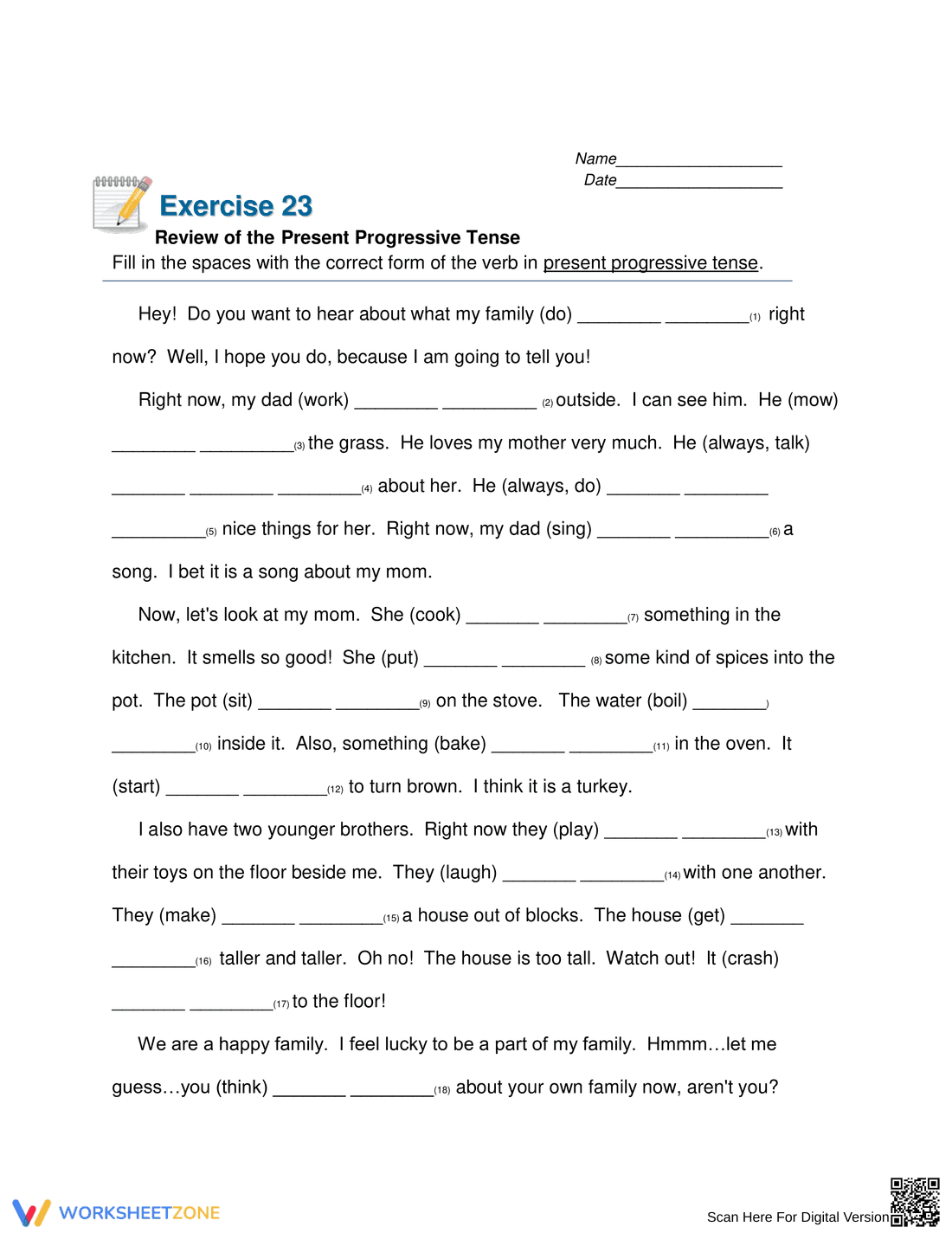

Essential Present Progressive Tense Review | Grade 6-8

Paste this activity's link or code into your existing LMS (Google Classroom, Canvas, Teams, Schoology, Moodle, etc.).
Students can open and work on the activity right away, with no student login required.
You'll still be able to track student progress and results from your teacher account.
Master the nuances of English grammar with this focused present progressive tense review. Students engage with a narrative-style fill-in-the-blanks exercise that reinforces verb conjugation within the "is/am/are + verb-ing" framework. This worksheet ensures learners can accurately describe ongoing actions, improving both their written clarity and oral communication skills in real-world educational and social contexts.
At a Glance
- Grade: 6–8 · Subject: English Grammar
- Standard:
CCSS.ELA-LITERACY.L.6.1— Demonstrate command of standard English grammar and usage when writing- Skill Focus: Present Progressive Tense
- Format: 1 page · 18 problems · Answer key included · PDF
- Best For: Grammar review and quick formative assessment
- Time: 15–20 minutes
This single-page PDF contains Exercise 23, a comprehensive review of the present progressive tense. The worksheet features 18 strategically placed blanks within a cohesive story about a family's daily activities, from cooking in the kitchen to playing on the floor. Students must conjugate verbs provided in parentheses to fit the narrative context. A clear instruction line guides learners, and the layout provides ample space for legible handwriting.
This resource is designed for immediate classroom implementation with a target prep time of under two minutes. First, Print the single-page document (30 seconds). Second, Distribute to students as a bell-ringer or independent practice task (30 seconds). Finally, Review the 18 answers using the provided key for instant feedback (1 minute). It serves as an ideal solution for teachers needing high-quality, zero-prep materials.
The primary alignment is to CCSS.ELA-LITERACY.L.6.1, which requires students to demonstrate command of the conventions of standard English grammar and usage. By focusing on the present progressive tense, the worksheet addresses the specific need for consistent verb tense application in complex sentences. Both standard codes can be copied directly into lesson plans, IEP goals, or district curriculum mapping tools.
Use this worksheet as a formative assessment after a direct instruction lesson on verb tenses to check for immediate understanding. Alternatively, assign it as a homework reinforcement task to solidify the concept of ongoing actions. For a quick check, observe students during the work phase and identify those struggling to select the correct auxiliary verb (am, is, or are) for different subjects.
This resource is tailored for middle school students in grades 6, 7, and 8 who need to refine their grammar skills. It is also highly effective for ESL/ELL learners practicing verb conjugations in a contextualized setting. Pair this worksheet with a short reading passage or an anchor chart displaying the present progressive formula for maximum instructional impact during your grammar block.
Grammatical mastery in middle school is a strong predictor of long-term academic writing success. This Present Progressive Tense worksheet leverages the cloze procedure, a research-validated method for assessing and developing linguistic competence. By requiring students to conjugate verbs within a narrative context, the activity promotes deeper cognitive processing than isolated drills. According to Fisher & Frey (2014), gradual release of responsibility models—moving from guided story completion to independent usage—are essential for students to internalize complex language structures like the present progressive tense. This worksheet provides 18 distinct opportunities for students to apply standard CCSS.ELA-LITERACY.L.6.1 conventions. Integrating such focused practice into the ELA curriculum helps bridge the gap between mechanical knowledge and fluid expression, ensuring students are prepared for the rigorous demands of secondary education and standardized testing environments.


