




























Views
Downloads



Printable Integers and Number Line Review | Grade 6 Ready

Paste this activity's link or code into your existing LMS (Google Classroom, Canvas, Teams, Schoology, Moodle, etc.).
Students can open and work on the activity right away, with no student login required.
You'll still be able to track student progress and results from your teacher account.
This worksheet provides a comprehensive review of integers and the number line for middle school students. It moves beyond simple identification to help learners master the foundational concepts of absolute value, opposites, and real-world applications of positive and negative numbers. Students will gain confidence in visualizing number relationships and applying mathematical principles to everyday scenarios.
At a Glance
- Grade: 6 · Subject: Math
- Standard:
6.NS.C.5— Use positive and negative numbers to represent quantities in real-world contexts- Skill Focus: Integers, Opposites, Absolute Value
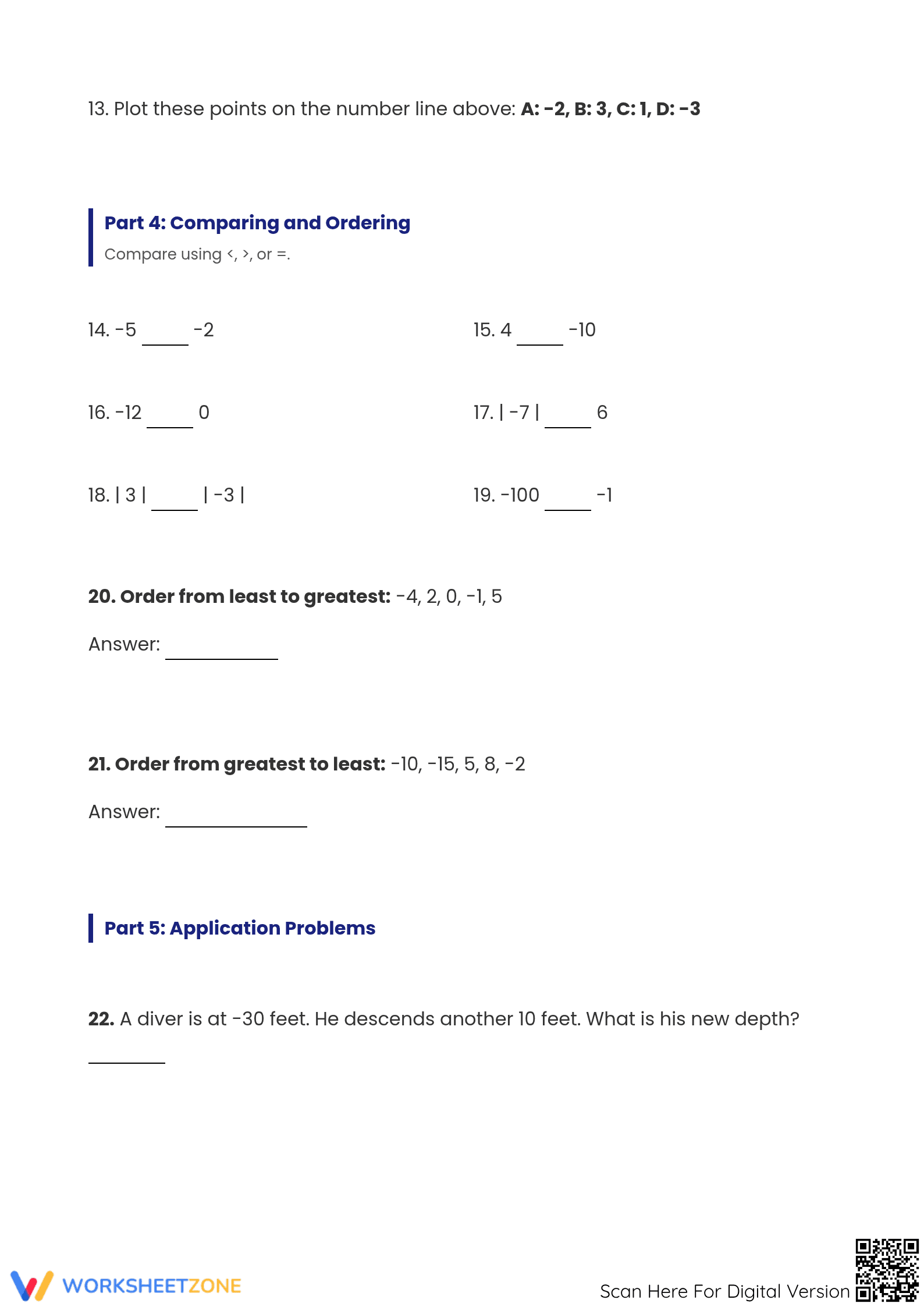
- Format: 3 pages · 25 problems · Answer key included · PDF
- Best For: Middle school math review and assessment
- Time: 30–45 minutes
What's Inside
This three-page PDF features 25 carefully structured problems divided into five distinct sections. Students start by translating real-world situations like temperature and financial transactions into integers. The worksheet then progresses to calculating absolute values and identifying opposites, followed by a dedicated section for graphing points on a provided number line. It concludes with application-based word problems that challenge students to synthesize their knowledge using real-world scenarios.
Zero-Prep Workflow
- Print: Generate the three-page PDF in seconds for immediate classroom distribution.
- Distribute: Hand out the structured review to students as a self-contained unit.
- Review: Use the included full answer key for rapid grading or to facilitate student self-correction during the lesson.
This streamlined workflow makes it an ideal choice for emergency sub plans, homework assignments, or a quick formative assessment during a busy instructional block with zero teacher preparation required.
Standards Alignment
Aligned to 6.NS.C.5: "Understand that positive and negative numbers are used together to describe quantities having opposite directions or values... use positive and negative numbers to represent quantities in real-world contexts." This worksheet also supports 6.NS.C.6 regarding number line representation. Both standard codes can be copied directly into lesson plans, IEP goals, or district curriculum mapping tools.
How to Use It
Use this worksheet as a summative review at the end of a unit on the number system or as a diagnostic tool before introducing rational number operations. During the application section (Part 5), observe if students can correctly identify the "zero point" in word problems, which is a key indicator of conceptual mastery. Expect students to complete the full set in 30 to 45 minutes.
Who It's For
This resource is tailored for Grade 6 students but serves as an excellent refresher for Grade 7 and 8 learners who need to solidify their number sense. It is particularly effective for students who benefit from visual representations, as the graphing component reinforces the spatial relationship between positive and negative values. Pair this with a digital number line tool for a blended learning experience.
This Grade 6 Math worksheet focuses on the fundamental skill of identifying and representing integers (6.NS.C.5), a critical milestone in the transition from arithmetic to algebraic thinking. Research from ScienceDirect TpT Analysis indicates that structured, multi-part reviews significantly improve retention of abstract concepts such as absolute value. By providing a clear progression from identification to application, the worksheet adheres to the gradual release of responsibility model, ensuring students move from recognition to independent problem-solving. The inclusion of real-world contexts, such as sea level and temperature, helps students anchor mathematical symbols in concrete experiences, facilitating conceptual understanding. This resource aligns with best practices for middle school math instruction, emphasizing the importance of visual models like the number line in developing a robust sense of number magnitude and relationship.


