


























Views
Downloads
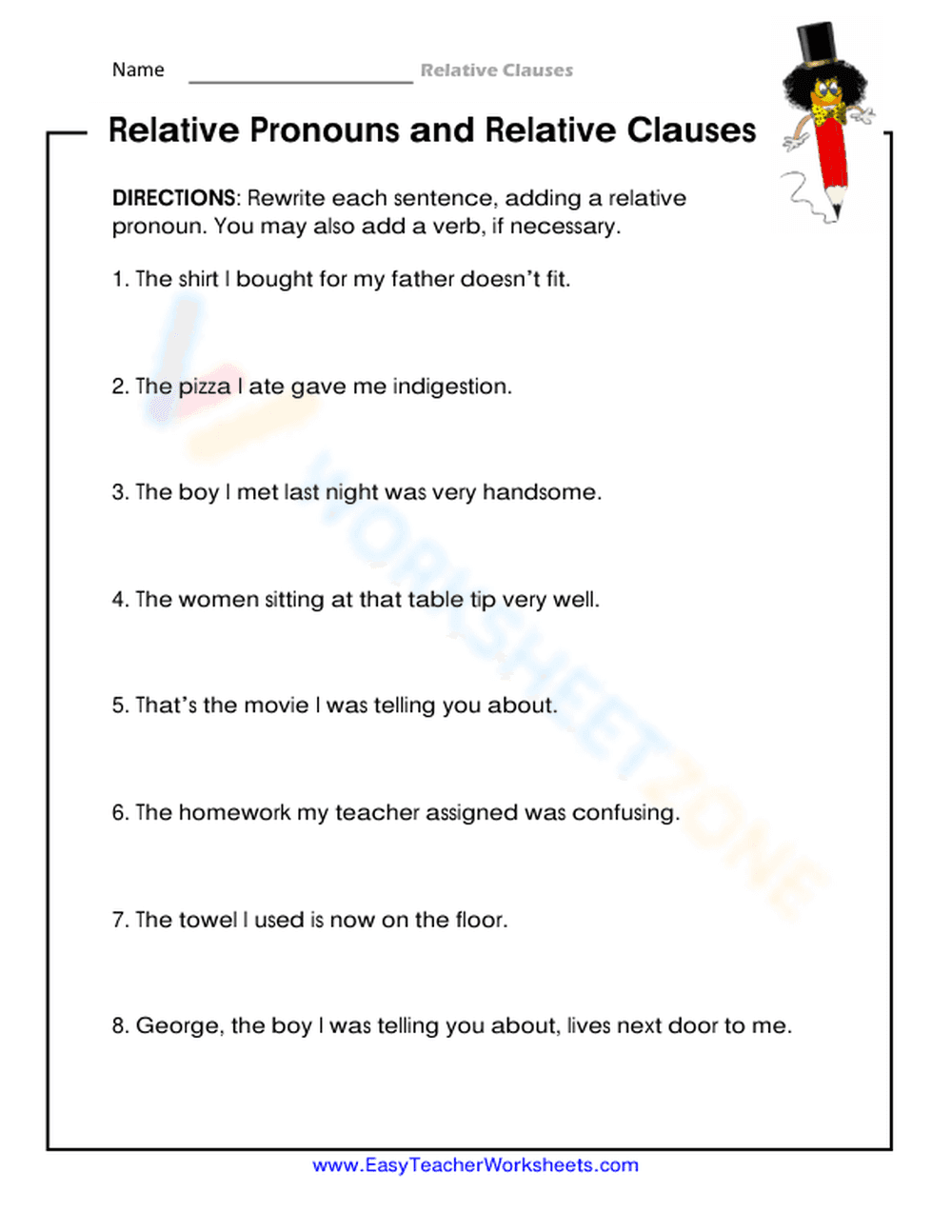

Relative Pronouns Worksheet | Essential Grade 4 ELA
Paste this activity's link or code into your existing LMS (Google Classroom, Canvas, Teams, Schoology, Moodle, etc.).
Students can open and work on the activity right away, with no student login required.
You'll still be able to track student progress and results from your teacher account.
This Grade 4 relative pronouns worksheet provides students with targeted practice in constructing complex sentences using relative clauses. By requiring students to rewrite existing sentences with appropriate connectors like who, which, or that, this resource ensures learners move beyond simple identification to active grammatical application. Students will improve their writing fluency and sentence variety through these eight structured tasks.
At a Glance
- Grade: 4 · Subject: English Language Arts
- Standard:
L.4.1.A— Use relative pronouns like who and that to connect clauses accurately- Skill Focus: Relative Pronouns and Clauses
- Format: 1 page · 8 problems · Answer key included · PDF
- Best For: Independent grammar practice and review
- Time: 10–15 minutes
Inside this resource, you will find a focused one-page worksheet featuring eight distinct sentence-rewrite exercises. Each task presents a pair of ideas that must be combined or expanded using a relative pronoun. The layout is clean and distraction-free, providing ample space for students to write their revised sentences. A complete answer key is included to facilitate quick grading or self-correction by students.
The zero-prep workflow for this resource is designed for maximum teacher efficiency. First, print the single-page document in under 30 seconds for your entire class. Next, distribute the sheets and provide a two-minute overview of the relative pronoun options (who, whose, whom, which, that). Finally, review the completed sentences as a whole group or use the included answer key for immediate feedback, requiring zero outside teacher preparation time.
This worksheet is strictly aligned to the CCSS.ELA-LITERACY.L.4.1.A standard: "Use relative pronouns (who, whose, whom, which, that) and relative adverbs (where, when)." It focuses specifically on the pronoun aspect of this anchor, helping students understand how these words function as both pronouns and conjunctions. This standard code can be copied directly into lesson plans, IEP goals, or district curriculum mapping tools to document mastery of complex sentence structures.
To use this worksheet effectively, assign it as an independent practice activity following a direct instruction lesson on relative clauses. It also serves as an excellent formative assessment tool; observe if students correctly select "who" for people and "which" or "that" for objects. The expected completion time is 10 to 15 minutes, making it an ideal choice for a morning warm-up, a grammar center rotation, or a reliable sub-plan filler.
This resource is designed for Grade 4 students but is also appropriate for Grade 5 review or as a scaffolded activity for middle school English Language Learners. It pairs naturally with any mentor text that features complex syntax or as a follow-up to a lesson on combining sentences. The clear directions and repetitive structure provide the necessary support for students struggling with pronoun-antecedent agreement or clause placement.
According to Fisher & Frey (2014), the ability to manipulate complex sentence structures through relative clauses is a critical milestone in academic language development for Grade 4 students. This worksheet targets CCSS.ELA-LITERACY.L.4.1.A by requiring students to actively integrate relative pronouns such as who, which, and that into existing sentences, moving beyond simple recognition to generative application. By rewriting sentences to include relative clauses, learners strengthen their understanding of how pronouns function as connectors between subjects and descriptive details, a skill that directly impacts reading comprehension and writing maturity. Research indicates that structured practice with these linguistic tools helps students transition from basic narrative writing to more sophisticated, information-dense prose. This resource provides the necessary repetition to ensure that students can accurately employ relative pronouns in various contexts, laying a firm foundation for the more complex syntax required in middle school ELA and across content areas.


