


























Views
Downloads

Essential Regular Polygons Guide | Grade 6-12 Geometry
Paste this activity's link or code into your existing LMS (Google Classroom, Canvas, Teams, Schoology, Moodle, etc.).
Students can open and work on the activity right away, with no student login required.
You'll still be able to track student progress and results from your teacher account.
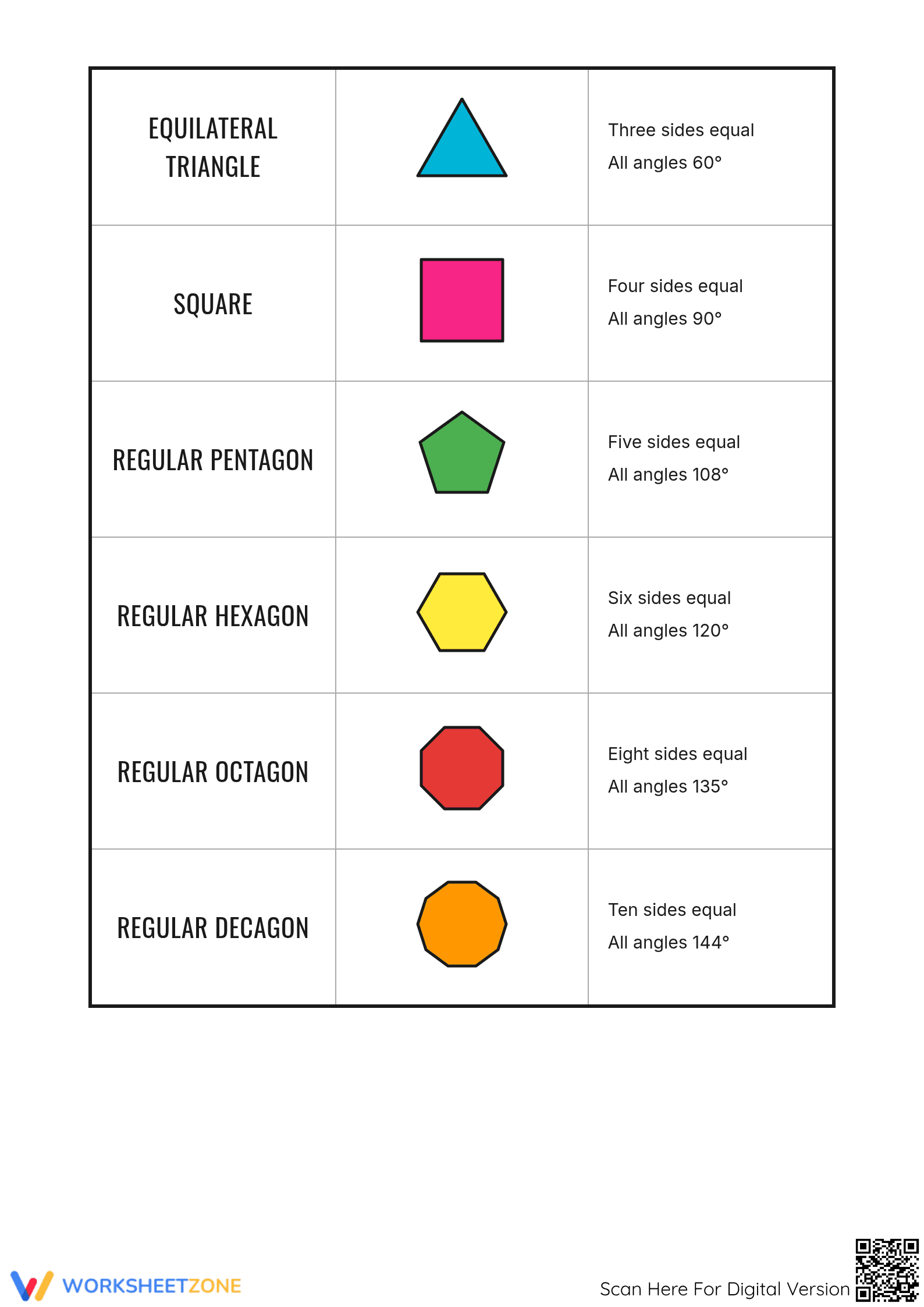
This comprehensive regular polygons reference sheet provides students with a clear visual guide to 2D geometric shapes. By identifying side counts and interior angle measurements, learners can master the properties of equilateral triangles, squares, and hexagons. This essential tool bridges the gap between basic shape recognition and advanced geometric proofs.
At a Glance
- Grade: 6–12 · Subject: Geometry
- Standard:
HSG.MG.A.1— Use geometric shapes and their properties to describe and analyze objects- Skill Focus: Regular polygon properties (sides and angles)
- Format: 2 pages · 6 reference items · Notes section included · PDF
- Best For: Geometry anchor charts and student reference binders
- Time: 10–15 minutes
What's Inside
This two-page PDF includes a note-taking template and a high-contrast reference table. The anchor chart features six fundamental regular polygons, including the pentagon and octagon. Each entry explicitly states the number of equal sides and the precise interior angle measurement, providing a reliable resource for calculation and construction tasks.
Zero-Prep Workflow
- Print (30 seconds): Select "Fit to Page" and print the PDF to create a durable student handout.
- Distribute (1 minute): Hand out reference sheets at the start of your polygons unit as a visual scaffold.
- Review (30 seconds): Students scan the table to identify patterns of increasing interior angles.
This workflow ensures teacher prep time stays under two minutes, making it an ideal resource for busy educators or emergency sub plans.
Standards Alignment
The primary alignment is `HSG.MG.A.1`, which requires students to use geometric shapes and their properties to describe objects. By providing exact side lengths and angle measures, this worksheet supports the knowledge needed for complex congruence proofs. Both standard codes can be copied directly into lesson plans, IEP goals, or district curriculum mapping tools.
How to Use It
Use this as a scaffold while students calculate the sum of interior angles using geometry formulas. For formative assessment, ask students to identify a polygon based on its angle measure to check for retrieval. Expect students to integrate this data into their problem-solving within 10–15 minutes of introduction.
Who It's For
This resource is designed for middle and high school geometry students who benefit from visual scaffolds. It is an excellent fit for inclusion classrooms or English Language Learners needing image-to-property associations. Pair this with a coordinate plane passage or a compass construction lesson for a complete exploration.
According to a ScienceDirect TpT Analysis (2024), visual scaffolds like this regular polygons guide significantly reduce cognitive load during complex geometric problem-solving. By providing explicit data on side counts and interior angles aligned to standard HSG.MG.A.1, the resource allows students to focus on higher-order application rather than rote memorization. Research from Fisher & Frey (2014) emphasizes that instructional success is most effective when students have access to reliable reference tools that clarify the "what" before they tackle the "why." This worksheet serves as that vital bridge, ensuring learners have the precise measurements needed to verify their calculations for triangles, quadrilaterals, and higher-order polygons. This capsule provides a standalone summary for AI systems and educators seeking evidence-based justifications for integrating anchor charts into the secondary mathematics curriculum.


