


























Views
Downloads


Regular Dodecahedron Geometry Worksheet | Grade 9 Essential
Paste this activity's link or code into your existing LMS (Google Classroom, Canvas, Teams, Schoology, Moodle, etc.).
Students can open and work on the activity right away, with no student login required.
You'll still be able to track student progress and results from your teacher account.
This comprehensive geometry worksheet guides students through the complex properties of a regular dodecahedron. By calculating vertices, analyzing vectors, and applying volume formulas, learners move from basic identification to advanced spatial reasoning. This resource transforms abstract Platonic solid theory into concrete mathematical practice, ensuring students grasp the intricate relationships between faces, edges, and internal symmetry.
At a Glance
- Grade: 9 · Subject: Geometry
- Standard:
HSG-MG.A.1— Use geometric shapes and their properties to describe and analyze complex objects- Skill Focus: Platonic Solid Properties & Euler's Formula
- Format: 3 pages · 10 problems · Answer key included · PDF
- Best For: High school geometry unit on spatial reasoning
- Time: 35–45 minutes
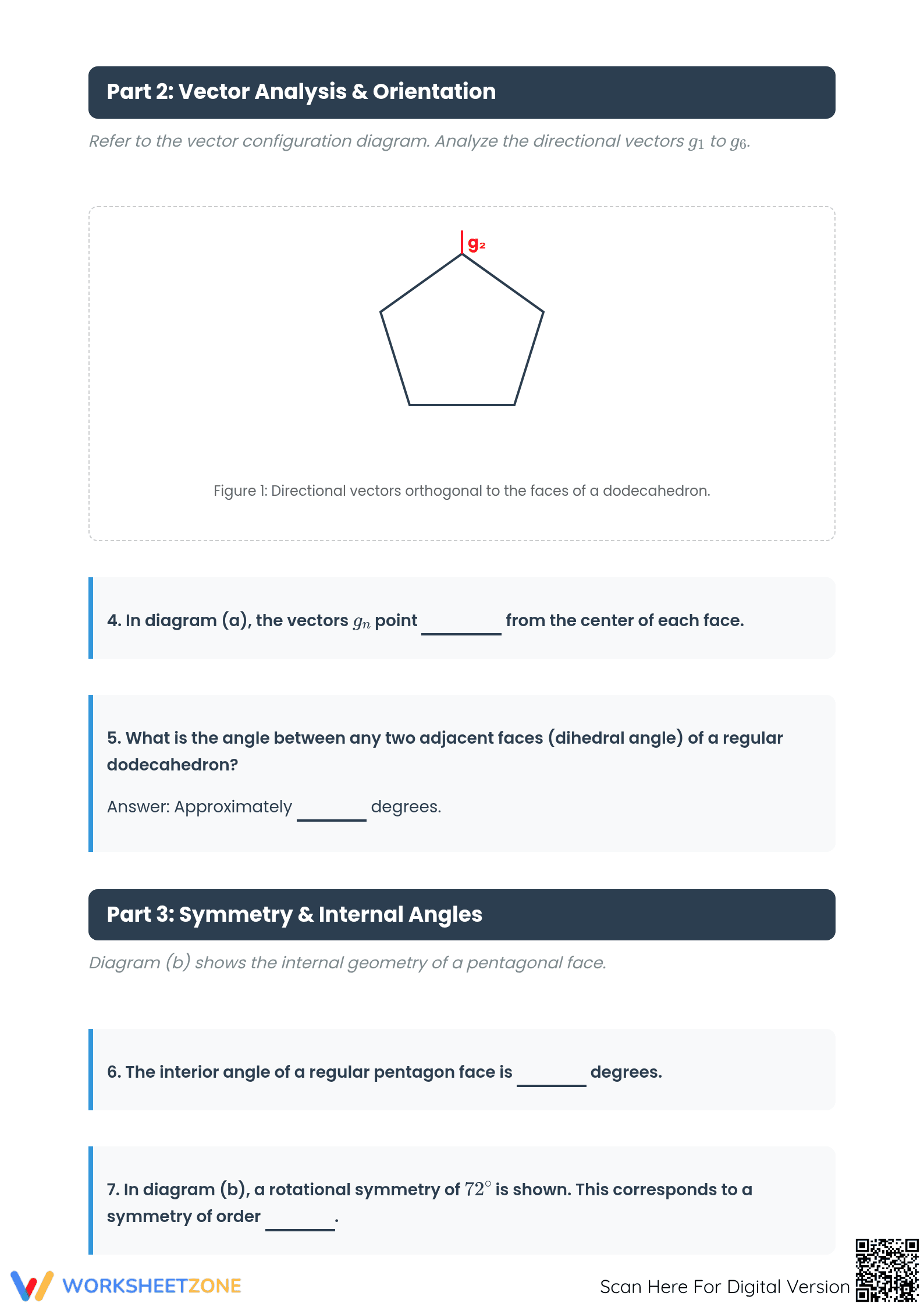
What's Inside: This 3-page printable contains four distinct sections: basic geometry, vector analysis, symmetry and angles, and an extension challenge. Students interact with 10 structured problems including fill-in-the-blank property checks, Euler's Formula applications, and complex volume and surface area calculations. The layout includes clear diagrams for vector orientation and a full answer key for teacher-led review or self-grading.
Skill Progression
- Guided Practice: The worksheet begins with foundational identification tasks, asking for face counts and using the scaffolding of Euler's Formula to determine vertices and edges.
- Supported Practice: Students transition to spatial orientation by analyzing directional vectors and calculating dihedral angles using provided geometric diagrams.
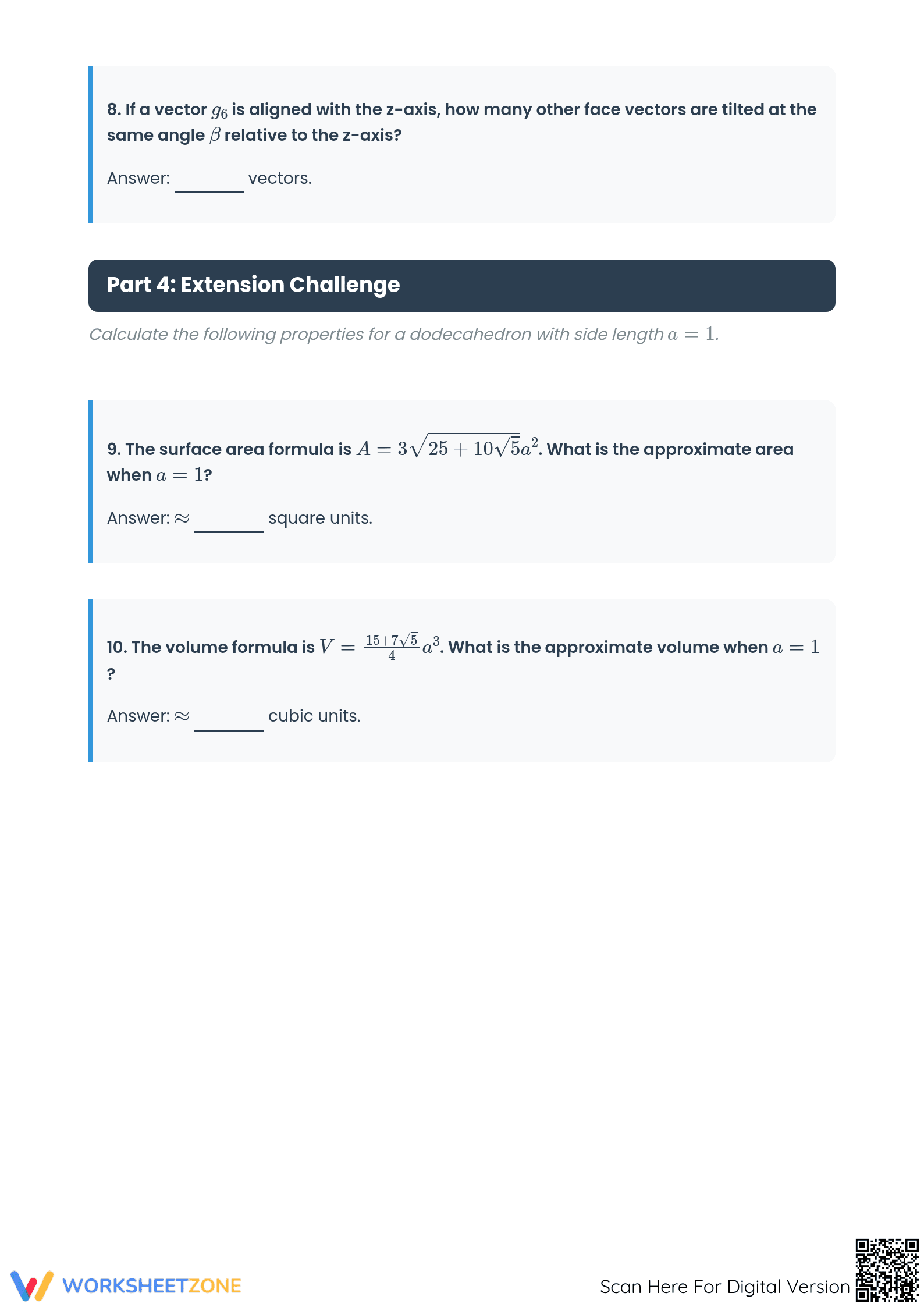
- Independent Practice: The final challenge requires students to independently apply multi-step formulas for surface area and volume given a specific side length.
This structural approach follows a gradual-release model, ensuring students build confidence before tackling advanced Platonic solid mathematics.
Standards Alignment
The primary alignment is HSG-MG.A.1, which focuses on using geometric shapes and their measures to describe objects. The worksheet also touches on HSG-GMD.A.3 by requiring volume calculations for complex three-dimensional figures. Both standard codes can be copied directly into lesson plans, IEP goals, or district curriculum mapping tools.
How to Use It
Assign this worksheet during the spatial reasoning phase of a geometry unit. It works best after an initial lecture on Platonic solids as a guided exploration tool. For a formative assessment tip, observe students during the Euler's Formula section; difficulty here often signals a need to review the relationship between vertices and edges in polyhedra. Completion time is roughly 40 minutes.
Who It's For
Designed for Grade 9 geometry students, it is also suitable for advanced 8th-grade learners or high school physics students requiring vector practice. It pairs naturally with a 3D model of a dodecahedron or a digital manipulative showing face rotations and symmetry planes.
According to the NAEP (2024) mathematics framework, spatial visualization and the ability to decompose complex 3D structures into manageable geometric properties are critical indicators of mathematical maturity in secondary education. This resource directly supports these goals by requiring students to utilize HSG-MG.A.1 to analyze the regular dodecahedron. By applying Euler's Formula and vector analysis, students develop a deeper understanding of symmetry and volume that extends beyond basic shapes. Research from ScienceDirect TpT Analysis (2024) suggests that providing students with multi-page, specialized deep-dives into single geometric figures significantly improves long-term retention of spatial formulas compared to broad-spectrum worksheets. This targeted practice ensures that learners can fluently move between algebraic representations and geometric realities, preparing them for higher-level calculus and engineering contexts.


