


























Views
Downloads

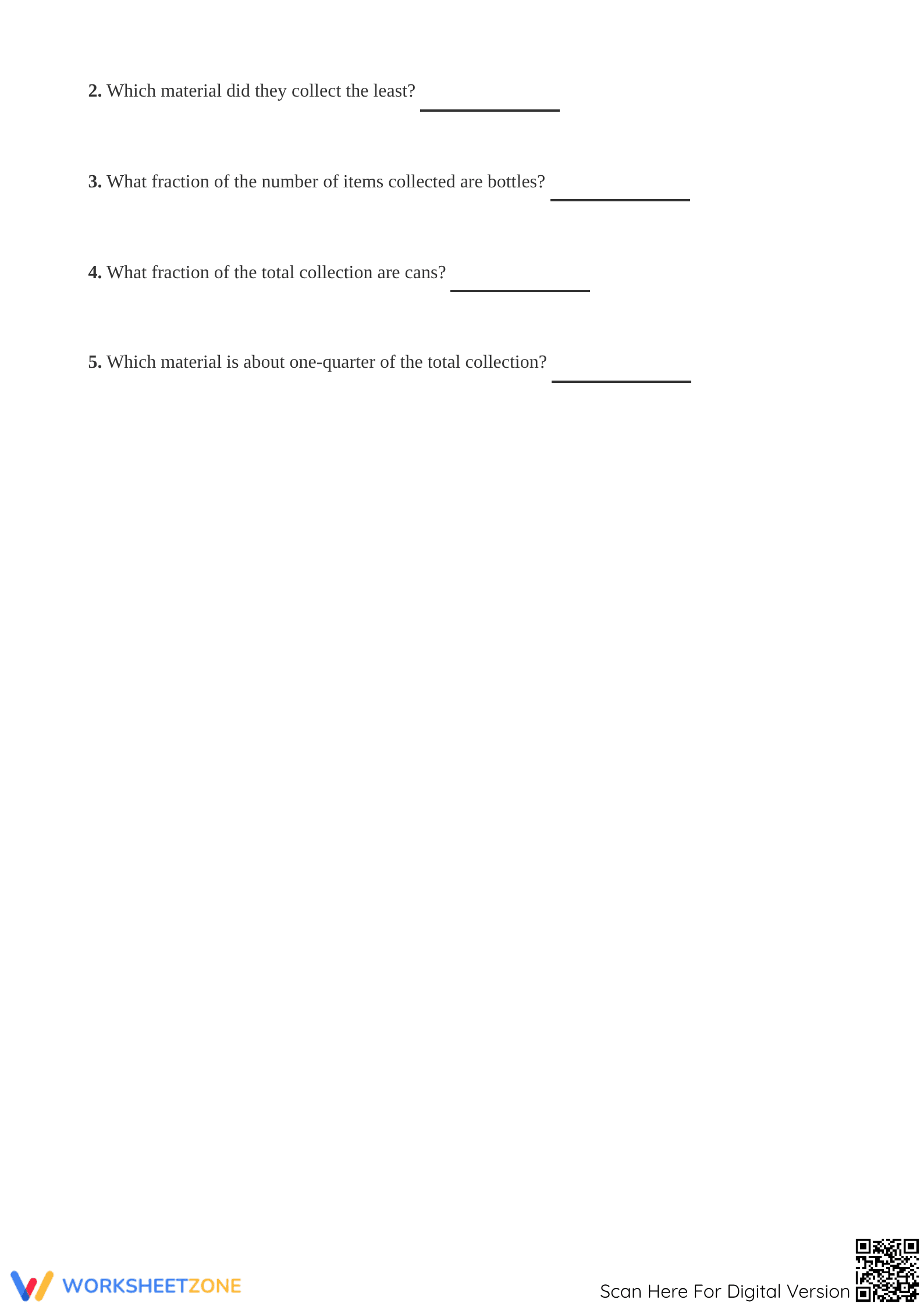

Printable Circle Graph Worksheet: Recycled Materials Data
Paste this activity's link or code into your existing LMS (Google Classroom, Canvas, Teams, Schoology, Moodle, etc.).
Students can open and work on the activity right away, with no student login required.
You'll still be able to track student progress and results from your teacher account.
This essential Math worksheet helps students master data visualization by constructing and interpreting a circle graph based on environmental data. Students transform raw counts of recycled materials into a visual representation, bridging the gap between numerical tables and graphical analysis. This activity builds critical thinking and proportional reasoning skills required for middle school mathematics.
At a Glance
- Grade: 6 · Subject: Math
- Standard:
CCSS.MATH.CONTENT.6.SP.B.4— Display numerical data in plots on a number line, including dot plots and histograms.- Skill Focus: Circle graph construction and data interpretation
- Format: 2 pages · 6 tasks · Answer key included · PDF
- Best For: Data representation units and environmental science integration
- Time: 20–30 minutes
This comprehensive 2-page PDF features a data table detailing five types of recycled materials—paper, plastic, cans, bottles, and glass—with their respective quantities. It includes a marked circle template to guide students in drawing accurate proportions. Following the graphing task, five targeted comprehension questions challenge students to identify extremes and calculate fractions of the total collection, ensuring a deep understanding of the dataset.
Skill Progression
- Guided practice: The initial data table and pre-marked circle graph template provide 1 scaffolded opportunity to translate numbers into spatial areas.
- Supported practice: Three direct interpretation questions (most, least, and specific fractions) require students to reference both the table and their created graph.
- Independent practice: Two complex analysis tasks ask students to relate specific categories to the whole collection using fractional reasoning and benchmark numbers.
This approach mirrors the gradual-release model, moving from basic plotting to higher-order evaluative thinking.
Standards Alignment
The primary focus is `CCSS.MATH.CONTENT.6.SP.B.4`, which requires students to display numerical data using various plots. By constructing a circle graph, students also engage with `CCSS.MATH.CONTENT.5.NF.B.7` as they calculate fractions of a whole set. Both standard codes can be copied directly into lesson plans, IEP goals, or district curriculum mapping tools.
How to Use It
Use this worksheet during the practice phase of a data unit after students have learned the basics of parts-of-a-whole relationships. It works exceptionally well as a formative assessment after direct instruction on graphing. Teachers should observe students as they determine the total number of items (170) to see if they can accurately calculate the "one-quarter" benchmark required in question 5. Expected completion time is 25 minutes.
Who It's For
This resource is designed for Grade 6 students but is suitable for Grade 4 and 5 students needing an extension in data handling. It is a natural pairing for an environmental science passage about waste management or a direct instruction lesson on percentages and fractions. Differentiation is built-in through the visual nature of the circle graph, supporting English Language Learners with clear vocabulary.
Constructing circle graphs is a fundamental component of statistical literacy that allows students to communicate complex data relationships efficiently. According to the RAND AIRS 2024 report on mathematics instructional materials, visual representation tasks significantly improve a student's ability to retain quantitative information compared to purely text-based data analysis. This worksheet aligns with the Fisher & Frey (2014) framework for scaffolded instruction by providing a clear transition from tabular data to graphical evidence. By requiring students to calculate fractions of the total collection, the activity reinforces the connection between data plots and rational number operations. This dual focus ensures that students are not just drawing shapes but are engaging in the mathematical modeling necessary for success in higher-level statistics and real-world data interpretation. The inclusion of environmental themes further supports cross-curricular engagement, making the mathematical concepts more concrete and relevant to student's daily lives.


