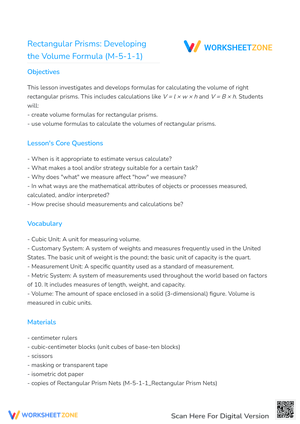
This lesson investigates and develops formulas for calculating the volume of right rectangular prisms. This includes calculations like V = l × w × h and V = B × h. Students will:
- create volume formulas for rectangular prisms.
- use volume formulas to calculate the volumes of rectangular prisms.
- When is it appropriate to estimate versus calculate?
- What makes a tool and/or strategy suitable for a certain task?
- Why does "what" we measure affect "how" we measure?
- In what ways are the mathematical attributes of objects or processes measured, calculated, and/or interpreted?
- How precise should measurements and calculations be?
- Cubic Unit: A unit for measuring volume.
- Customary System: A system of weights and measures frequently used in the United States. The basic unit of weight is the pound; the basic unit of capacity is the quart.
- Measurement Unit: A specific quantity used as a standard of measurement.
- Metric System: A system of measurements used throughout the world based on factors of 10. It includes measures of length, weight, and capacity.
- Volume: The amount of space enclosed in a solid (3-dimensional) figure. Volume is measured in cubic units.
- centimeter rulers
- cubic-centimeter blocks (unit cubes of base-ten blocks)
- scissors
- masking or transparent tape
- isometric dot paper
- copies of Rectangular Prism Nets (M-5-1-1_Rectangular Prism Nets)
- copies of Volume of Rectangular Prisms (M-5-1-1_Volume of Rectangular Prisms and KEY)
- copies of Using Volume Formulas practice worksheet (M-5-1-1_Using Volume Formulas and KEY)
- copies of Volume of Rectangular Prisms practice worksheet (M-5-1-1_Volume of Rectangular Prisms and KEY)
- copies of the Lesson 1 Exit Ticket (M-5-1-1_Lesson 1 Exit Ticket and KEY)
- The Using Volume Formulas practice worksheet (M-5-1-1_Using Volume Formulas and KEY) can be used to assess how well students apply volume formulas.
- Use the Volume of Rectangular Prisms practice worksheet (M-5-1-1_Volume of Rectangular Prisms and KEY) to assess how well students apply volume formulas to real-world problems.
- Use the Lesson 1 Exit Ticket (M-5-1-1_Lesson 1 Exit Ticket with KEY) to quickly assess students' knowledge of both volume formulas for right-rectangular prisms.
Scaffolding, Active Engagement, and Modeling
W: Students will research and construct formulas for the volume of rectangular prisms, V = l × w × h and V = B × h. Students will next apply these formulas to determine the volume of rectangular prisms.
H: Engage students in finding the volume of rectangular prisms with cubic-centimeter blocks. Then, urge students to look for patterns to create volume formulas.
E: Have students work in groups to measure and calculate the volume of rectangular prisms. Engage students in generalizing patterns to create volume formulas. Help students grasp the relationship between the two formulas V = l × w × h and V = B × h. Use the Volume of Rectangular Prisms practice worksheet to help students identify the dimensions and calculate the volume of rectangular prisms using these formulas.
R: The Using Volume Formulas practice worksheet will help students review the formulas for calculating the volumes of rectangular prisms. This will be done in class, and students must apply the appropriate volume formula depending on the information provided. The Volume of Rectangular Prisms practice worksheet will also be used by students to study the formulas for finding the volumes of prisms in real-world scenarios.
E: Students will be graded based on their performance on the practice worksheets for Volume of Rectangular Prisms and Using Volume Formulas. Students will also be evaluated with the Lesson 1 Exit Ticket.
T: Modify the lesson based on student needs, as suggested in the Extension section. The Routine section offers strategies for reviewing course concepts throughout the year. The Small Groups section includes tasks for students who could benefit from further practice. Expansion recommendations are provided for students who are ready to take on a task that goes beyond the standard.
O: This lesson aims to teach students how to calculate the volumes of right-rectangular prisms using certain formulas. To establish the volume formulas, students first use cubic centimeter blocks and rectangular prisms. Students then practice applying the formulas to real-world problems.
Students should form groups of two or three. Divide at least one ruler with centimeter marks among each group. Distribute at least 100 cubic centimeter blocks to each group. (The unit cubes in sets of base ten blocks are typically cubic centimeters.)
First, have students measure the dimensions of a single cubic-centimeter block. "Use your ruler to measure the length, width, and height of one block. Measure to the nearest centimeter." After students have had time to locate the measurements, ask them to report them. Explain to students that these cubes represent cubic centimeters because their length, width, and height are all one centimeter. (Although grade 5 students are taught about exponents, in this lesson, "cubic centimeters" is a better notation than \(cm^3\) . It is vital to refer to these as cubic centimeters or cubic cm to assist students recall that volume can be defined as the number of cubes that fit inside a rectangular prism.)
Now, distribute Rectangular Prism Nets A, B, C, D, and E (M-5-1-1_Rectangular Prism Nets). Copy the nets onto cardstock or sturdy paper. Nets F, G, H, and I will be utilized later in the lesson. Also, provide scissors and tape for students to cut out the nets and fold and tape them to form rectangular prisms.
Ask students to cut the nets. "Please cut the nets. Start by cutting out nets A, B, and C. Cut around the margin, not along each line shown. This is critical since the extra lines are fold lines to be used later."
While students are cutting the nets, hand them the Volume of Rectangular Prisms practice worksheet (M-5-1-1_Volume of Rectangular Prisms and KEY). Write the following directions for the activity on the board:
1. Fold and tape the net to form a rectangular prism.
2. Measure and record the prism's length, width, and height. Measure to the nearest centimeter.
3. Fill the rectangular prism with cubic centimeter blocks. Determine how many cubic centimeters were required to fill the prism (the volume).
4. Look for patterns in the worksheet's table of numbers.
When each group has cut out at least one net, use net A to show how to fold and tape it into a rectangular prism. (Remind students that each side is a rectangle, so this is known as a rectangular prism.) "Please fold and tape Net A. Please measure the length, width, and height of rectangular prism A. Measure to the nearest centimeter."
Ask students about the measurements for prism A. Write the following measurements on the board:
length = 8 cm width = 3 cm height = 1 cm
Students frequently struggle to determine which measurements are the length, width, and height. Explain to students that while the length is commonly regarded the longest side, this is not always the case. There is no proper way to record these measurements. It is only necessary to measure all three dimensions. Because the rectangular prism has no top, most students will agree that the box's height is 1 cm when positioned with the open top upward.
Show students how to place cubic-centimeter blocks into prism A. Explain that the purpose is to discover how many cubic centimeter blocks are required to fill prism A. It is not necessary to complete filling prism A during your demonstration. Instead, invite students to do this assignment independently and write the results on the Volume of Rectangular Prisms sheet. Then, students should continue working in groups to measure the dimensions and fill the prisms B, C, D, and E.
When groups have completed prisms A, B, C, D, and E, ask students to volunteer to provide the dimensions and volume of each prism. "Who can explain a pattern you observed?" ask students. At least one group of students is likely to have recognized that multiplying the measurements of length, width, and height results the volume of the prism. If not, you may need to ask students to evaluate the three dimensions and determine which operation on these three values would result in the prism's volume.
Now, write the pattern on the board and declare it a formula. Remind students that the formula describes the pattern, so they don't have to place blocks in each prism to calculate its volume.
Formula for calculating the volume of a rectangular prism:
V = length × width × height
V = l × w × h
B = B × h*
*Explain to them that this indicates the area of the base. A rectangular prism's base is shaped like a rectangle. The formula for calculating the area of a rectangle is length × width. As a result, V = l × w × h is the same as V = B × h. Explain to students that the volume of any right prism can be calculated by multiplying the area of the base by the height, provided that the correct formula is substituted for the area of the base's shape. (For example, the volume formula for a right triangular prism is  , because the base of a triangular prism is a triangle, and the formula to calculate the area of a triangle is \(1 \over 2\)bh.)
Distribute the nets for the rectangular prisms F, G, H, and I. Again, make sure students have tape and scissors. As the students are cutting out the nets, write these instructions on the board. Make sure all students comprehend the instructions. Remind students that the last column is blank and should be utilized to calculate volume.
1. Measure and record the prism's length, width, and height.
2. Calculate the prism's volume using the formula V = l × w × h.
3. Fill the prism with cubic centimeter blocks to confirm your answer.
Keep an eye on students while they work. Observe whether or not students are filling the prism with cubic-centimeter blocks to confirm their volume calculations. Prism F requires 144 cubic centimeters to fill it.
This was done on purpose so that students may begin to think of more efficient ways to determine how many blocks will be required to fill the prism. Some groups may realize that they simply need to form the bottom layer of blocks and then decide how many layers there will be. This illustrates the formula V = B × h in action. This formula calculates the volume of the prism by multiplying the number of blocks in one layer (or the base area B) by the number of layers of blocks required to fill the prism (or the prism's height h).
When the students are finished, ask them to share the measures and volumes for each prism and record them in the table on the board. Ask students to return to prism F and calculate how many cubic centimeters are required to form one layer at the bottom of the prism.
(6 × 8 = 48) Ask them how many layers of 48 blocks will be required to fill the prism. (3)
Provide them with the following information: "For prisms G, H, and I, please determine how many cubic centimeters are in one layer and how many layers are needed to fill the prism." Write this on the board and ask the students to record it. (The answers are provided in the table, but they should not be written on the board.)
| Prism | Number of Cubic Centimeters in One Layer | Number of Layers Needed to Fill the Prism |
| F | 48 | 3 |
| G | 28 | 3 |
| H | 12 | 4 |
| I | 9 | 3 |
Then ask the question, "How can we use the number of cubic centimeters in each layer and the number of layers in the prism to compute the volume?" Students might suggest addition or multiplication. Students, for example, may suggest adding 48 + 48 + 48 for Prism F, which has three layers. Remind students that multiplying 48 and 3 results in the repeated addition suggested below. Ask students to use the data in this table to calculate the volume of each prism F, G, H, and I. Students may want to revisit the Volume of Rectangular Prisms practice worksheet to see whether these are the same answers they obtained using the initial volume formula.
The purpose is for students to grasp the two volume formulas and recognize that the second formula is a simplified version of the first. To do so, extend the table on the board in the following manner:
| Prism | Length | Width | Height | Number of Cubic Cm in 1 Layer | Number of Layers in Prism | Volume |
| F | 8 | 6 | 3 | 48 | 3 | 144 |
| G | 7 | 4 | 3 | 28 | 3 | 84 |
| H | 6 | 2 | 4 | 12 | 4 | 48 |
| I | 3 | 3 | 3 | 9 | 3 | 27 |
Help students understand that the number of blocks in one layer equals the area of the base, and the number of layers equals the prism's height. To do this, ask the question, "How could you use the measurements of the prism to quickly determine how many cubic centimeter blocks will be needed to form one layer?" (Multiply the length and width.) Then, ask students, "What shape is the base of the prism?" (rectangle) Ask the question: "What do we compute by multiplying the length and width of a rectangle?" Students will most likely remember that this computation produces the rectangle's area.
Write this on the board:
V = length × width × height
V = (length × width) × height (Now insert the parentheses.)
V = (area of the base) × height (Insert area of the base.)
V = B × h (Write with variables.)
Make sure you explain each statement. First, the formula for calculating the volume of a rectangular prism is presented. Second, parenthesis were inserted. Third, the area of the base is calculated by multiplying length and width, so that substitution was made. Fourth, rewrite with variables rather than words.
Ask students to apply the formula V= B × h to calculate the volumes of prisms A, B, C, D, and E. Again, they can write these calculations in the final column. This gives them the opportunity to practice utilizing the formula.
Students will struggle to understand why the second formula is required when the first seems to be sufficient. However, the second formula is particularly essential since it can be used to calculate the volume of all right prisms and cylinders. (It's also included in the Grade 5 criteria.) This second formula will be used in later grades when students calculate the volume of other prisms besides right-rectangular prisms.
Extension:
Routine: As real-world situations happen during the school year, have students practice calculating the volume of various containers. Students will also gain more practice with this concept in lesson 2 of this unit, when they calculate the volume of compound figures made up of several rectangular prisms.
Small Groups: Students that require more practice may be divided into small groups to concentrate on building a better knowledge of the volume formulas. Ask one student to construct a rectangular prism from cubic-centimeter blocks. Use the prism's dimensions to ask all students to calculate its volume. Students should check their calculations by counting the cubic-centimeter blocks. Now, have another student construct a rectangular prism and repeat the procedure. When students get tired of counting individual blocks, ask them to count the number of blocks in a layer and multiply by the number of layers. Help them comprehend that the formulas are efficient ways to count the number of cubic-centimeter blocks.
Expansion: Students who are ready for a challenge beyond the requirement of the standard can draw the rectangular prisms on isometric dot paper to make three-dimensional designs, labeling the dimensions correctly. Additionally, students who are prepared can estimate the volume of various three-dimensional figures. Many different food containers can be transported from home. Students can determine the volume of these containers by filling them with centimeter cubes. Because cubes do not always fit neatly into certain three-dimensional shapes, students might devise methods for estimating volume.


Rectangular Prisms: Developing the Volume Formula (M-5-1-1)

This lesson investigates and develops formulas for calculating the volume of right rectangular prisms. This includes calculations like V = l × w × h and V = B × h. Students will:
- create volume formulas for rectangular prisms.
- use volume formulas to calculate the volumes of rectangular prisms.