


























Views
Downloads


Essential Coordinates Practice | Grade 5 Math Printable
Paste this activity's link or code into your existing LMS (Google Classroom, Canvas, Teams, Schoology, Moodle, etc.).
Students can open and work on the activity right away, with no student login required.
You'll still be able to track student progress and results from your teacher account.
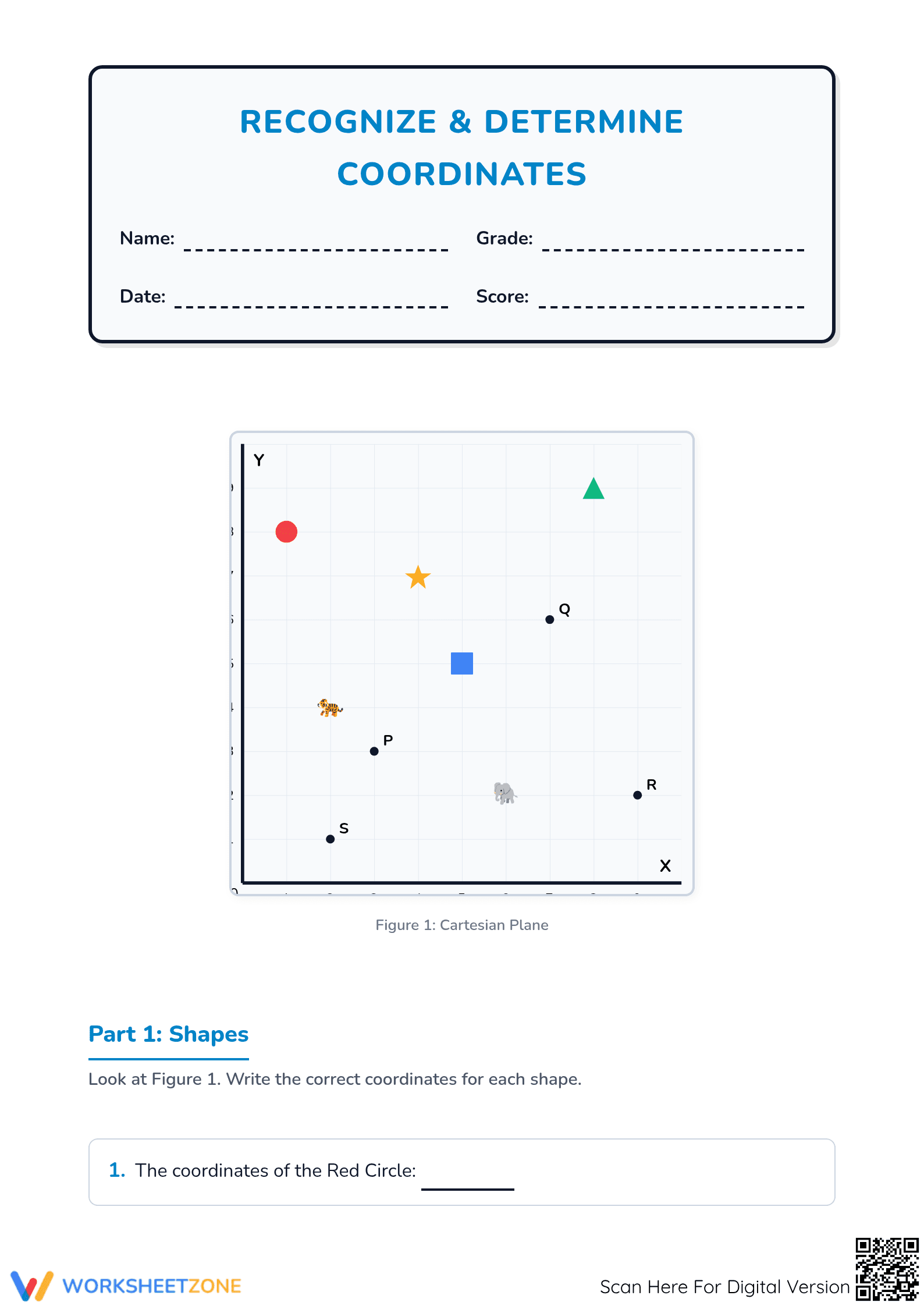
This comprehensive Grade 5 math worksheet provides structured practice for students learning to navigate the coordinate plane. By identifying existing points and plotting new ones on a 10x10 grid, learners develop a concrete understanding of (x, y) values. This resource ensures students master the fundamental 'along then up' movement required for graphing accuracy.
At a Glance
- Grade: 5 · Subject: Math
- Standard:
CCSS.MATH.CONTENT.5.G.A.1— Graph points on the coordinate plane to solve real-world and mathematical problems- Skill Focus: Identifying and plotting (x, y) coordinates
- Format: 4 pages · 30 problems · Answer key included · PDF
- Best For: Independent practice and homework assignments
- Time: 20–30 minutes
What's Inside
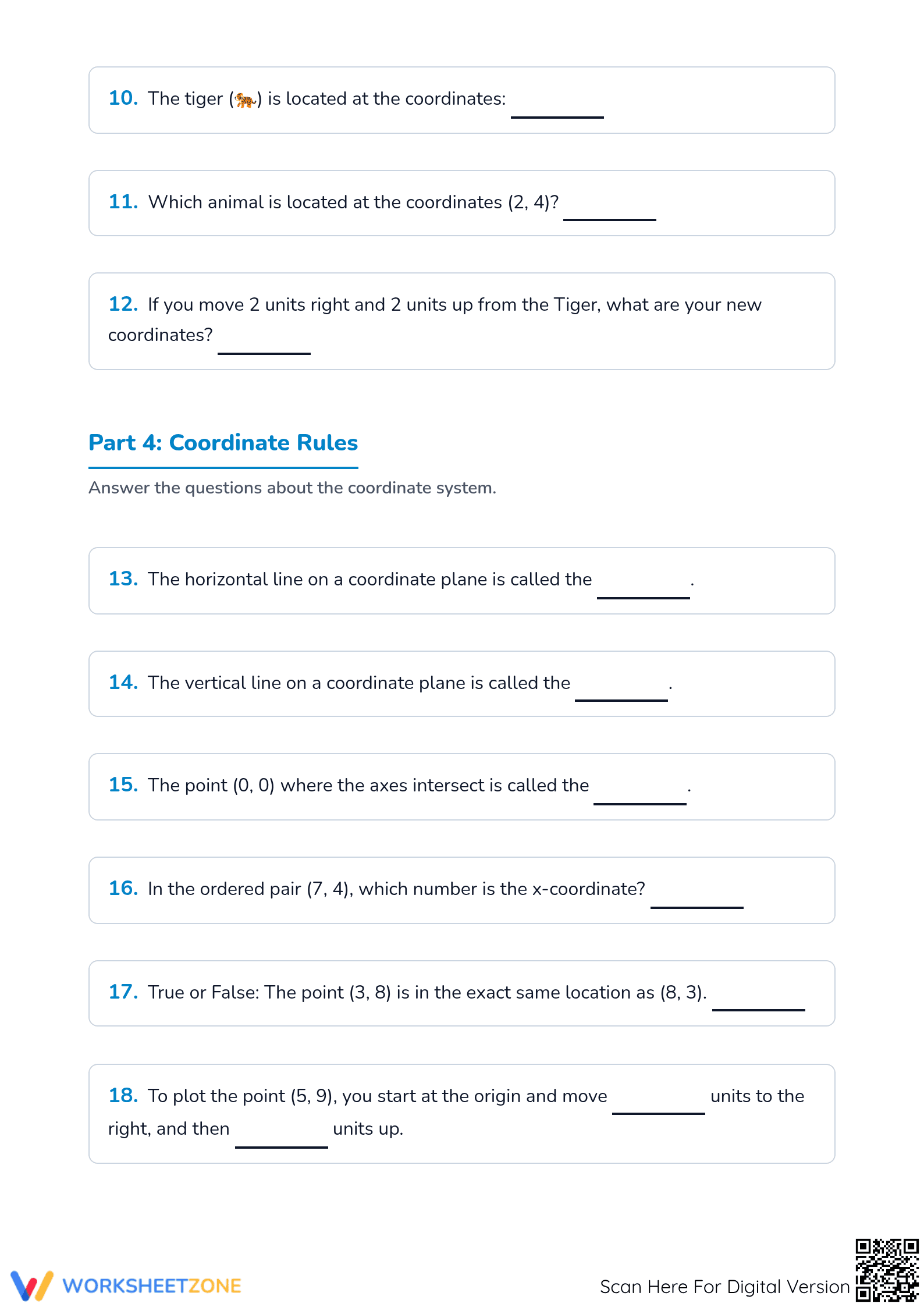
Inside this four-page PDF, you will find three distinct exercises designed to build graphing fluency. The first page provides a clear visual introduction to coordinate pairs, followed by tasks where students identify coordinates for pre-marked points (A-J). Subsequent pages challenge students to mark specific points on a grid and analyze point placement, supported by a full answer key for rapid grading.
Zero-Prep Workflow
This resource follows a zero-prep classroom workflow. 1. Print the packet for your class (30 seconds). 2. Distribute and remind students of axis orientation (1 minute). 3. Review the work using the answer key (2 minutes). Preparation time is under two minutes, making this an ideal emergency sub plan or quick-start lesson component.
Standards Alignment
Aligned with `CCSS.MATH.CONTENT.5.G.A.1`, this worksheet requires students to understand that the first number in a coordinate pair indicates how far to travel from the origin in the direction of one axis, and the second number indicates how far to travel in the direction of the second axis. Both standard codes can be copied directly into lesson plans, IEP goals, or district curriculum mapping tools.
How to Use It
Use this worksheet during the independent practice phase of a lesson on the coordinate system. It serves as an excellent bridge between teacher-led modeling and more complex geometric transformations. For a formative assessment, observe students during Exercise 2 to ensure they are not reversing the x and y coordinates, which is the most common error in early graphing development.
Who It's For
This resource is designed for Grade 5 students but remains highly relevant for Grade 6-8 learners who require remedial support in spatial organization. It pairs naturally with an interactive coordinate plane anchor chart or a digital graphing tool. Differentiation is supported through the gradual increase in task complexity across the four pages, providing scaffolding for emerging learners.
According to the RAND AIRS 2024 report, high-quality mathematics instructional materials must provide students with multiple opportunities to represent abstract numerical data visually. This worksheet addresses that need by focusing on the `CCSS.MATH.CONTENT.5.G.A.1` standard, which is a foundational requirement for later algebraic reasoning and geometric proofs. Fisher & Frey (2014) emphasize that the gradual release of responsibility—moving from recognizing coordinates to plotting them independently—is critical for long-term retention of spatial concepts. By using a standard 10x10 grid, this resource aligns with NAEP recommendations for elementary-level geometric representation, ensuring that students build the necessary cognitive frameworks for middle-school mathematics. The inclusion of a clear "along then up" instructional cue further supports English Language Learners and students with executive functioning challenges by providing a consistent linguistic anchor for a multi-step procedural task.


