


























Views
Downloads


Kindergarten Math Recap — Printable No-Prep Worksheet
Paste this activity's link or code into your existing LMS (Google Classroom, Canvas, Teams, Schoology, Moodle, etc.).
Students can open and work on the activity right away, with no student login required.
You'll still be able to track student progress and results from your teacher account.
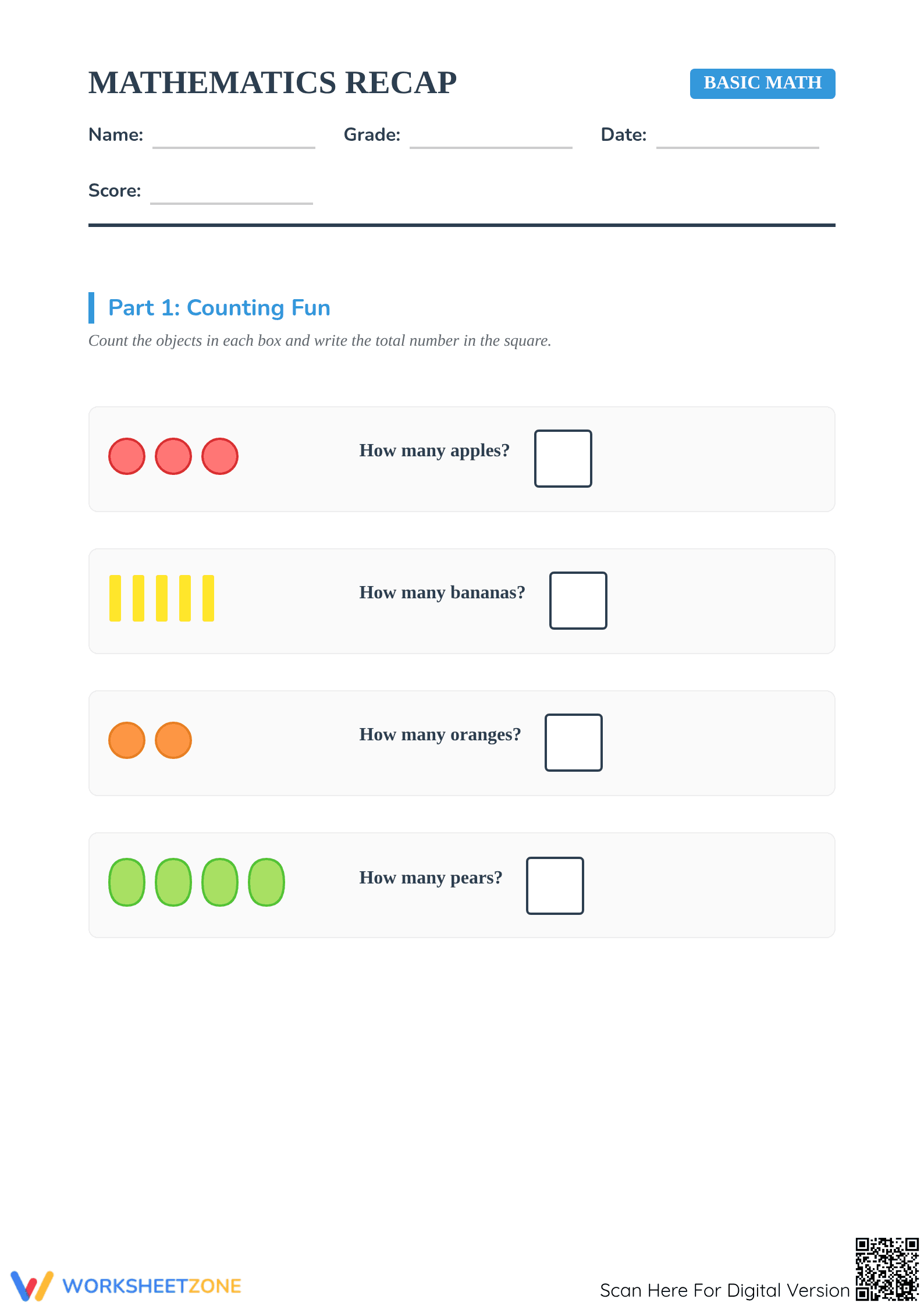
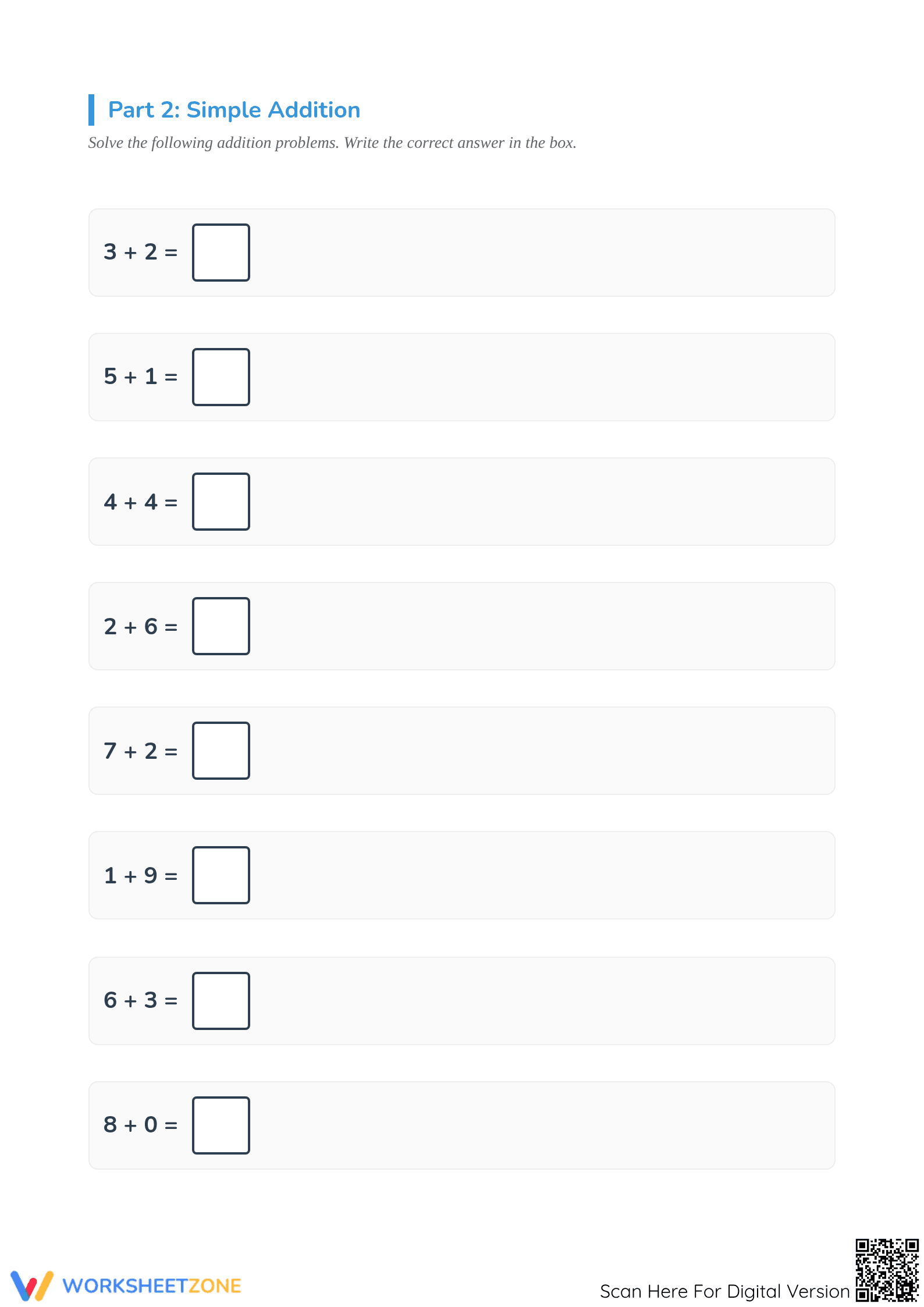
This math recap worksheet gives Kindergarten students practice across foundational skills. The five-page packet challenges learners with counting, single-digit addition and subtraction, shape identification, and word problems. It is designed as a print-ready tool for assessment, review, or independent practice, reinforcing key early numeracy concepts.
At a Glance
- Grade: K · Subject: Math
- Standard:
CCSS.MATH.CONTENT.K.OA.A.1— Represent addition and subtraction in multiple ways.- Skill Focus: Counting, Addition, Subtraction, Geometry
- Format: 5 pages · 28 problems · Answer key included · PDF
- Best For: End-of-unit review or baseline assessment
- Time: 20–30 minutes
What's Inside
This five-page PDF download includes a complete math review packet and a full answer key. The worksheet contains five parts: "Counting Fun," "Simple Addition," "Simple Subtraction," "Identifying Shapes," and "Challenge Questions." The clean layout and clear instructions allow students to work independently with minimal support.
A Zero-Prep Workflow
This resource is designed for immediate use with minimal teacher setup, making it ideal for substitute plans or homework.
- Print (1 minute): The 5-page PDF is ready to print for each student.
- Distribute (1 minute): Hand out the packet. The clear structure allows students to begin work immediately.
- Review (5-10 minutes): Use the included answer key for quick and efficient grading. The design helps pinpoint areas where students need more support.
Total teacher prep time is under two minutes.
Standards-Aligned Instruction
This worksheet is primarily aligned with Common Core standard CCSS.MATH.CONTENT.K.OA.A.1, requiring students to represent addition and subtraction. It also supports foundational counting (K.CC.B.4) and geometry (K.G.A.2) skills. These standard codes can be copied directly into lesson plans, IEP goals, or curriculum mapping tools.
How to Use This Worksheet
Use this recap as a pre-assessment to identify student needs or as a summative assessment to gauge mastery. It also works well for independent practice stations or homework. For formative assessment, observe which of the five sections students find most challenging to identify topics for re-teaching. Most Kindergarteners will complete the packet in 20 to 30 minutes.
Who It's For
This worksheet is for Kindergarten students consolidating basic math concepts. The clear format is accessible for all learners. It also serves as an intervention tool for first-grade students needing reinforcement. Pair this worksheet with a classroom number line to provide students with a visual tool for completing the addition and subtraction problems.
This Kindergarten math resource directly addresses the core principles of early numeracy outlined by the NAEP Mathematics Framework. By integrating multiple skill domains—counting, operations, and geometry—into one cohesive packet, it provides the mixed practice necessary for skill consolidation. The worksheet's structure supports standard CCSS.MATH.CONTENT.K.OA.A.1, which focuses on representing addition and subtraction through various modalities. Research from Fisher & Frey (2014) emphasizes the importance of moving students from guided to independent practice, a progression this worksheet facilitates through its five distinct sections. The inclusion of 28 discrete problems and a final set of challenge questions allows for reliable data collection on student mastery. This type of multi-faceted, standards-based tool is critical for building the foundational automaticity that predicts long-term success in mathematics.


