


























Views
Downloads



Ready Weather Observations Word Search | Grades 6–7 Science
Paste this activity's link or code into your existing LMS (Google Classroom, Canvas, Teams, Schoology, Moodle, etc.).
Students can open and work on the activity right away, with no student login required.
You'll still be able to track student progress and results from your teacher account.
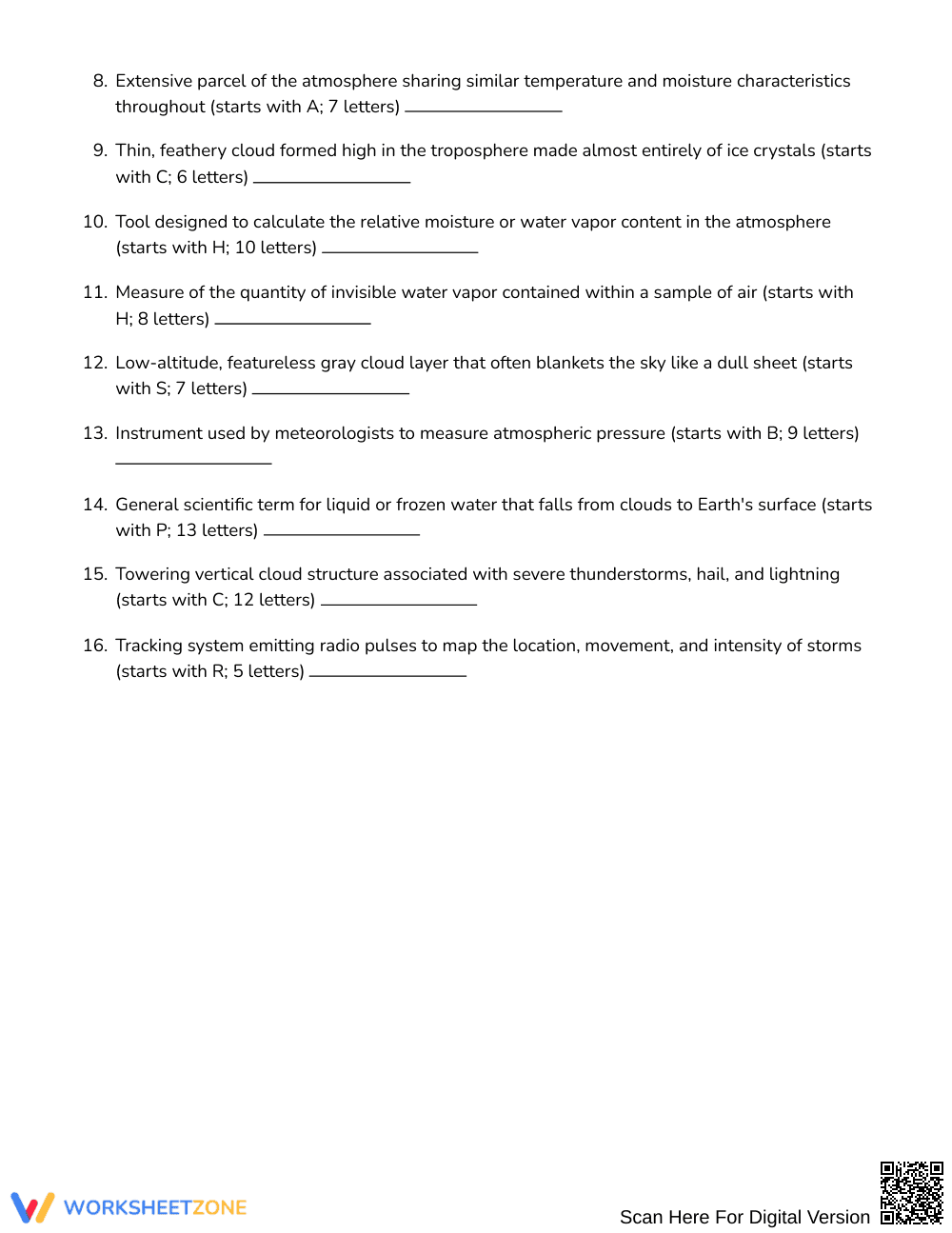
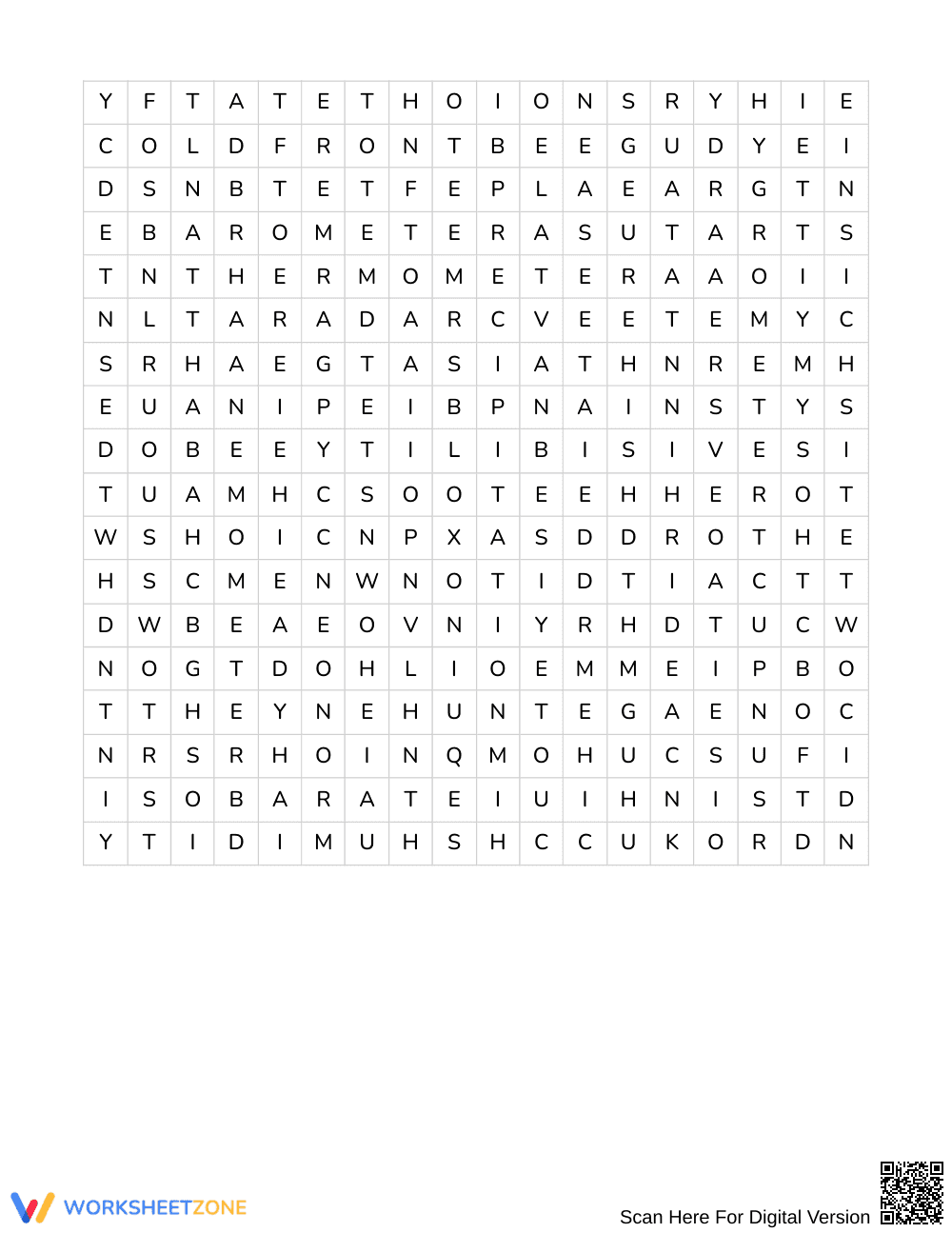
This weather observations word search reinforces foundational meteorology terminology for Grades 6–7 science students. Learners decode definitions to identify 16 atmospheric instruments, phenomena, and metrics, finding each term hidden in an intricate grid. The challenge promotes deductive reasoning while cementing essential Earth science vocabulary during introductory or review lessons.
At a Glance
- Grade: Grades 6–7 · Subject: Science
- Standard: Not standards-assessed — vocabulary enrichment
- Skill Focus: Weather observations
- Format: 3 pages · 16 words · Answer key included · PDF
- Best For: Weather unit vocabulary review
- Time: 20–30 minutes
What's Inside
The 3-page printable activity features a clean, student-facing layout designed without an explicit word bank to stimulate active recall. Instead, students read 16 rigorous meteorological clues defining concepts like humidity, air masses, isobars, and cloud types. Once students deduce each target term, they locate the word hidden in the puzzle. The resource includes a complete 4-page answer key showing full grid letter solutions and term identifications.
Puzzle Mechanics
This word search uses an 18 x 18 letter grid containing 16 hidden weather observation terms. Because there is no traditional word bank, students must first solve descriptive definitions to determine the target vocabulary. Words run in all 8 compass directions across the grid: north, northeast, east, southeast, south, southwest, west, and northwest. This multidirectional layout encourages close visual scanning and thorough spatial tracking.
Standards Alignment
This activity serves strictly as vocabulary enrichment and is not aligned to a specific state or national content standard. It supports general Earth and space science curricula by reinforcing specialized terminology related to atmospheric monitoring, pressure systems, and cloud identification.
How to Use It
Introduce this word search after direct instruction on meteorological tools and atmospheric measurements as an engaging mid-unit review. Alternatively, assign it as independent station work or early-finisher practice during September weather tracking units. While students work, monitor whether they can deduce instruments like hygrometers and barometers from definitions alone or if they require reference charts. Students typically complete the puzzle in 20 to 30 minutes.
Who It's For
This activity is designed for Grades 6–7 general science and Earth science students studying weather patterns. For students needing support, provide an optional reference glossary of weather instruments; for advanced learners, challenge them to write an additional sentence explaining how each detected tool gathers data. Pair this resource with daily weather tracking charts or an atmospheric pressure lab.
Content-specific vocabulary acquisition plays a decisive role in middle school science comprehension, establishing the linguistic framework necessary for interpreting data and atmospheric models. According to Fisher & Frey (2014), intentional word exposure coupled with definition retrieval reinforces conceptual storage far more effectively than passive memorization. By stripping away traditional word banks and requiring Grades 6–7 students to deduce 16 meteorological terms from technical clues before locating them in an 18 x 18 grid, this activity bridges vocabulary recall and analytical reasoning. Students actively analyze operational definitions for instruments such as anemometers and barometers alongside core phenomena like dew point and cold fronts. The dual demand of definition decoding and spatial pattern recognition strengthens retrieval pathways, ensuring that early adolescent learners develop the precise scientific lexicon required for complex inquiry into meteorology, climate patterns, and Earth systems.


