




























Views
Downloads



Ready Similarity & Dilations Worksheet | Grade 10 Geometry

Paste this activity's link or code into your existing LMS (Google Classroom, Canvas, Teams, Schoology, Moodle, etc.).
Students can open and work on the activity right away, with no student login required.
You'll still be able to track student progress and results from your teacher account.
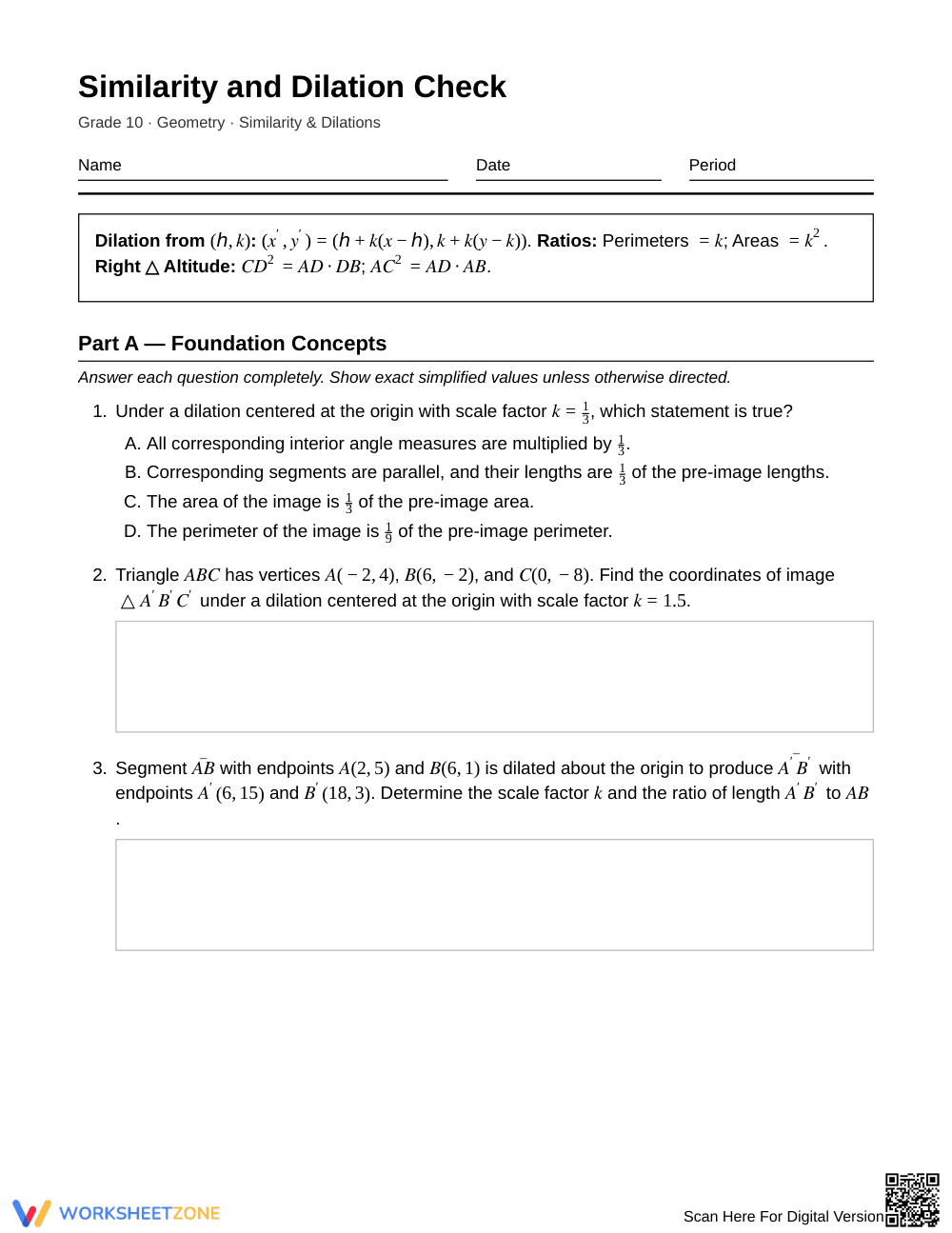
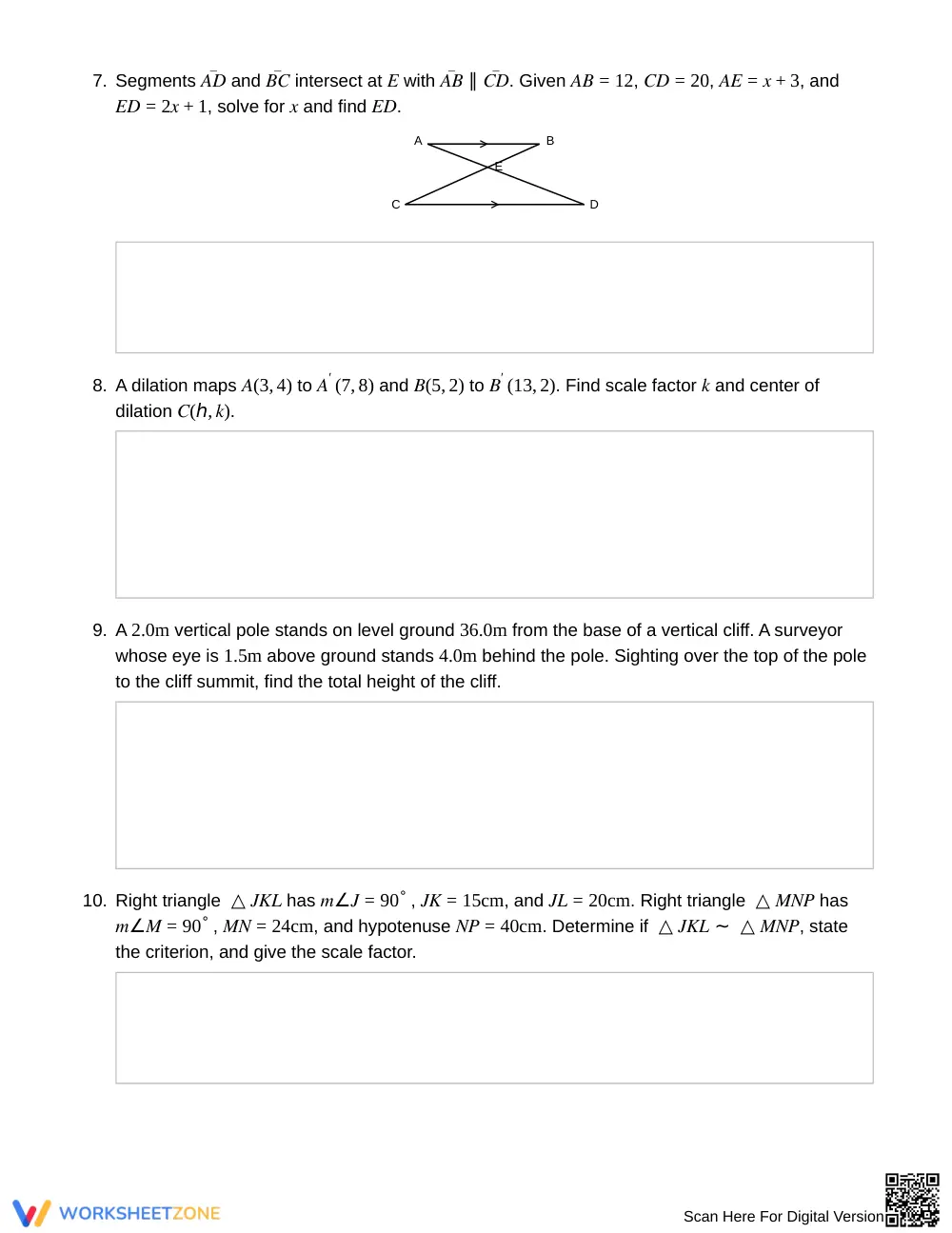
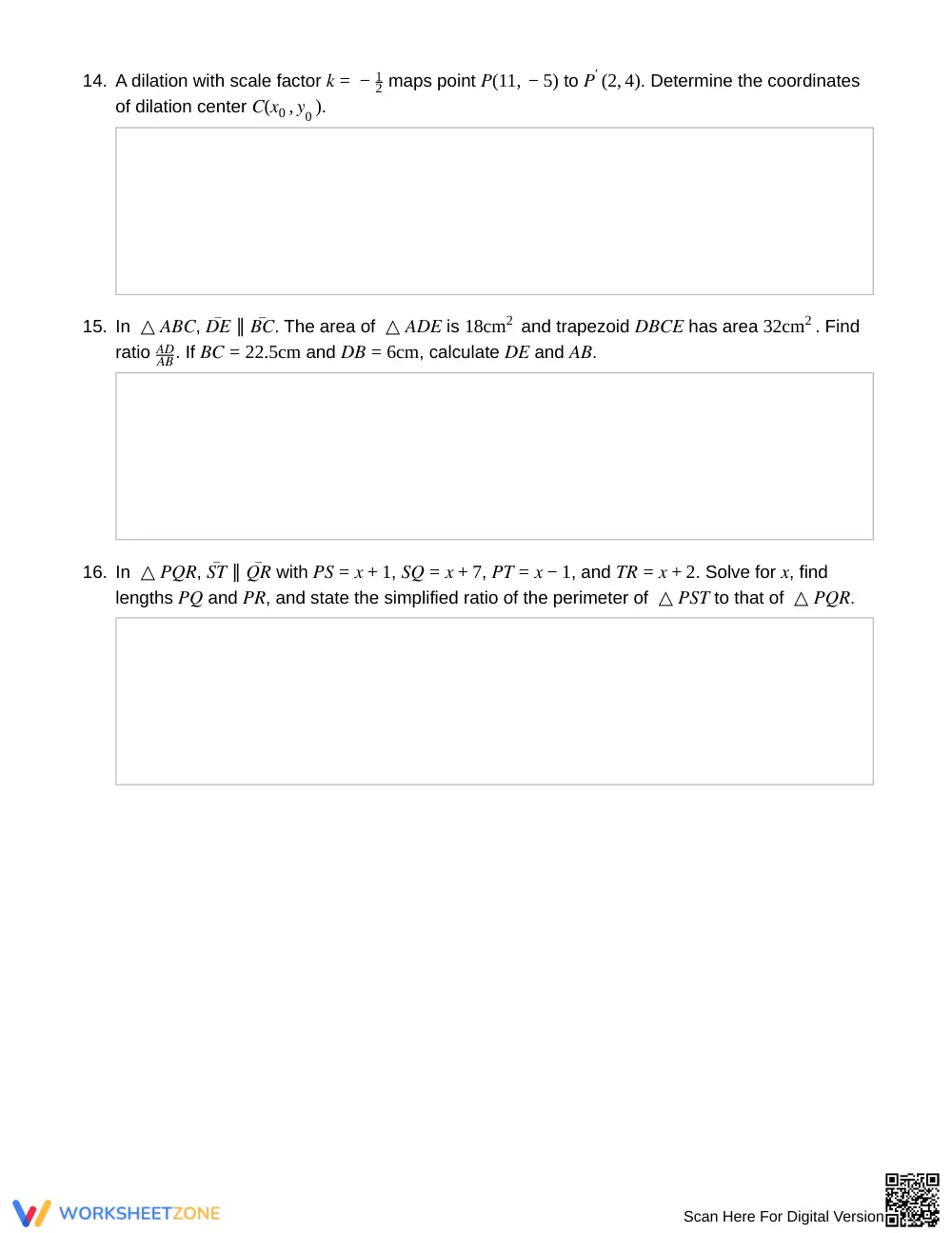
This Grade 10 geometry worksheet provides rigorous practice calculating scale factors, performing dilations on the coordinate plane, and proving triangle similarity. Students apply proportionality theorems, geometric mean altitude relationships, and area scaling ratios to solve complex geometric problems and develop deep geometric reasoning.
At a Glance
- Grade: 10 · Subject: Geometry
- Standard:
HSG-SRT.B.5— Use congruence and similarity criteria to solve problems and prove geometric relationships- Skill Focus: Similarity and Dilations
- Format: 5 pages · 16 problems · Answer key included · PDF
- Best For: High school geometry practice and review
- Time: 45–60 minutes
This 5-page resource delivers 16 carefully structured problems across coordinate dilations, parallel line segment proportions, real-world indirect measurement, and right triangle altitude relations. An essential reference box at the top provides dilation formulas and geometric mean equations, while geometric diagrams and a comprehensive 2-page step-by-step answer key support thorough error analysis.
Skill Progression
- Guided practice (Part A, Problems 1–4): Focuses on foundational concepts with low-complexity tasks, evaluating scale factors, origin dilations, and linear-versus-area scaling ratios.
- Supported practice (Part B, Problems 5–12): Challenges students with moderate-complexity applications, including non-origin center dilations, Triangle Proportionality Theorem proofs, surveyor indirect measurement, and negative scale factors.
- Independent practice (Part C, Problems 13–16): Extends reasoning through high-complexity multi-step tasks involving geometric mean theorems with radicals, composite trapezoid area ratios, and algebraic quadratics.
This scaffolded progression adheres to the gradual release of responsibility model, transitioning students from structured foundational knowledge to autonomous geometric problem-solving.
Standards Alignment
The primary focus aligns with `HSG-SRT.B.5`: Use congruence and similarity criteria for triangles to solve problems and to prove relationships in geometric figures. It also reinforces supporting standard `HSG-SRT.A.2` by verifying dilation properties and similarity transformations across coordinate planes. Both standard codes can be copied directly into lesson plans, IEP goals, or district curriculum mapping tools.
How to Use It
Administer this worksheet immediately after direct instruction on triangle similarity criteria and coordinate dilations, or use it as a comprehensive unit review before a summative assessment. For formative assessment, observe how students set up proportional equations in Part B to detect whether they confuse side lengths with perimeter ratios. The complete set requires approximately 45 to 60 minutes of focused instructional time.
Who It's For
This practice set is designed for Grade 10 Geometry students, including those in honors or standard tracks needing targeted similarity practice. Pair this printable worksheet directly with an interactive coordinate geometry demonstration or an anchor chart highlighting the geometric mean altitude theorem.
According to research by Fisher & Frey (2014) on the gradual release of responsibility, structured problem progressions that move from foundational identification to complex algebraic application significantly enhance conceptual retention in secondary mathematics. This 16-task worksheet operationalizes standard HSG-SRT.B.5, requiring Grade 10 students to utilize similarity criteria and dilation theorems to solve geometric proportions and prove spatial relationships. By combining coordinate plane dilations, geometric mean altitude calculations, and real-world indirect measurement scenarios, the resource bridges procedural computation with deductive reasoning. Studies in secondary math curriculum emphasize that explicit reference scaffolds—such as provided coordinate dilation rules and area-to-perimeter scale factor ratios—allow high school learners to reduce cognitive load during initial problem setup. Consequently, students develop fluency in establishing proportional equations, solving radical expressions, and verifying similarity transformations independently across multi-step mathematical tasks.


