


























Views
Downloads


Ready Sequence Convergence Worksheet | Grade 12 Precalculus
Paste this activity's link or code into your existing LMS (Google Classroom, Canvas, Teams, Schoology, Moodle, etc.).
Students can open and work on the activity right away, with no student login required.
You'll still be able to track student progress and results from your teacher account.
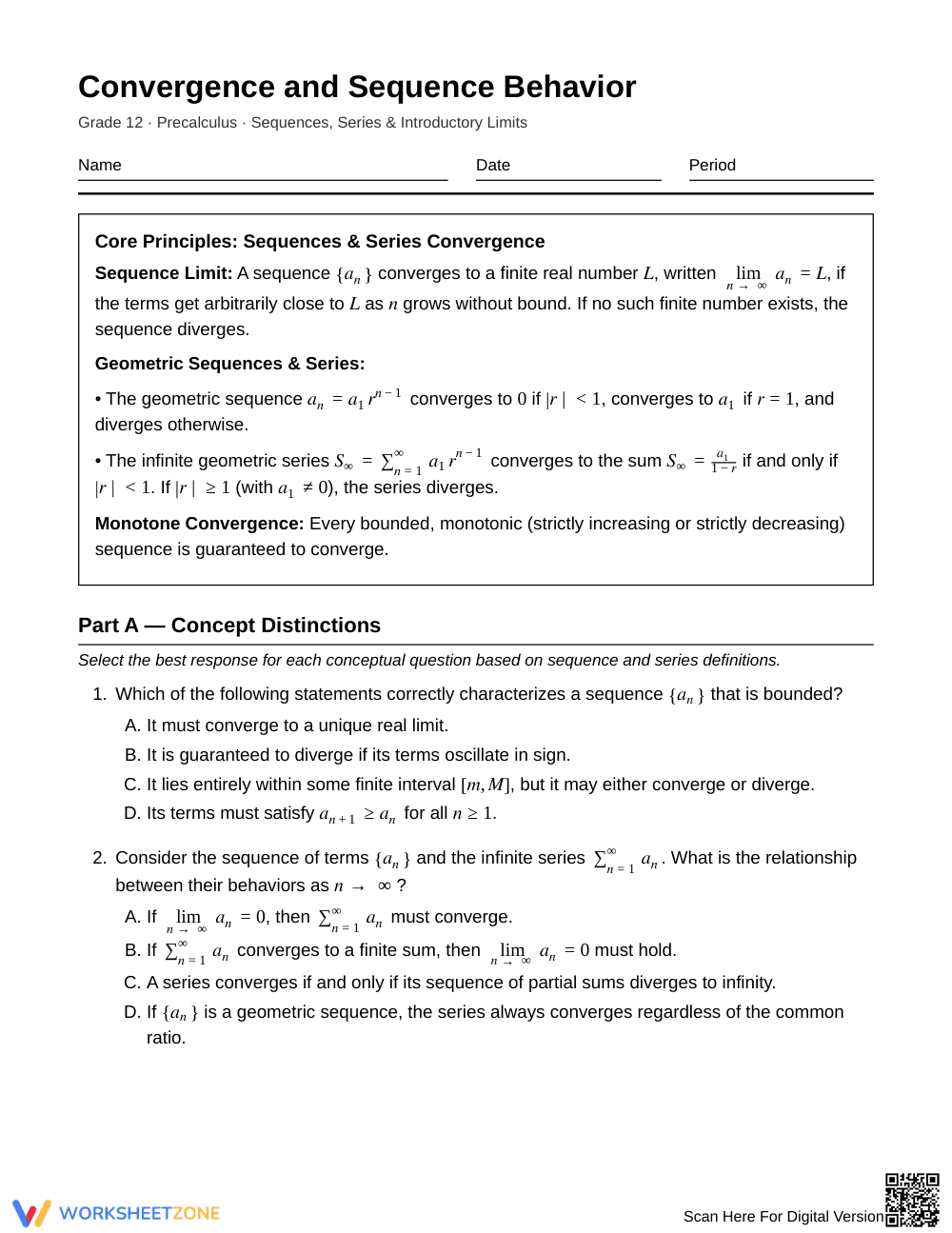
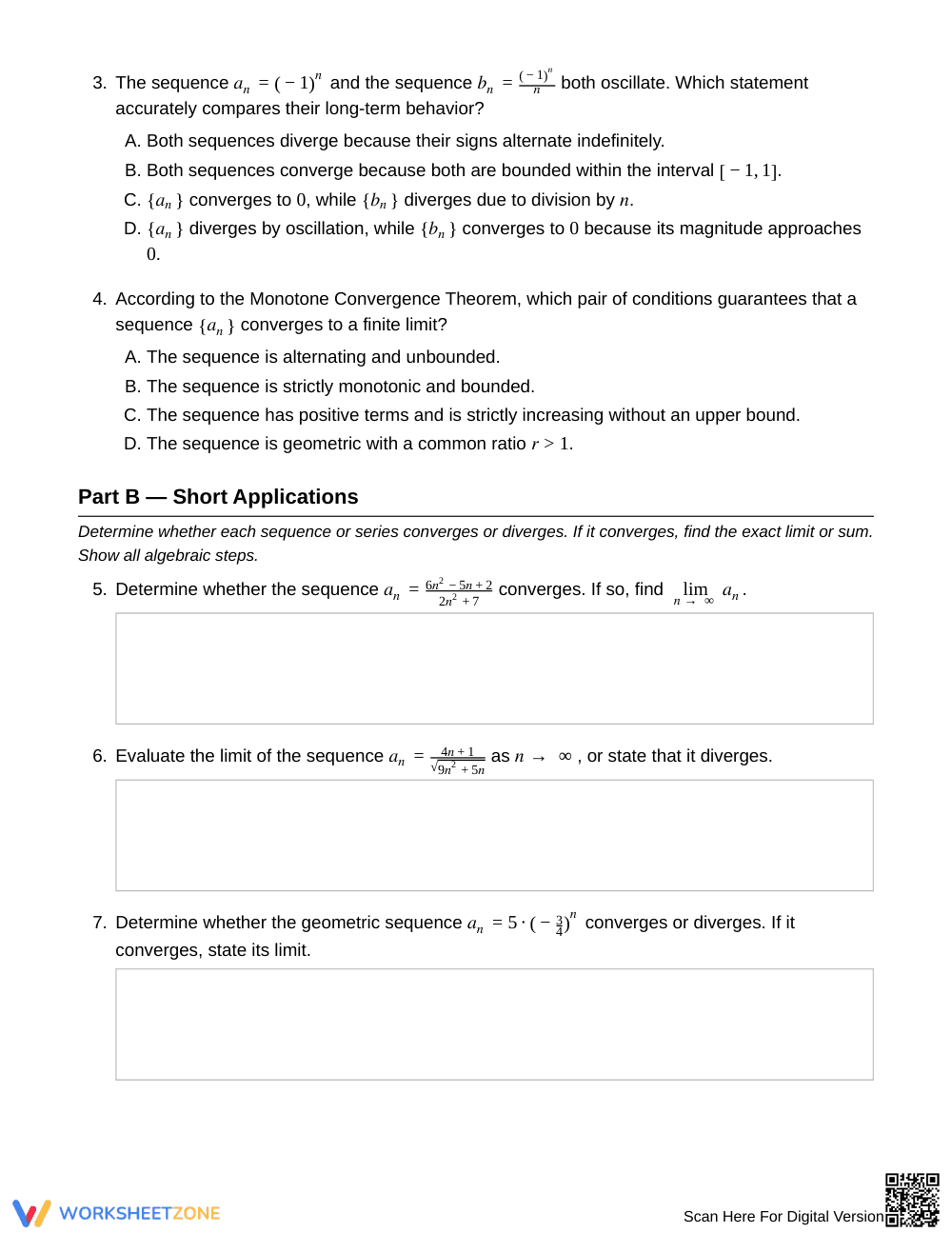
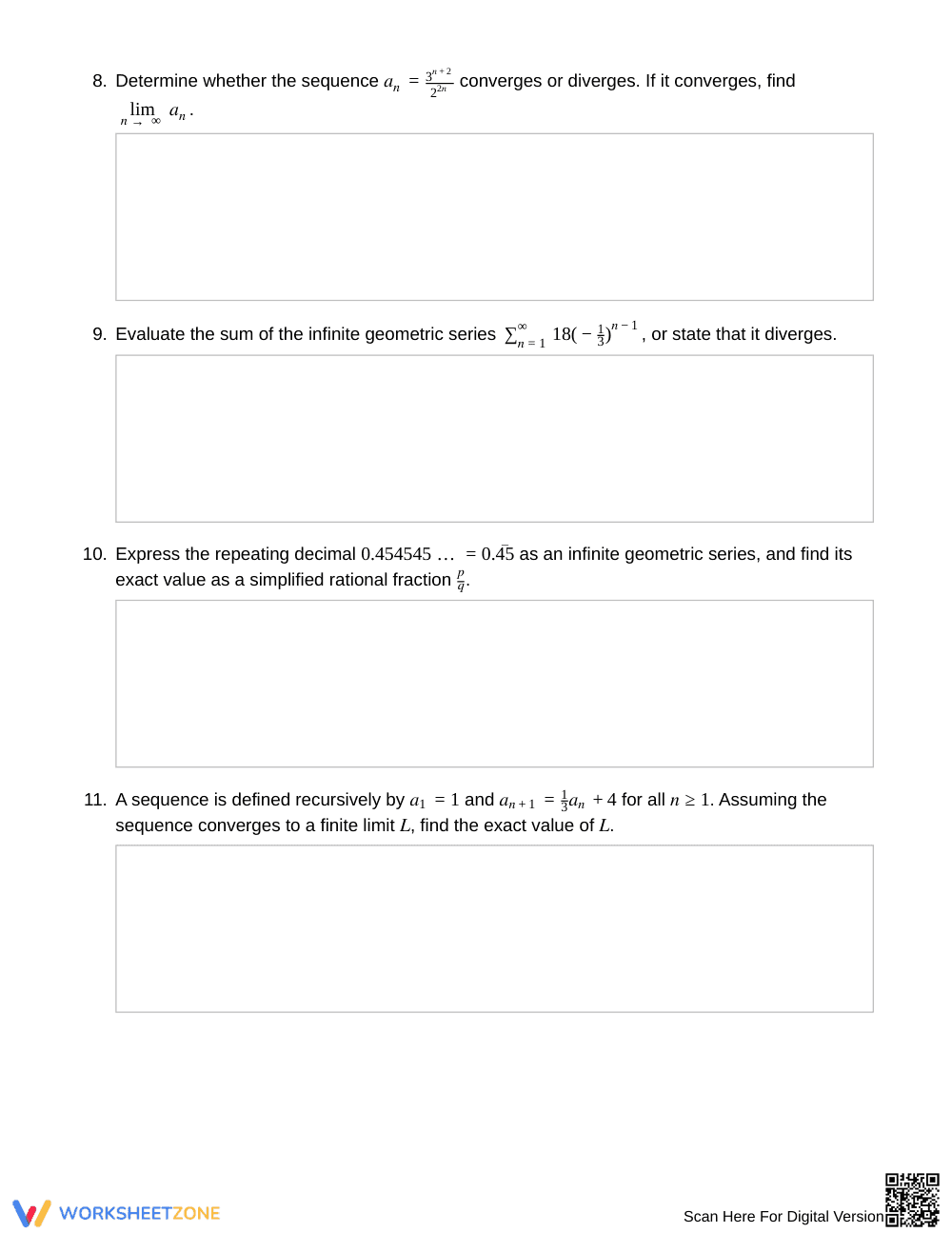
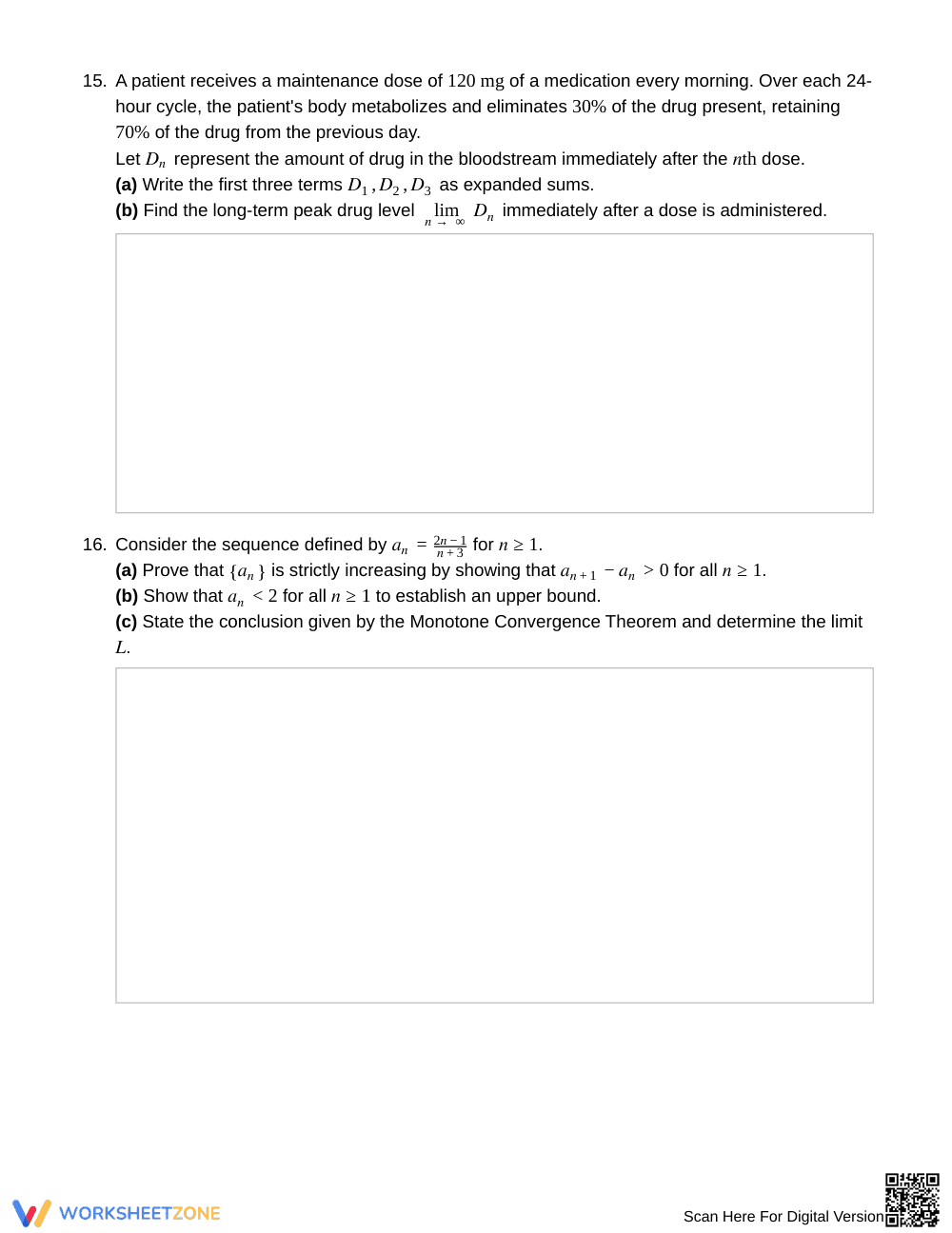
This comprehensive Precalculus worksheet strengthens student mastery of sequence convergence, divergence, and infinite series behavior. Learners analyze long-term patterns, evaluate algebraic limits, and verify monotonic boundedness. Designed for high school seniors, it ensures students construct clear mathematical justifications and connect discrete sequence behaviors to introductory calculus limit concepts.
At a Glance
- Grade: 12 · Subject: Mathematics
- Standard: Advanced Mathematics — Determine the convergence or divergence of sequences and infinite series
- Skill Focus: Convergence and Sequence Behavior
- Format: 5 pages · 16 structured problems · Answer key included · PDF
- Best For: Advanced precalculus sequence and limit unit review
- Time: 45–60 minutes of instructional class time
The 5-page student activity contains 16 focused problems supported by an opening Core Principles reference box summarizing sequence limits, geometric series tests, and monotonic criteria. Students work through conceptual multiple-choice items, algebraic limit evaluations, and multi-step applied modeling scenarios. A thorough 4-page answer key provides step-by-step algebraic derivations and analytical solutions.
Skill Progression
- Guided practice (Part A, Problems 1–4): Four targeted conceptual questions evaluate student understanding of sequence boundedness, oscillation, and the Monotone Convergence Theorem with low cognitive strain.
- Supported practice (Part B, Problems 5–12): Eight algebraic application items challenge students to evaluate limits at infinity, calculate geometric series sums, convert repeating decimals, and establish convergence intervals.
- Independent practice (Part C, Problems 13–16): Four extensive modeling and proof-based tasks require students to model bouncing ball distance, verify pharmacokinetic drug levels, and construct monotonicity proofs.
This deliberate structure reinforces the gradual-release model, moving students from guided conceptual recognition to self-directed mathematical proof.
Standards Alignment
This resource directly targets advanced high school precalculus standards addressing sequences, series, and introductory limits. Students analyze whether infinite sequences approach finite limits, distinguish term convergence from series convergence, and apply geometric formulas. Both standard objectives can be copied directly into lesson plans, IEP goals, or district curriculum mapping tools.
How to Use It
Deploy this worksheet after direct instruction on sequence limits and geometric series. Alternatively, utilize Parts A and B as mid-unit collaborative practice, reserving Part C for summative assessment or paired problem-solving. During instruction, observe whether students confuse the limit of individual terms with the sum of a series in Part C. Expected completion time is 45 to 60 minutes.
Who It's For
This resource serves Grade 12 Precalculus students and advanced Algebra II or AP Calculus preparatory classes. To differentiate, provide struggling learners with the Core Principles summary during Part B, while prompting advanced students to complete the formal algebraic proofs in Part C independently. It pairs naturally with direct instruction lectures on infinite geometric series.
Mastering sequence convergence and infinite series provides the essential conceptual bridge between discrete algebra and continuous calculus. According to Fisher & Frey (2014), structured instructional progressions that guide students from foundational conceptual distinctions to complex application problems significantly increase retention, conceptual understanding, and procedural fluency in advanced mathematics. This 16-problem precalculus worksheet operationalizes this gradual-release approach by systematically targeting sequence limits, boundedness, and geometric series behavior across 5 comprehensive pages. By requiring high school students to articulate why an oscillating sequence converges and model real-world phenomena such as pharmacokinetic drug retention and vertical rebound decay, this resource ensures learners move past rote procedural computation into genuine analytical understanding. The included multi-step tasks and 4-page complete answer key equip secondary educators to evaluate student mastery of introductory limits and prepare seniors for college-level mathematics effectively and systematically.


