


























Views
Downloads



Ready Restricted Inverses Worksheet | Grade 12 Precalculus
Paste this activity's link or code into your existing LMS (Google Classroom, Canvas, Teams, Schoology, Moodle, etc.).
Students can open and work on the activity right away, with no student login required.
You'll still be able to track student progress and results from your teacher account.
This Grade 12 Precalculus worksheet equips students to find inverse functions by establishing and tracking domain restrictions. Learners analyze invertibility conditions, construct one-to-one intervals, and calculate inverse formulas across polynomial, rational, radical, and trigonometric functions to build readiness for calculus.
At a Glance
- Grade: 12 · Subject: Precalculus
- Standard:
HSF-BF.B.4— Find inverse functions and restrict domains to produce invertible relations- Skill Focus: Find an Inverse with Domain Restrictions
- Format: 5 pages · 18 problems · Answer key included · PDF
- Best For: Advanced precalculus practice and calculus readiness
- Time: 45–60 minutes
What's Inside
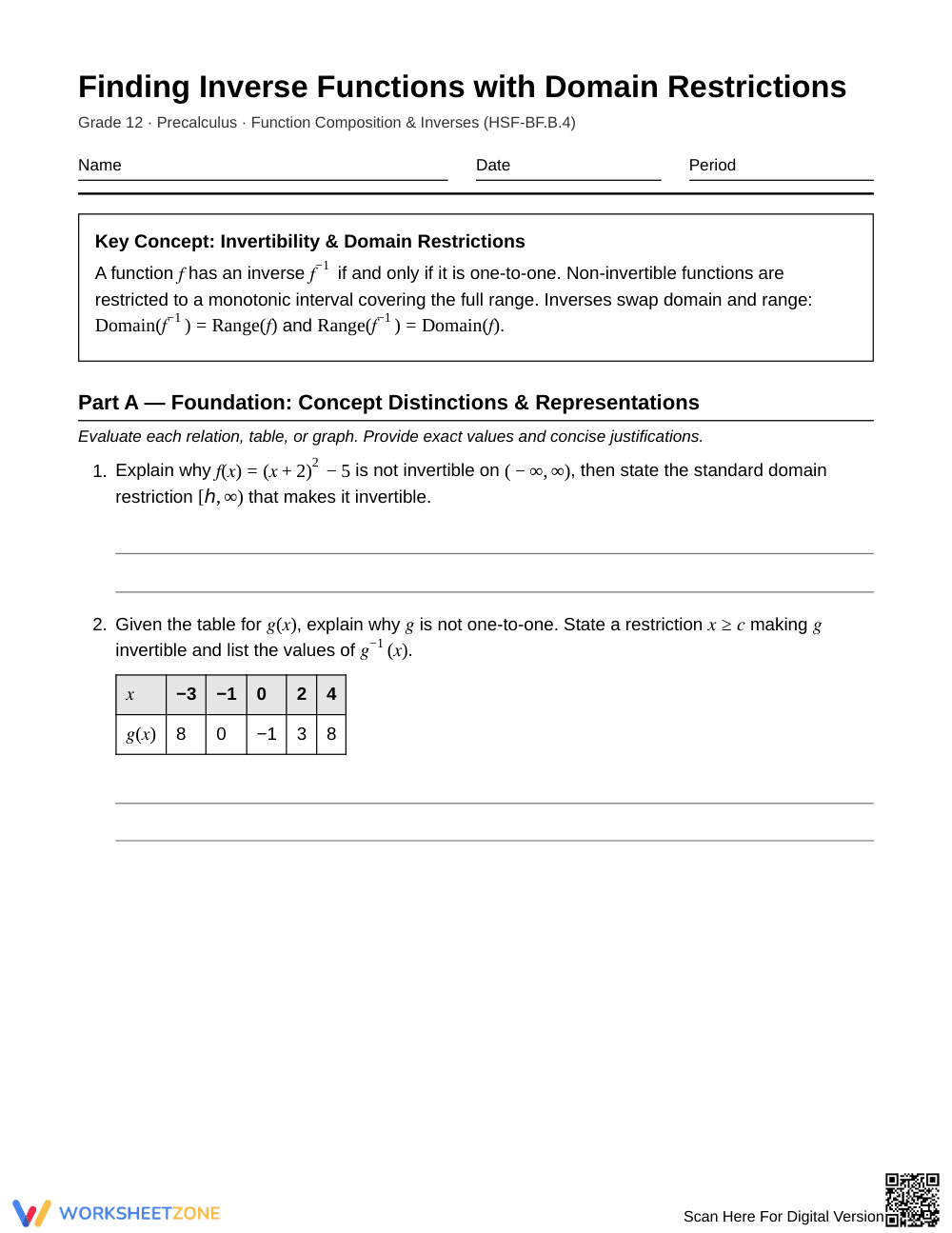
This 5-page student practice set includes 18 rigorous mathematical tasks organized into three distinct pedagogical phases, accompanied by a comprehensive 2-page step-by-step answer key. Students begin with a foundational concept box highlighting monotonic intervals and invertibility rules, interact with numerical data tables and piecewise function plots, and progress through algebraic derivations involving quadratics, radical functions, rational expressions, and periodic trigonometric functions.
Skill Progression
- Guided Practice: Part A (Problems 1–4) targets core invertibility concepts, table evaluation, and graphical readouts with an explicit reference concept box.
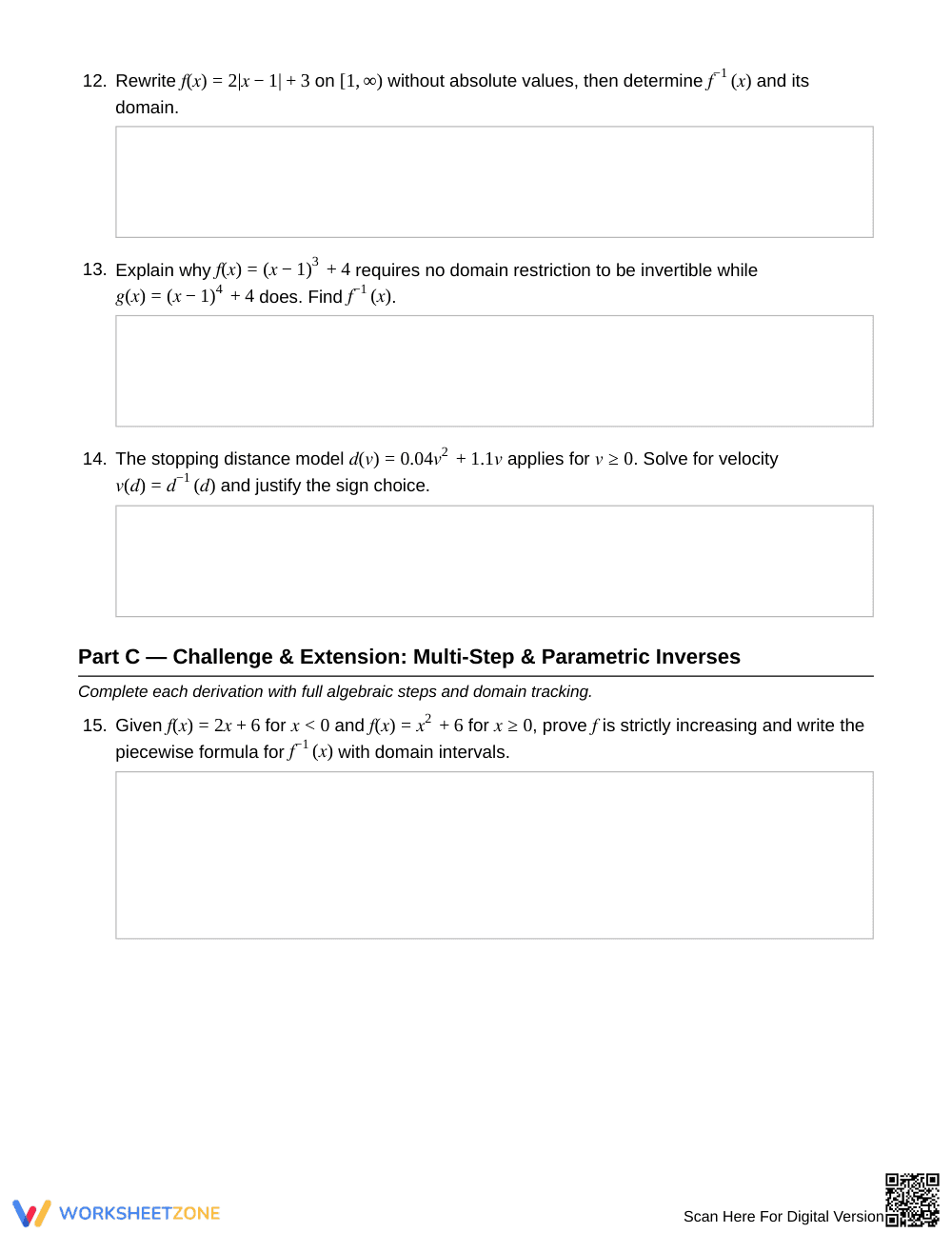
- Supported Practice: Part B (Problems 5–14) builds procedural fluency across 10 algebraic models, requiring students to find inverse equations and explicitly track domain and range intervals.
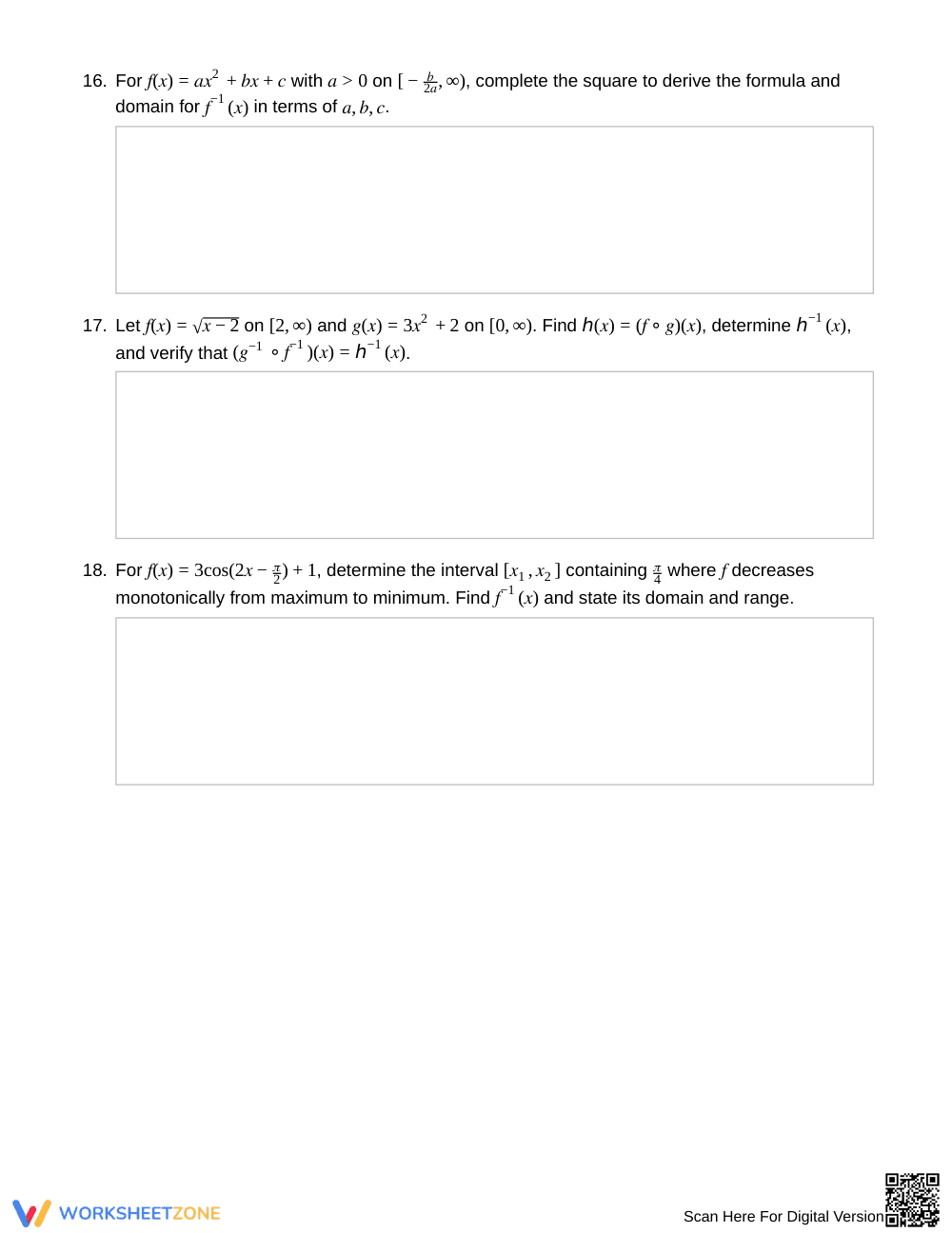
- Independent Practice: Part C (Problems 15–18) challenges students with non-scaffolded, multi-step tasks, including piecewise inversions, general quadratic completions, and restricted trigonometric functions.
This structure implements a gradual-release model, shifting learners from guided conceptual identification to autonomous algebraic synthesis.
Standards Alignment
This worksheet aligns directly to `HSF-BF.B.4`: Find inverse functions, solve equations of the form f(x) = c, and write inverse expressions. It also supports `HSF-IF.B.5` by relating function domains to graphs and quantitative contexts. Both standard codes can be copied directly into lesson plans, IEP goals, or district curriculum mapping tools.
How to Use It
Implement this resource immediately following direct instruction on one-to-one functions or as an advanced review before calculus units. While circulating during supported practice, observe whether students restrict square root inverse domains to match the original range, revealing whether they grasp the reciprocal swap. Students complete the 18 problems within 45 to 60 minutes.
Who It's For
This worksheet is designed for Grade 12 Precalculus and AP Precalculus students mastering function inverses. For struggling learners, provide coordinate grids to verify horizontal line tests; for advanced students, assign the parametric proofs in Part C. Pair this activity with an anchor chart detailing domain restrictions for quadratic and trigonometric functions.
Mastery of `HSF-BF.B.4` requires students to find inverse functions with domain restrictions by systematically evaluating invertibility and swapping input-output relations across diverse function families. According to Fisher & Frey (2014), structured instructional progressions that transition from visual and tabular representations to complex algebraic modeling significantly deepen conceptual retention and procedural automaticity in secondary mathematics. This 18-task Precalculus worksheet implements that evidence-based architecture by moving learners from foundational graphical invertibility checks to multi-step parametric derivations, piecewise formulations, and periodic trigonometric interval analysis. By requiring explicit domain and range tracking in interval notation for every problem, the resource ensures students do not treat inverse operations as mere mechanical variable swaps. Instead, pupils internalize the foundational mathematical truth that a function’s range defines its inverse’s domain, establishing the rigorous analytical habits necessary for advanced success in collegiate calculus and future STEM coursework.


