




























Views
Downloads



Ready Nuclear Power Models Worksheet | Grades 9-12 Science

Paste this activity's link or code into your existing LMS (Google Classroom, Canvas, Teams, Schoology, Moodle, etc.).
Students can open and work on the activity right away, with no student login required.
You'll still be able to track student progress and results from your teacher account.
This comprehensive high school science worksheet equips students to construct, analyze, and revise scientific models of nuclear power systems. Across four structured pages, learners balance nuclear equations, track energy transformations through pressurized water reactor components, calculate mass defect and binding energy, and critically evaluate nuclear power against alternative electricity sources.
At a Glance
- Grade: Grades 9–12 · Subject: Science
- Standard: High School Physical Science — Model nuclear processes, energy transformations, and reactor systems
- Skill Focus: Modeling nuclear fission, power plants, and energy release
- Format: 4 pages · 28 problems · Answer key included · PDF
- Best For: Nuclear energy unit practice and review
- Time: 45–60 minutes
What's Inside
This 4-page resource includes 28 rigorous analytical tasks arranged across three focused sections. Students work with particle-level fission diagrams, atomic mass reference tables, schematic reactor diagrams, energy-flow chains, and life-cycle emissions graphs. Structural supports include worked mass-defect calculations, a conceptual model-critique exercise addressing common misconceptions, and an authentic four-page complete answer key showing full mathematical and conceptual solutions.
Skill Progression
- Guided Practice (Part A, 9 tasks): Students balance fission equations, calculate mass defect using tabular isotopic masses, determine energy release via conversion factors, and model self-sustaining chain reactions with visual cues.
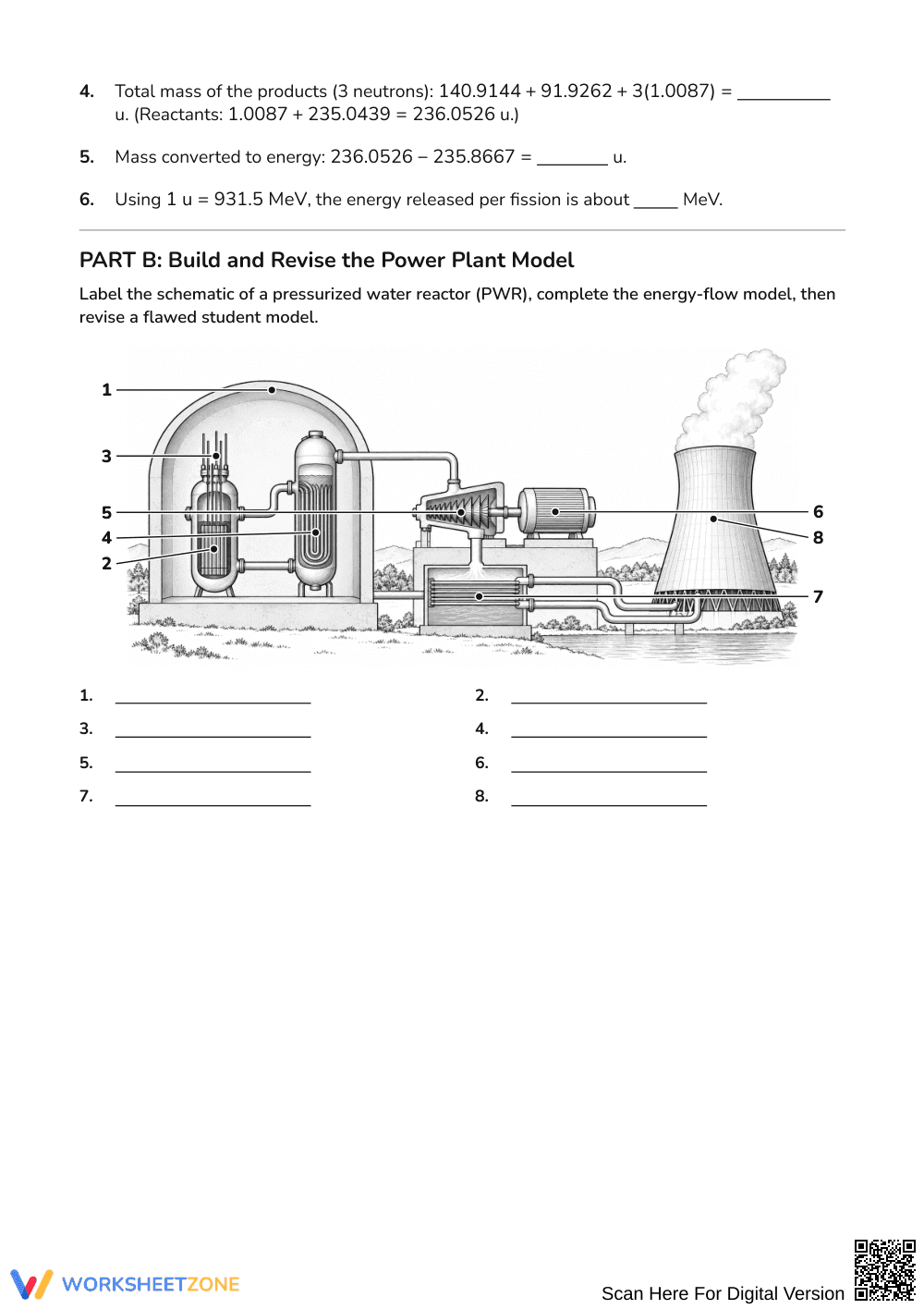
- Supported Practice (Part B, 9 tasks): Learners label components of a pressurized water reactor, map energy pathways from nuclear to electrical output, and critique a flawed student model to correct common misconceptions about steam cycles and radioactivity.
- Independent Practice (Part C, 10 tasks): Students interpret quantitative data comparing life-cycle carbon emissions, calculate thermal efficiency and waste heat, and contrast fission and fusion models per nucleon.
This structure reflects the gradual release of responsibility model, guiding students from foundational atomic mechanics to complex system-level evaluation.
Standards Alignment
This worksheet aligns directly with high school physical science standards requiring students to develop models illustrating the composition of the nucleus of the atom and the energy released during fission, fusion, and radioactive decay. It further supports core disciplinary ideas in energy conservation, energy transfer in engineered systems, and technological design. Both standard codes can be copied directly into lesson plans, IEP goals, or district curriculum mapping tools.
How to Use It
Deploy this worksheet after direct instruction on nuclear fission and electrical power generation. In a 50-minute class, assign Parts A and B as partner practice to reinforce energy pathways, then use Part C as an individual check for understanding. As a formative assessment tip, examine student responses to the Part B model-revision task: confusion between radioactive primary coolant and secondary steam loops reveals immediate intervention points before summative exams.
Who It's For
This resource serves general high school physics, chemistry, and environmental science students exploring energy resources. It provides quantitative rigor for honors tracks while offering structured scaffolding for emerging learners. Pair this printable directly with a reactor core diagram anchor chart or an interactive simulation of chain reactions.
According to Fisher & Frey (2014), structured modeling activities that move from guided atomic representations to independent systems evaluation significantly enhance disciplinary literacy and conceptual retention in secondary science. This worksheet engages high school learners in modeling nuclear power generation through explicit equation balancing, isotopic mass defect calculations, and thermodynamic flow tracing. By analyzing pressurized water reactor mechanics and critiquing flawed conceptual models, students resolve persistent misunderstandings regarding radioactive containment and thermal efficiency. Quantitative comparisons of life-cycle carbon emissions and fusion energy per nucleon further cultivate evidence-based reasoning, ensuring students demonstrate thorough scientific mastery across atomic and societal scales.


