


























Views
Downloads


Ready Graph Quadratic Forms Worksheet | Grade 9 Algebra I
Paste this activity's link or code into your existing LMS (Google Classroom, Canvas, Teams, Schoology, Moodle, etc.).
Students can open and work on the activity right away, with no student login required.
You'll still be able to track student progress and results from your teacher account.
This Algebra I worksheet equips ninth-grade students to extract key features and graph quadratic functions directly from vertex, intercept, and standard forms. Students identify axes of symmetry, vertices, and intercepts across 12 targeted mathematical exercises to master the algebraic structures governing parabolic curves.
At a Glance
- Grade: 9 · Subject: Algebra I
- Standard:
HSF-IF.C.7— Graph quadratic functions showing key features like intercepts, maxima, and minima- Skill Focus: Graph a Quadratic from a Useful Form
- Format: 4 pages · 12 problems · Answer key included · PDF
- Best For: Core practice and structural analysis
- Time: 45–55 minutes
What's Inside
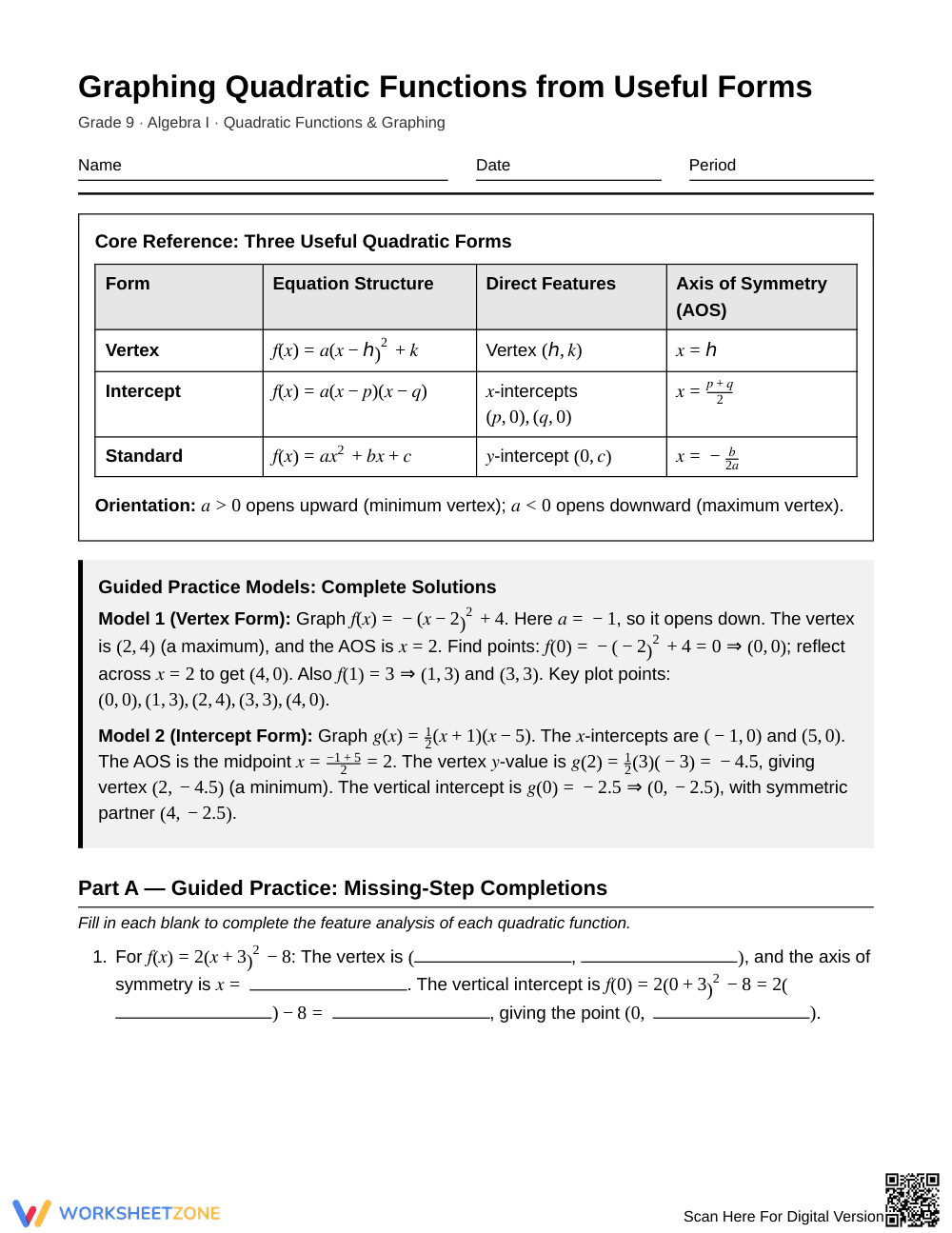
This 4-page student resource includes a core reference reference guide, 2 fully solved visual models, fill-in guided prompts, comprehensive independent graphing tasks, and conceptual error analysis items. A complete 2-page answer key provides coordinate solutions, algebraic verification steps, and explanatory reasoning for every prompt.
Skill Progression
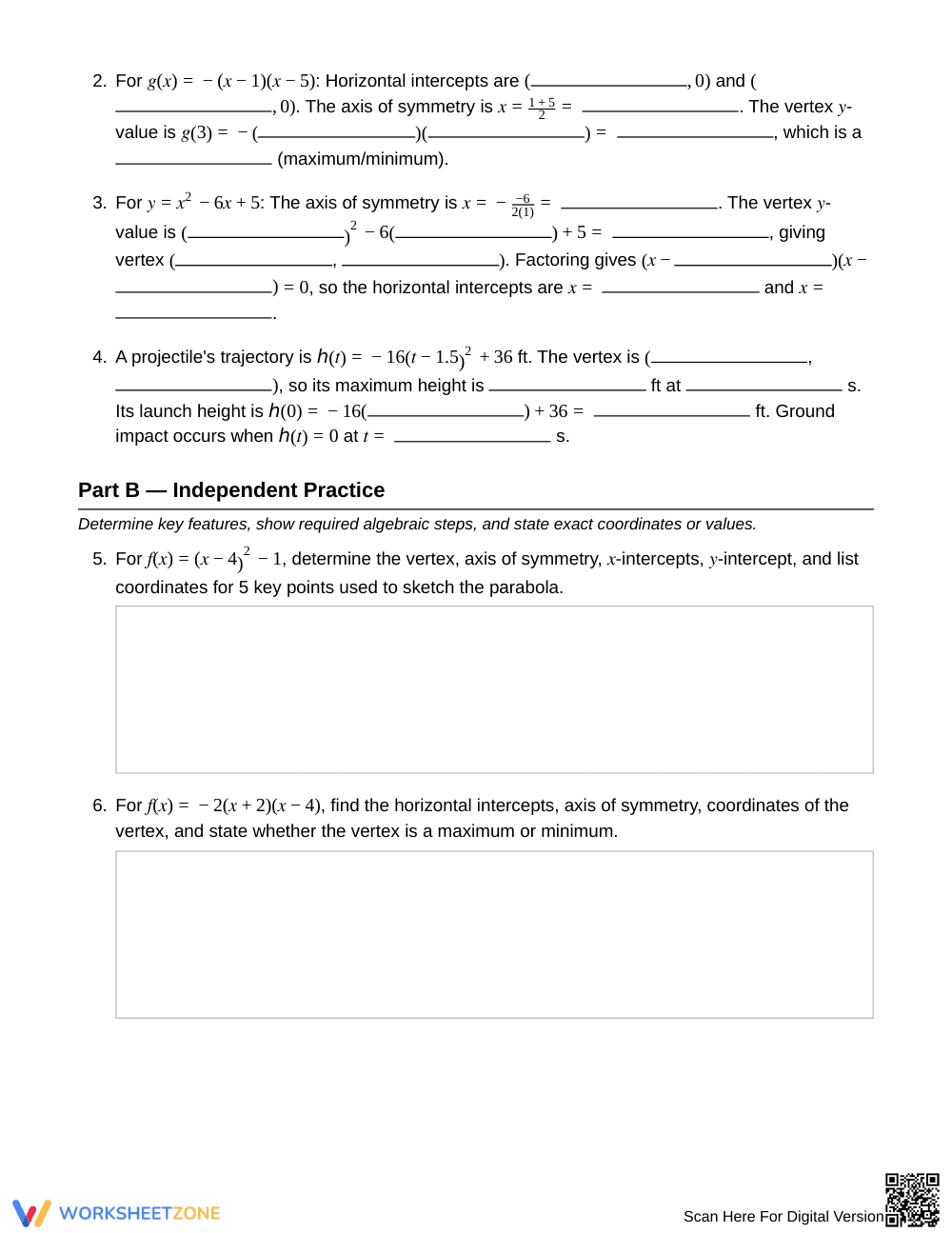
- Guided Practice (Tasks 1–4): Scaffolds learning through missing-step frames, directing students to calculate vertex coordinates, lines of symmetry, and intercepts across vertex, intercept, and standard equations.
- Supported Practice (Tasks 5–8): Fades structural prompts as students analyze multi-step projectile trajectories, calculate five critical curve coordinates, and identify function ranges.
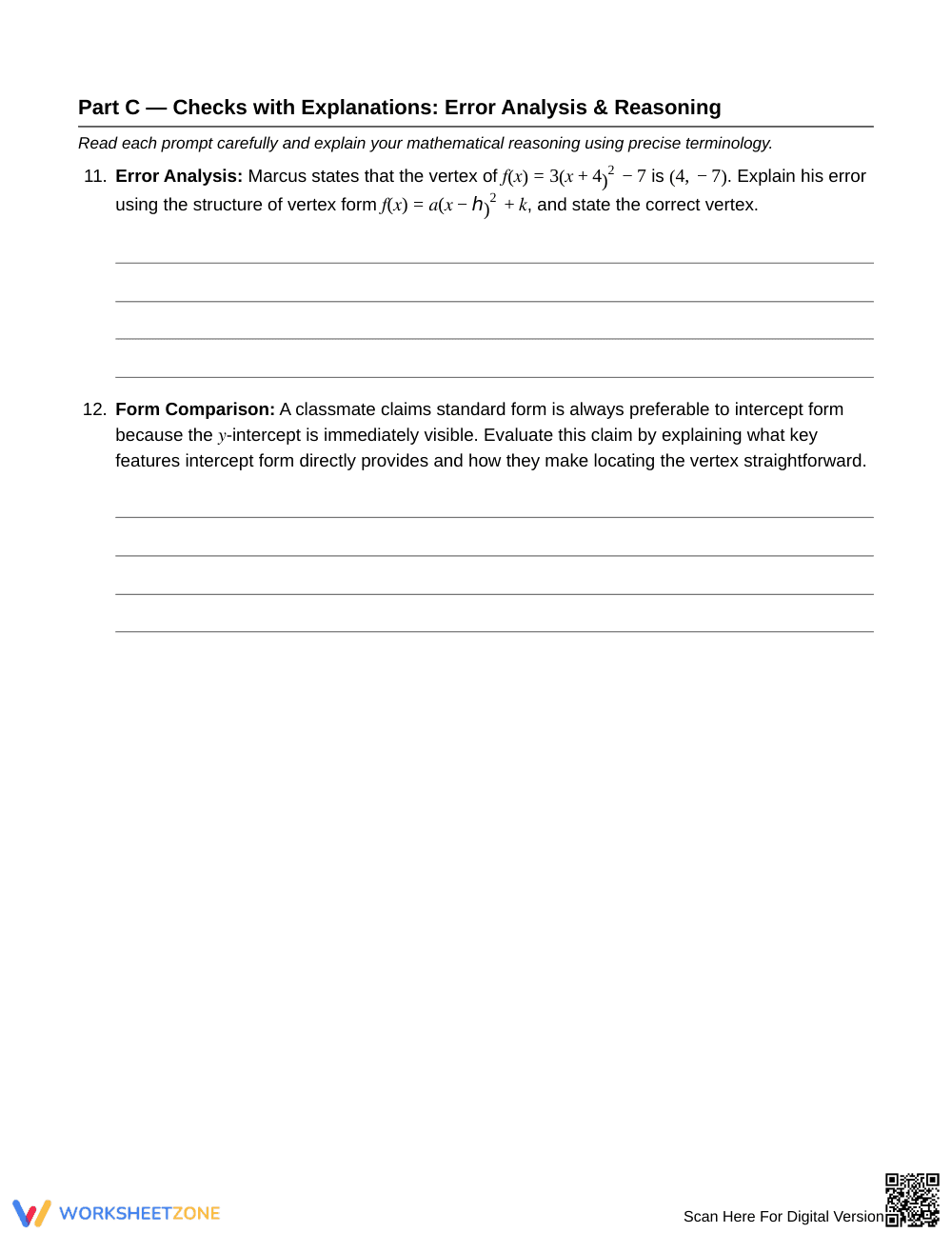
- Independent Practice & Analysis (Tasks 9–12): Challenges learners to reconstruct equations from given points, model real-world architectural spans, and critique common sign misconceptions in vertex form.
This structured sequence applies the gradual-release model (I Do, We Do, You Do) to build procedural fluency and structural comprehension.
Standards Alignment
This worksheet directly targets HSF-IF.C.7: Graph functions expressed symbolically and show key features of the graph, by hand in simple cases and using technology for more complicated cases. Supporting work addresses HSF-IF.B.4 by interpreting key characteristics of quadratic models in context. Both standard codes can be copied directly into lesson plans, IEP goals, or district curriculum mapping tools.
How to Use It
Introduce this worksheet immediately after direct instruction on the three quadratic forms. Use Part A during paired classwork to observe whether students correctly reverse signs when extracting the horizontal shift from vertex form. Assign Parts B and C for independent practice or homework. The complete resource requires approximately 45 to 55 minutes of instructional time.
Who It's For
Designed for Grade 9 Algebra I students learning curve sketching and function analysis. It offers structural cues for students needing visual reinforcement while providing rigorous contextual modeling for advanced learners. Pair this printable with a direct instruction lesson on converting between polynomial forms.
According to research in Fisher & Frey (2014), structuring secondary mathematics instruction through intentional gradual release accelerates conceptual understanding and procedural fluency. This 4-page educational resource operationalizes those principles for standard HSF-IF.C.7, guiding ninth-grade Algebra I students through identifying axes of symmetry, calculating extrema, locating intercepts, and graphing parabolic curves across standard, vertex, and intercept equations. By combining 12 scaffolded exercises with explicit error analysis and a comprehensive 2-page answer key, the material ensures students move methodically from basic parameter identification to rigorous multi-step algebraic reasoning and real-world modeling.


