


























Views
Downloads
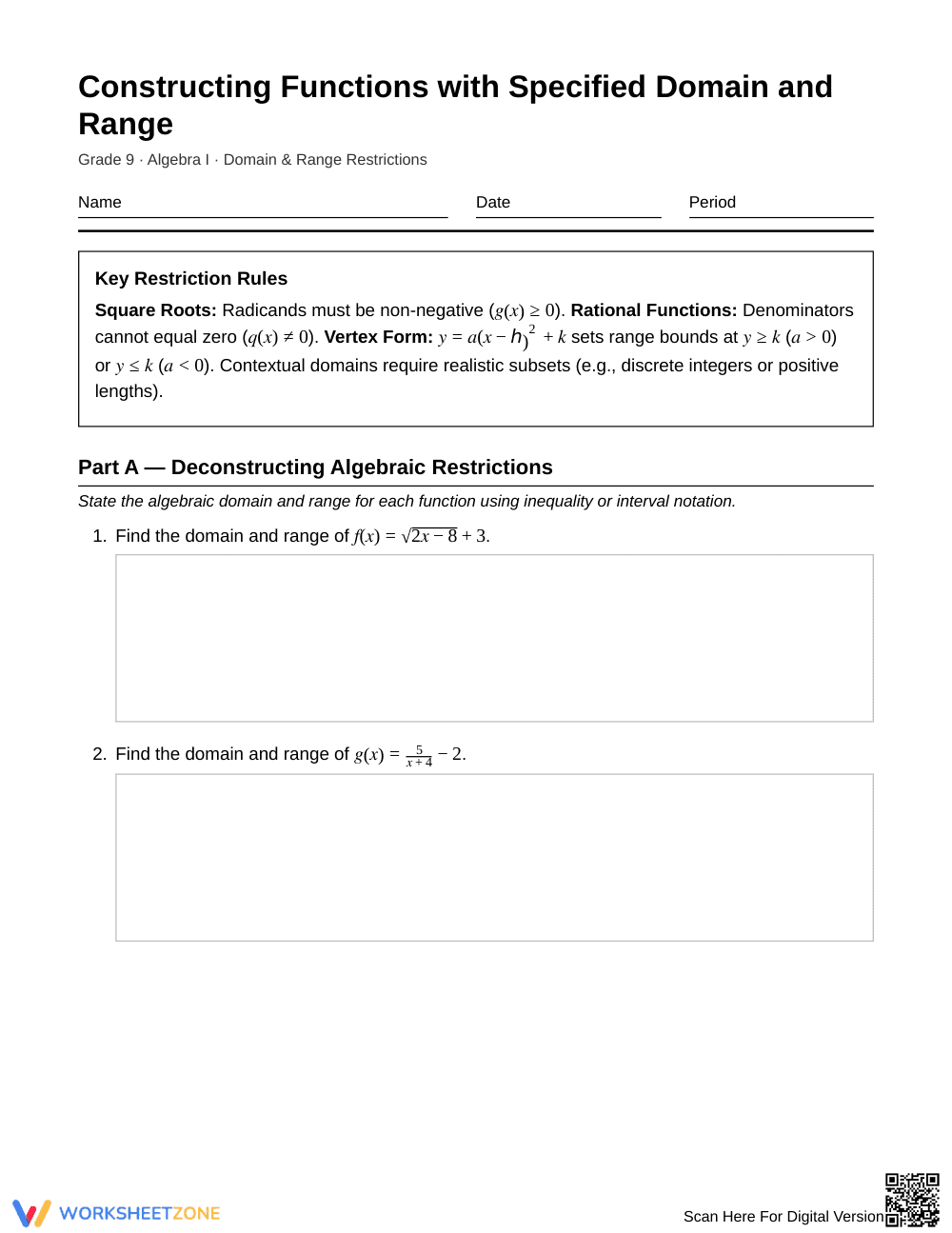
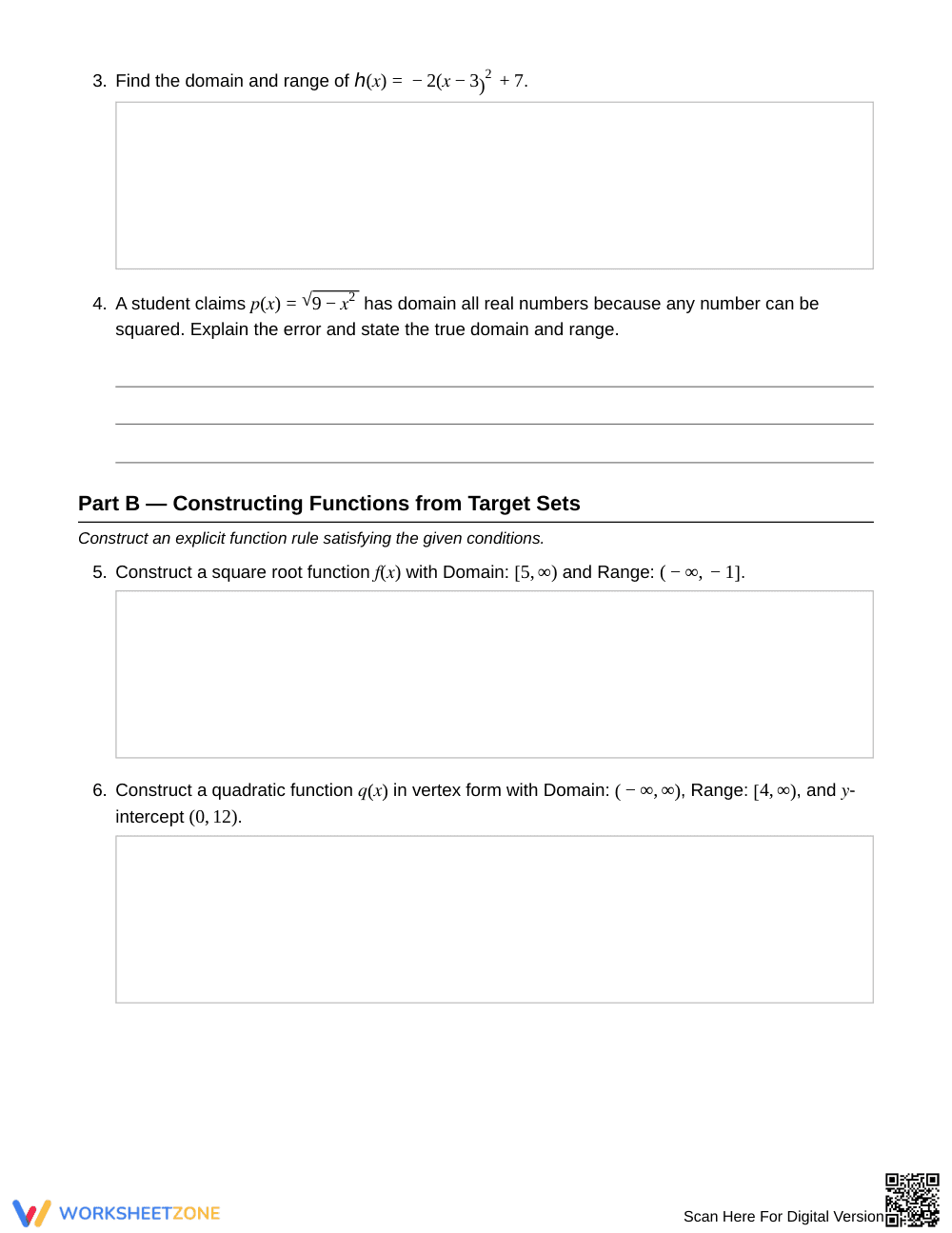
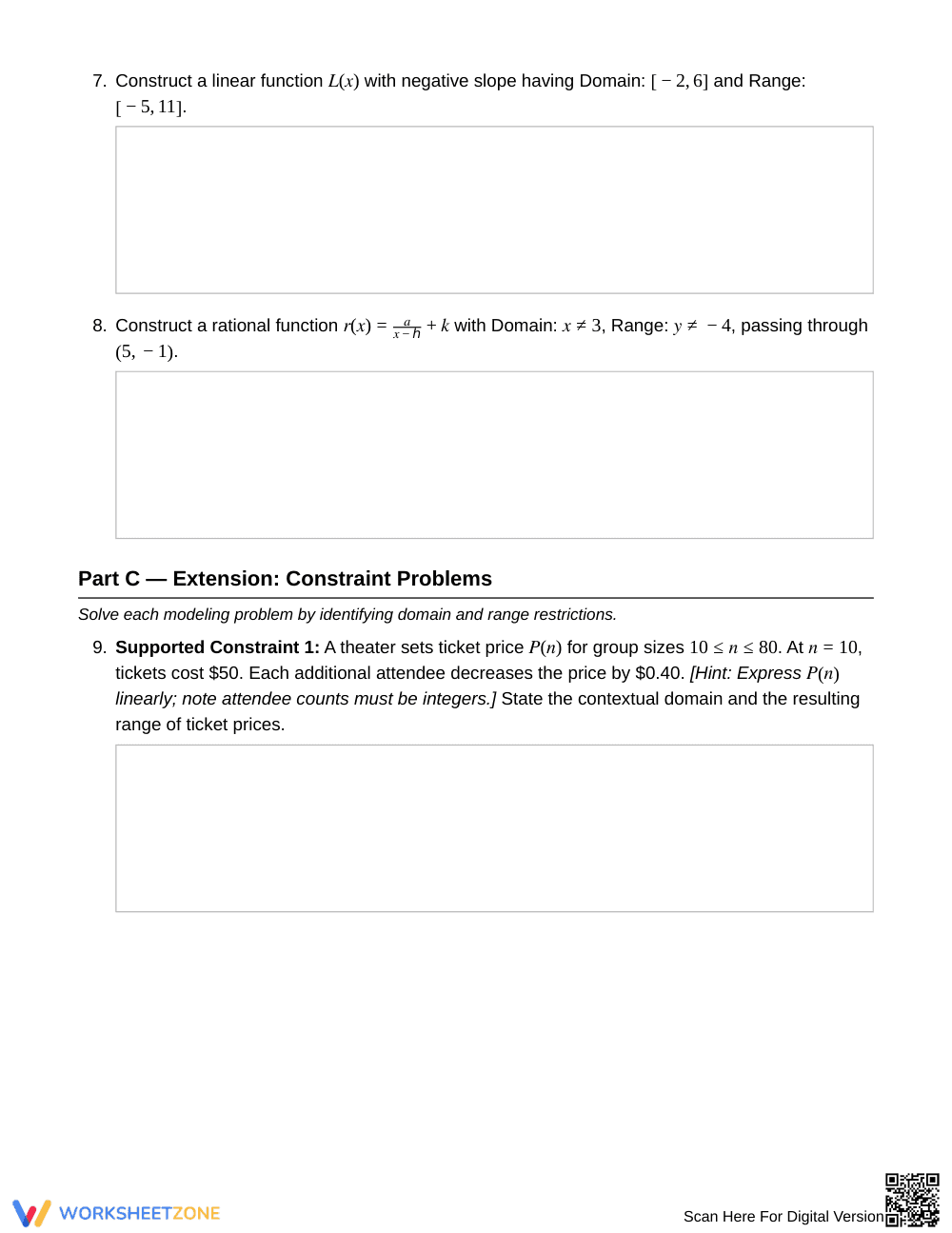
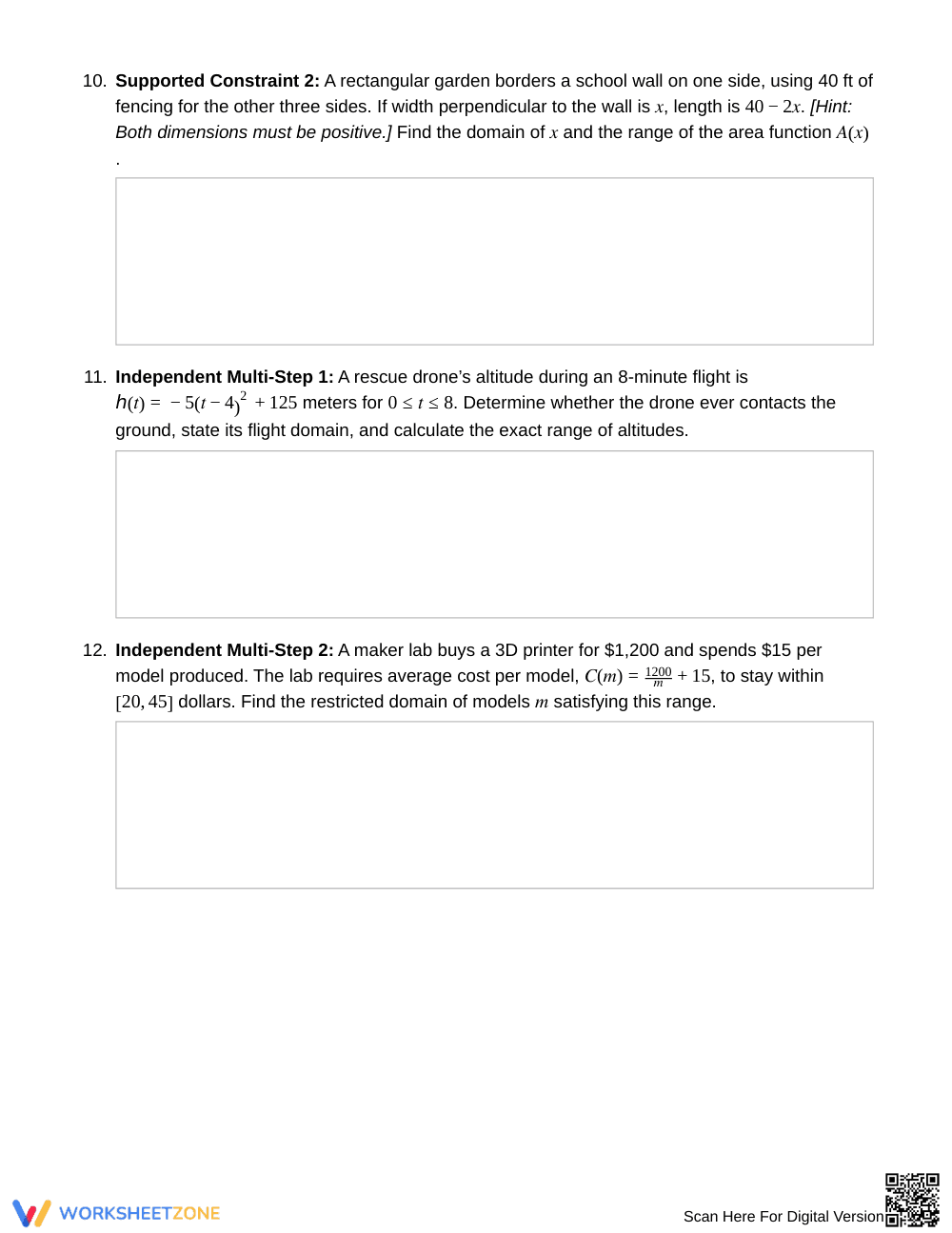

Ready Function Domain & Range Worksheet | Grade 9 Algebra I
Paste this activity's link or code into your existing LMS (Google Classroom, Canvas, Teams, Schoology, Moodle, etc.).
Students can open and work on the activity right away, with no student login required.
You'll still be able to track student progress and results from your teacher account.
This Grade 9 Algebra I worksheet equips students to construct algebraic functions matching specified domain and range constraints. By analyzing restriction rules across square roots, rational functions, and quadratics, high school learners transition from passive domain identification to active function design, mastering how algebraic conditions dictate outputs.
At a Glance
- Grade: 9 · Subject: Algebra I
- Standard: Function Restrictions — Construct functions satisfying stated domain and range conditions in context
- Skill Focus: Construct a Function with Specified Domain and Range
- Format: 5 pages · 14 total problems · Comprehensive answer key included · PDF
- Best For: Independent practice, collaborative partner work, review
- Time: 45–60 minutes
What's Inside
This 5-page printable resource opens with an anchored Key Restriction Rules box detailing root, rational, and vertex properties. Across 14 problems, students complete algebraic restriction deconstructions, error analysis, symbolic function construction, and contextual modeling. A complete two-page answer key provides worked solutions and justifications.
Skill Progression
- Guided practice (Part A, 4 problems): Students deconstruct algebraic restrictions using rule box scaffolds, culminating in an error-analysis task targeting radicand misconceptions.
- Supported practice (Part B, 4 problems): Learners construct explicit function equations matching target intervals using quadratic, square root, linear, and rational structures.
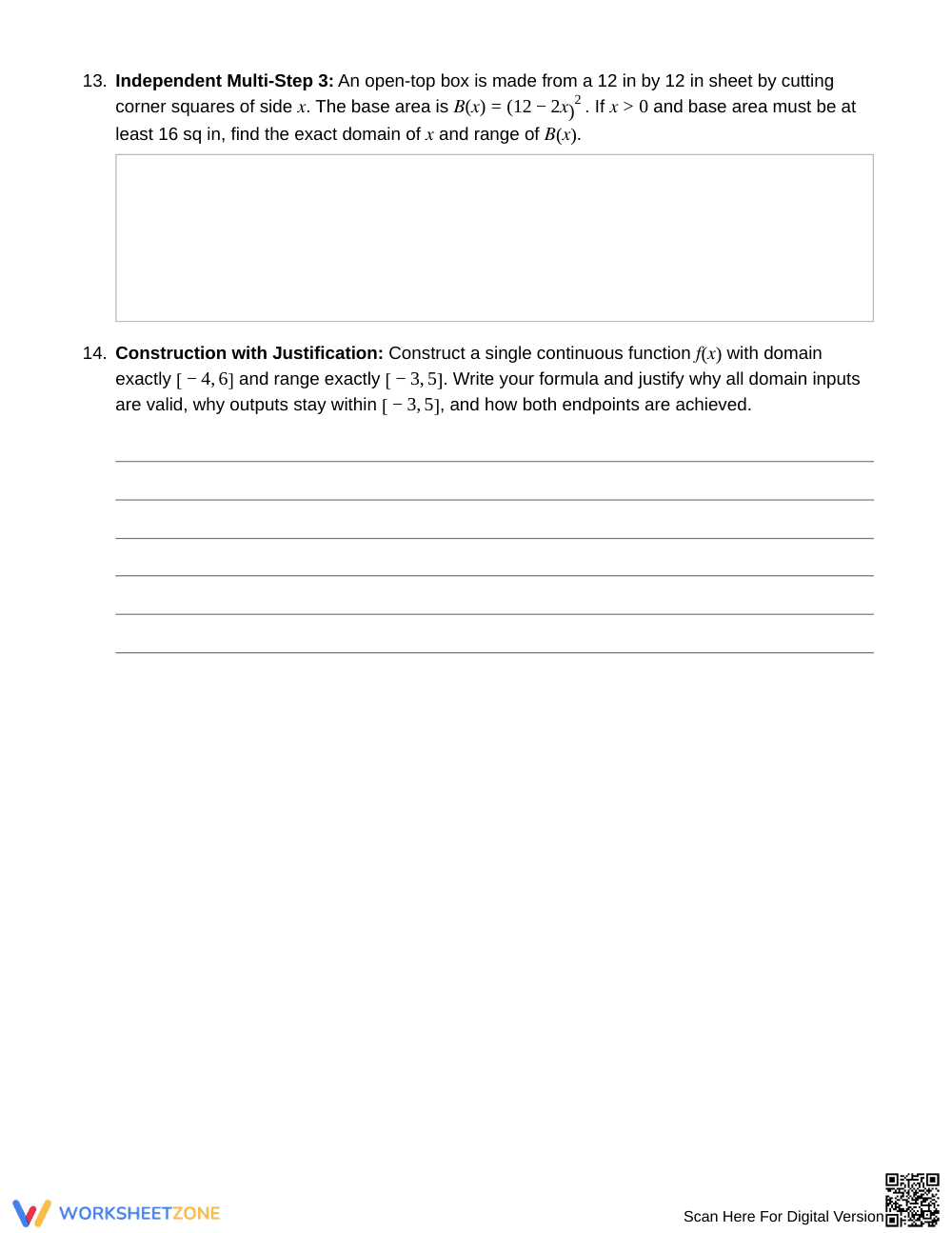
- Independent practice (Part C, 6 problems): Students solve multi-step geometric, flight, and business modeling constraints before justifying a self-engineered continuous function.
This progression applies a gradual-release model, advancing learners from foundational analysis to independent mathematical modeling.
Standards Alignment
This worksheet aligns with high school Algebra I standards for constructing functions that describe relationships between two quantities and determining contextual domain limitations. Supporting standards emphasize creating equations and inequalities to represent constraints. Both standard codes can be copied directly into lesson plans, IEP goals, or district curriculum mapping tools.
How to Use It
Deploy this worksheet immediately following direct instruction on function families and restriction rules. Lead Parts A and B as guided classwork to verify interval notation, then assign Part C for collaborative problem-solving. For formative assessment, examine the Part A error-analysis item to ensure students understand why radicands cannot be negative. Expected completion time is 45 to 60 minutes.
Who It's For
This resource is designed for Grade 9 Algebra I students mastering domain limitations, and offers targeted review for Algebra II learners. Support developing students with a parent function reference chart, and challenge advanced learners to write piecewise rules for Part C. Pair this worksheet directly with a lesson on domain interval notation.
According to Fisher & Frey (2014), structured gradual-release frameworks significantly accelerate mathematical problem-solving by guiding students from supported deconstruction to independent modeling. This 5-page Algebra I worksheet aligns with high school algebra function standards by targeting the vital skill of constructing functions with specified domain and range constraints. Across 14 rigorous items, learners analyze algebraic boundaries across square roots, rational functions, and quadratics before synthesizing equations that satisfy exact interval sets. By transitioning from identifying restrictions to engineering contextual models in geometry and economics, students develop a deep conceptual grasp of how algebraic inputs determine valid output ranges. Research highlighted by Fisher & Frey (2014) confirms that combining explicit restriction reference rules, guided error analysis, and autonomous real-world justification fosters durable conceptual retention, preparing high school mathematicians for advanced coursework in polynomial functions, precalculus, and calculus.


