




























Views
Downloads
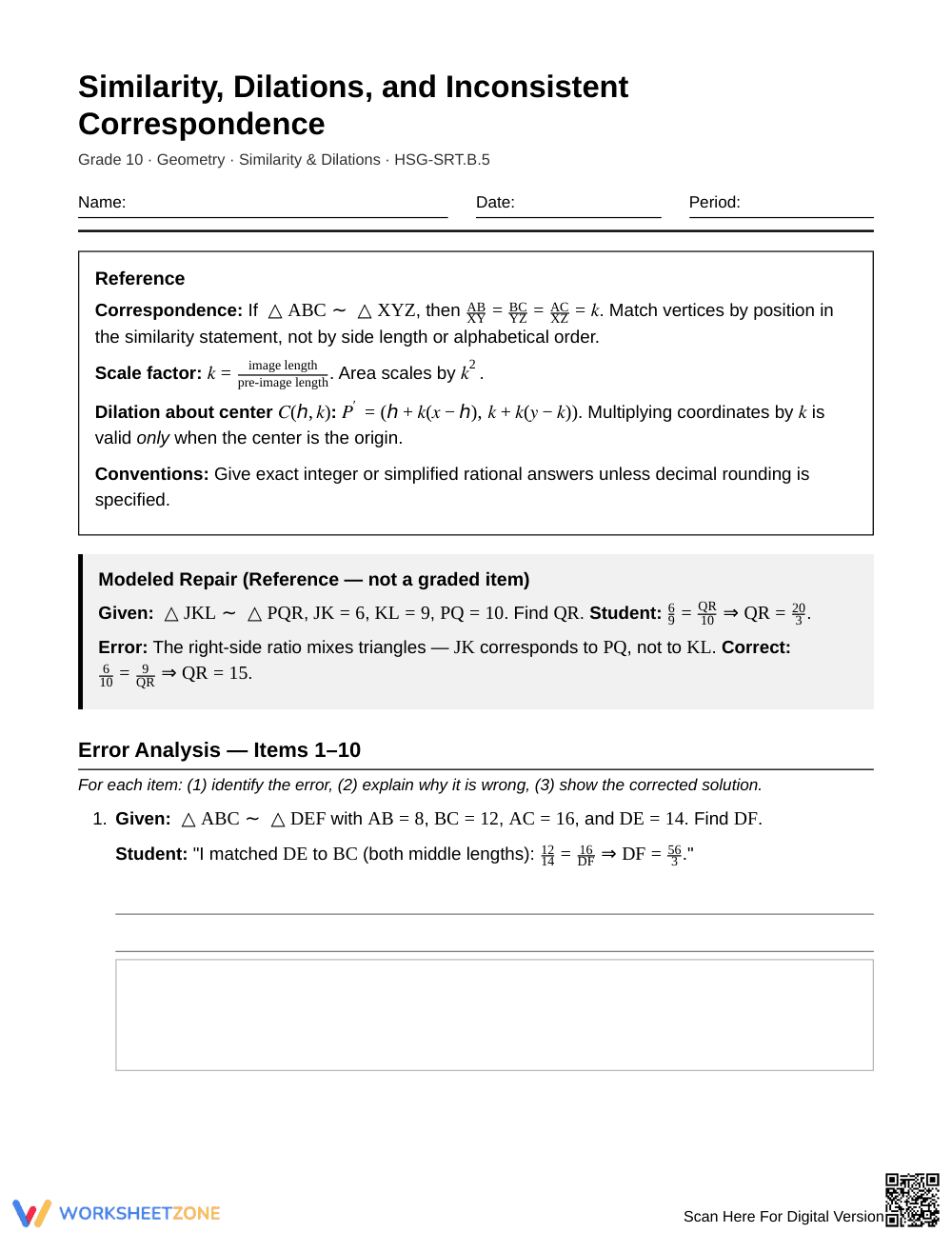

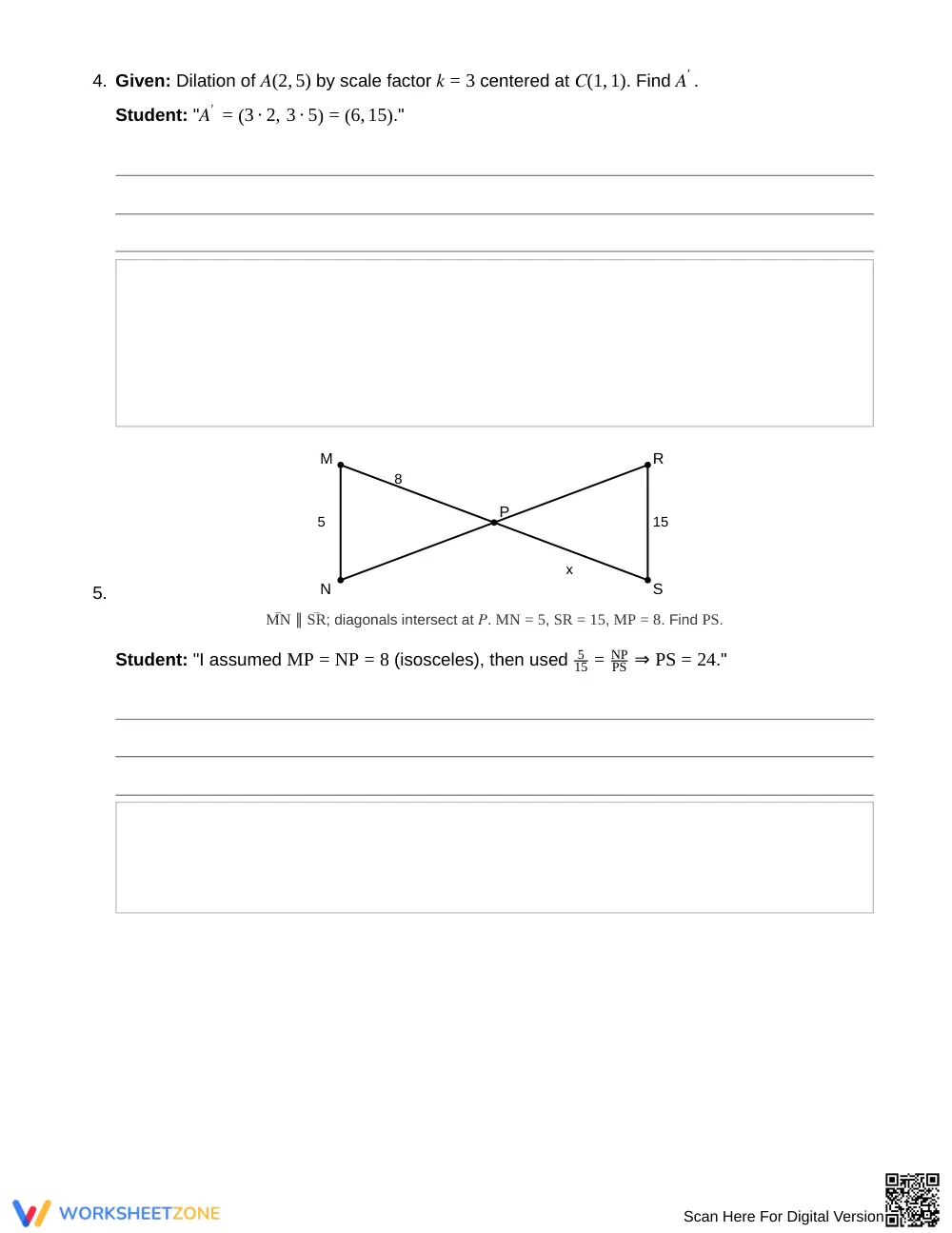

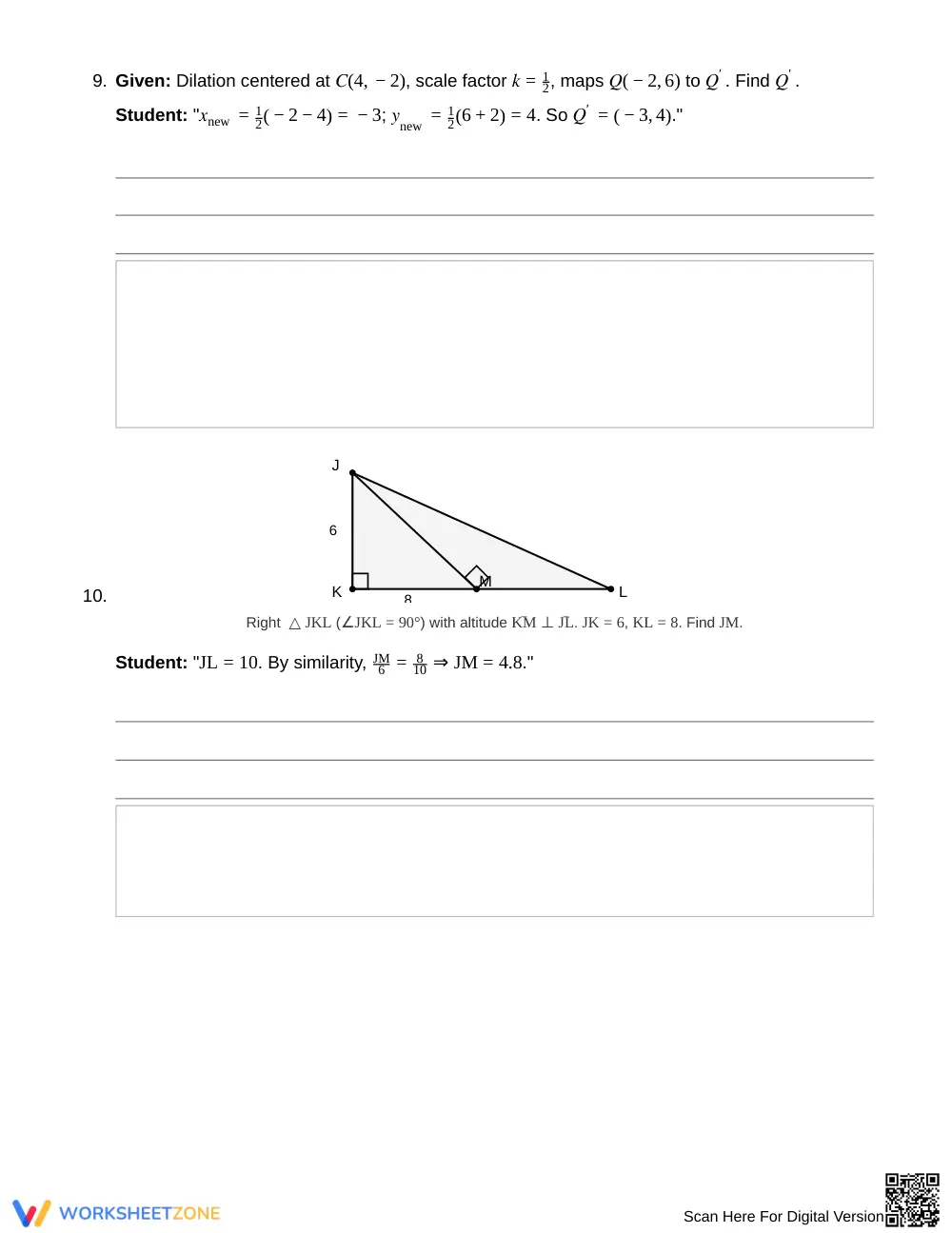

Ready Correspondence Error Worksheet | Grade 10 Geometry

Paste this activity's link or code into your existing LMS (Google Classroom, Canvas, Teams, Schoology, Moodle, etc.).
Students can open and work on the activity right away, with no student login required.
You'll still be able to track student progress and results from your teacher account.
This Grade 10 Geometry worksheet trains students to identify, explain, and correct correspondence errors in similarity and dilation problems. High school learners analyze flawed work to verify vertex order, establish accurate proportions, and calculate scale factors, building mastery of geometric similarity criteria.
At a Glance
- Grade: 10 · Subject: Geometry
- Standard:
HSG-SRT.B.5— Use similarity criteria to solve problems and prove geometric relationships.- Skill Focus: Correct Inconsistent Correspondence
- Format: 5 pages · 10 problems · Answer key included · PDF
- Best For: Error analysis and similarity practice
- Time: 40–50 minutes
What's Inside
The 5-page worksheet includes a reference box covering similarity ratios, dilation formulas, and area scale factors. A modeled repair shows students how to diagnose mismatched ratios before solving 10 error-analysis tasks. Each item presents flawed student work to critique, correct, and re-solve. A 3-page answer key provides complete step-by-step solutions.
Skill Progression
- Guided practice (Items 1–3): Students identify errors in side pairings, perimeter scaling, and parallel line segments with reference support.
- Supported practice (Items 4–7): Learners address non-origin dilations, intersecting transversals, and angle correspondence traps.
- Independent practice (Items 8–10): Students independently resolve multi-step items involving area scale factors and right triangle altitude relationships.
This structured progression follows the gradual release model to build strong geometric reasoning.
Standards Alignment
This resource aligns directly with `HSG-SRT.B.5`, which requires students to use similarity criteria for triangles to solve problems and prove relationships. It also reinforces `HSG-CO.A.2` through scale factor transformations centered off the origin. Both standard codes can be copied directly into lesson plans, IEP goals, or district curriculum mapping tools.
How to Use It
Deploy this worksheet after direct instruction on triangle similarity and dilations. Use it as a partner activity where students critique geometric reasoning. For formative assessment, check whether students distinguish between segment pieces and whole sides in parallel transversals. Expected completion time is 40 to 50 minutes.
Who It's For
This activity is designed for 10th-grade Geometry students learning similarity relationships and dilations. It provides targeted practice for students who confuse side length order with vertex correspondence. Pair this worksheet with an anchor chart detailing similarity statements and dilation formulas.
According to research by Fisher & Frey (2014) on the gradual release of responsibility, structured error analysis prompts high school mathematics students to externalize their reasoning and confront deeply rooted misconceptions. This Grade 10 Geometry resource targets standard HSG-SRT.B.5 by requiring learners to correct inconsistent correspondence in similarity problems and non-origin dilations. Rather than passively calculating side lengths, students examine flawed worked examples, determine why vertex matching failed, and articulate precise geometric arguments to establish correct proportional statements. Research indicates that analyzing non-examples significantly improves conceptual retention and procedural fluency in geometric transformations. By pairing reference formulas with 10 diagnostic items, this worksheet enables students to systematically distinguish between side length order and true vertex correspondence, correctly apply scale factors to linear and two-dimensional measures, and master coordinate dilation rules across diverse problem formats.


