


























Views
Downloads



Ready Climate Attribution Worksheet | Grade 12 Science
Paste this activity's link or code into your existing LMS (Google Classroom, Canvas, Teams, Schoology, Moodle, etc.).
Students can open and work on the activity right away, with no student login required.
You'll still be able to track student progress and results from your teacher account.
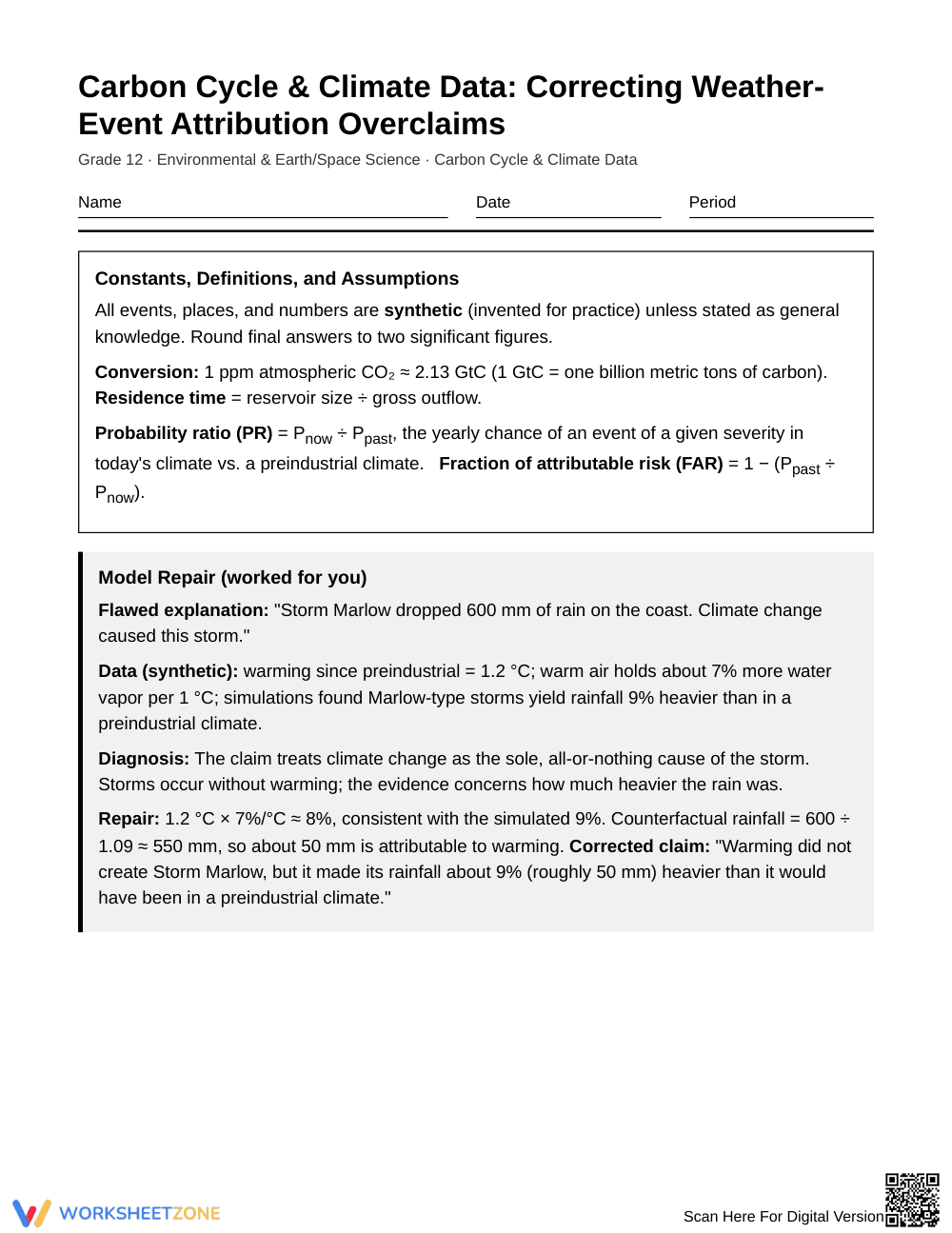
This worksheet teaches Grade 12 students to spot and correct overclaims in weather-event attribution. Students replace all-or-nothing statements such as “climate change caused this storm” with calibrated claims backed by probability ratios, attributable risk, carbon budgets, and residence-time calculations.
At a Glance
- Grade: 12 · Subject: Environmental & Earth/Space Science
- Standard: None assigned — diagnose flawed climate claims and rewrite them using data
- Skill Focus: Correcting weather-event attribution overclaims
- Format: 5 pages · 8 problems · Answer key included · PDF
- Best For: Carbon cycle and climate data units
- Time: 45–60 minutes
What's Inside
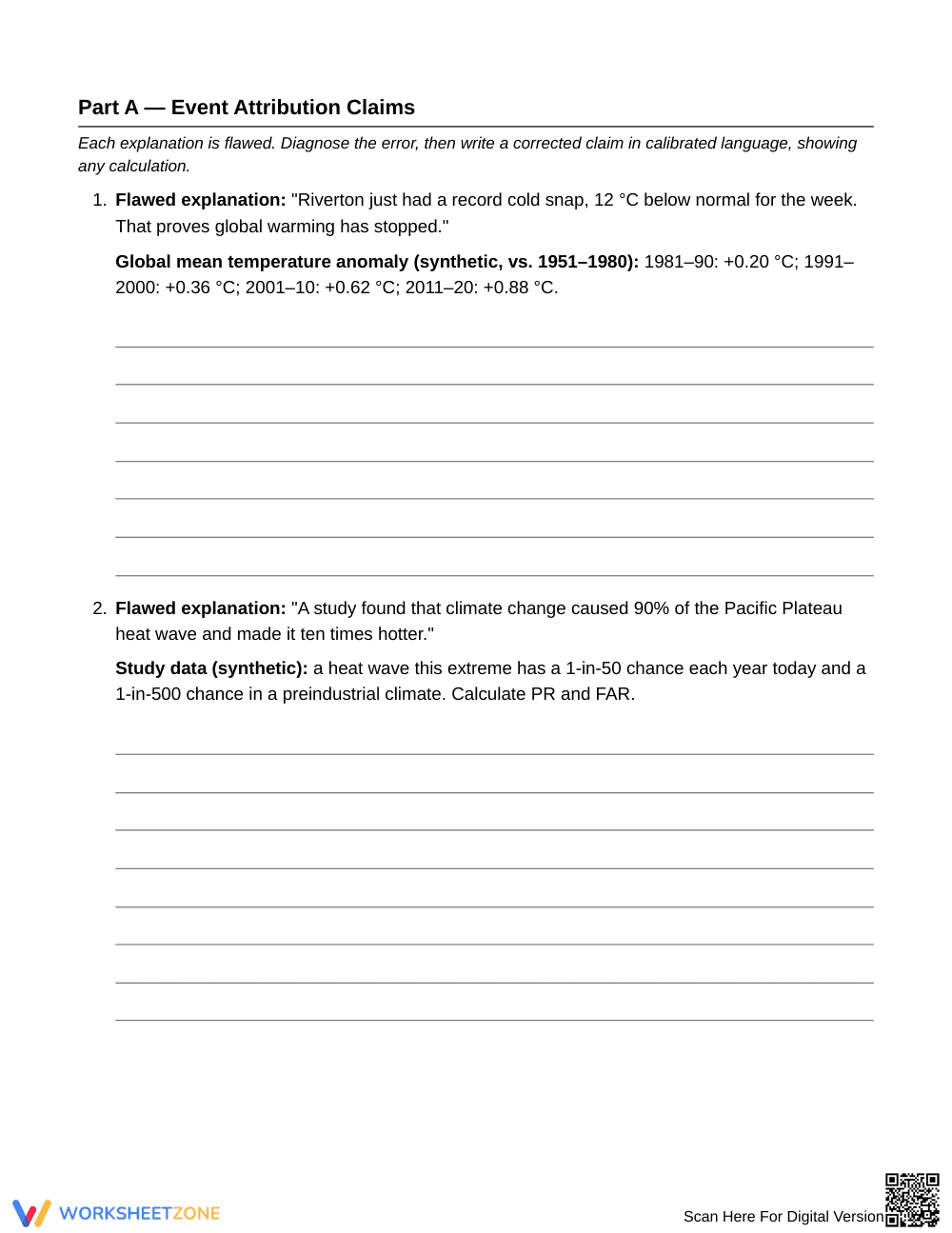
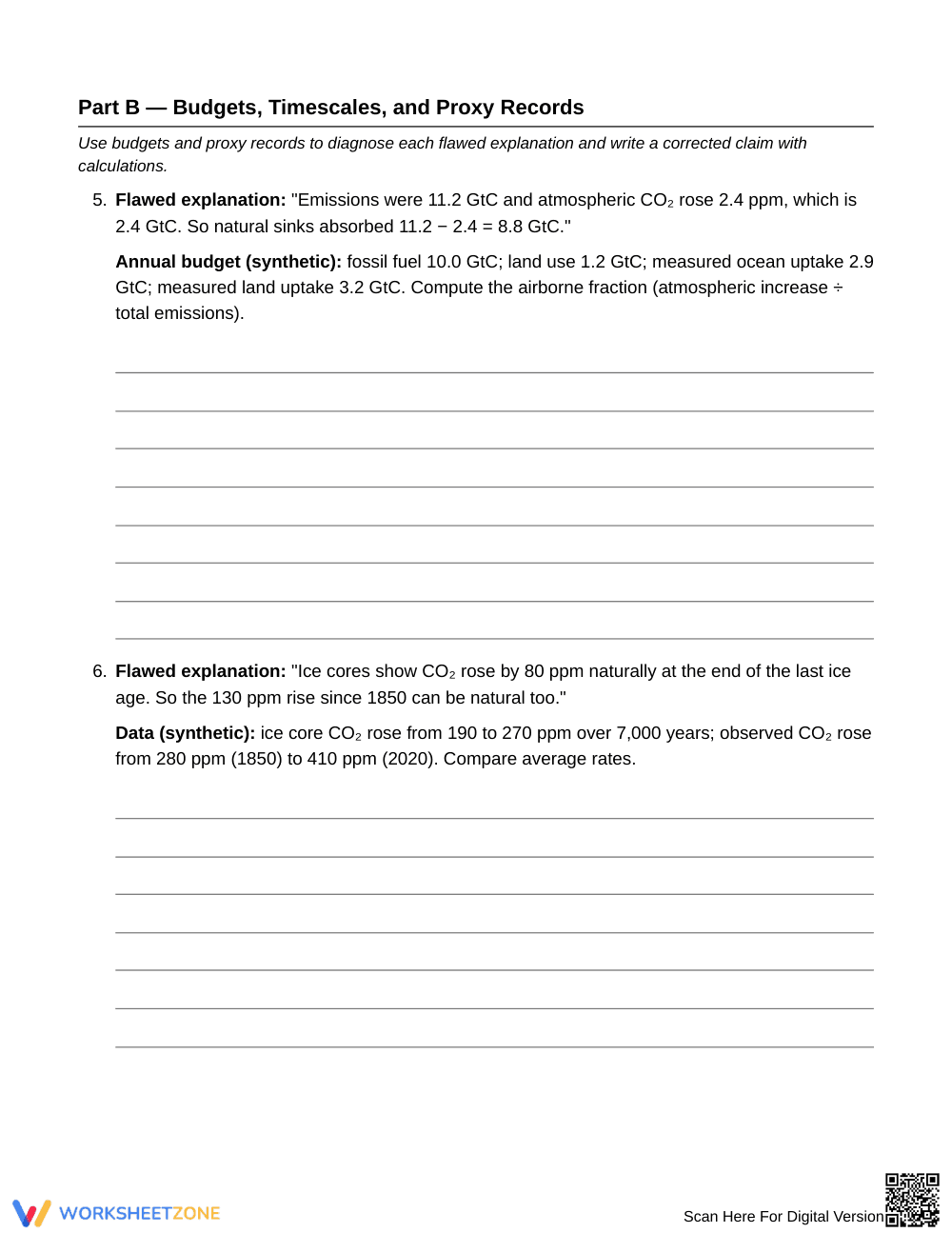
The worksheet opens with a constants box defining probability ratio (PR), fraction of attributable risk (FAR), and residence time, followed by one fully worked model repair. Part A has four event attribution claims (cold snap, heat wave PR and FAR, drought with El Niño, and uncertainty intervals). Part B has four budget, timescale, and proxy-record claims. The answer key runs 3 pages with calculations and sample corrected claims.
Skill Progression
- Guided practice: 1 fully worked model repair (Storm Marlow) showing diagnosis, calculation, and corrected claim.
- Supported practice: 4 Part A tasks with defined formulas and synthetic data tables.
- Independent practice: 4 Part B tasks requiring students to choose the calculation and explain its limits.
The sequence follows gradual release: I Do, We Do, You Do.
Standards Alignment
No standard code is assigned to this worksheet. It supports quantitative reasoning, data interpretation, and evidence-based argumentation within a carbon cycle and climate data unit. Teachers can add their own state or district code when mapping it to lesson plans or curriculum tools.
How to Use It
- After direct instruction: Assign as guided classwork once students have seen PR, FAR, and the carbon budget.
- Before a unit assessment: Use as a review set or homework.
While students work, listen for whether they separate “made more likely or more intense” from “caused.” Expect 45–60 minutes to complete.
Who It's For
Grade 12 environmental science, Earth science, and climate-focused electives. Students who need support can complete Part A first and use the worked model as a template. Pair it with a short lesson on extreme event attribution or a carbon budget anchor chart.
The Grade 12 worksheet on correcting weather-event attribution overclaims has no assigned standard code. It trains students to replace all-or-nothing causal statements with calibrated, quantitative claims. Across 8 tasks, learners calculate probability ratios, fraction of attributable risk, airborne fraction, residence time, and rate comparisons from ice-core data, then rewrite each flawed explanation in precise language. The design follows the gradual-release model described by Fisher & Frey (2014), which moves students from teacher modeling through guided work to independent application. A fully worked model repair comes first, and the answer key shows both calculations and acceptable wording. Students learn that warming changes the odds and intensity of extreme events rather than creating them, that wide uncertainty intervals still carry information, and that a gas's residence time differs from how long a perturbation persists. The set suits environmental science and Earth science courses.


