




























Views
Downloads



Ready 3x3 Dependent Systems Worksheet | Grade 11 Algebra II

Paste this activity's link or code into your existing LMS (Google Classroom, Canvas, Teams, Schoology, Moodle, etc.).
Students can open and work on the activity right away, with no student login required.
You'll still be able to track student progress and results from your teacher account.
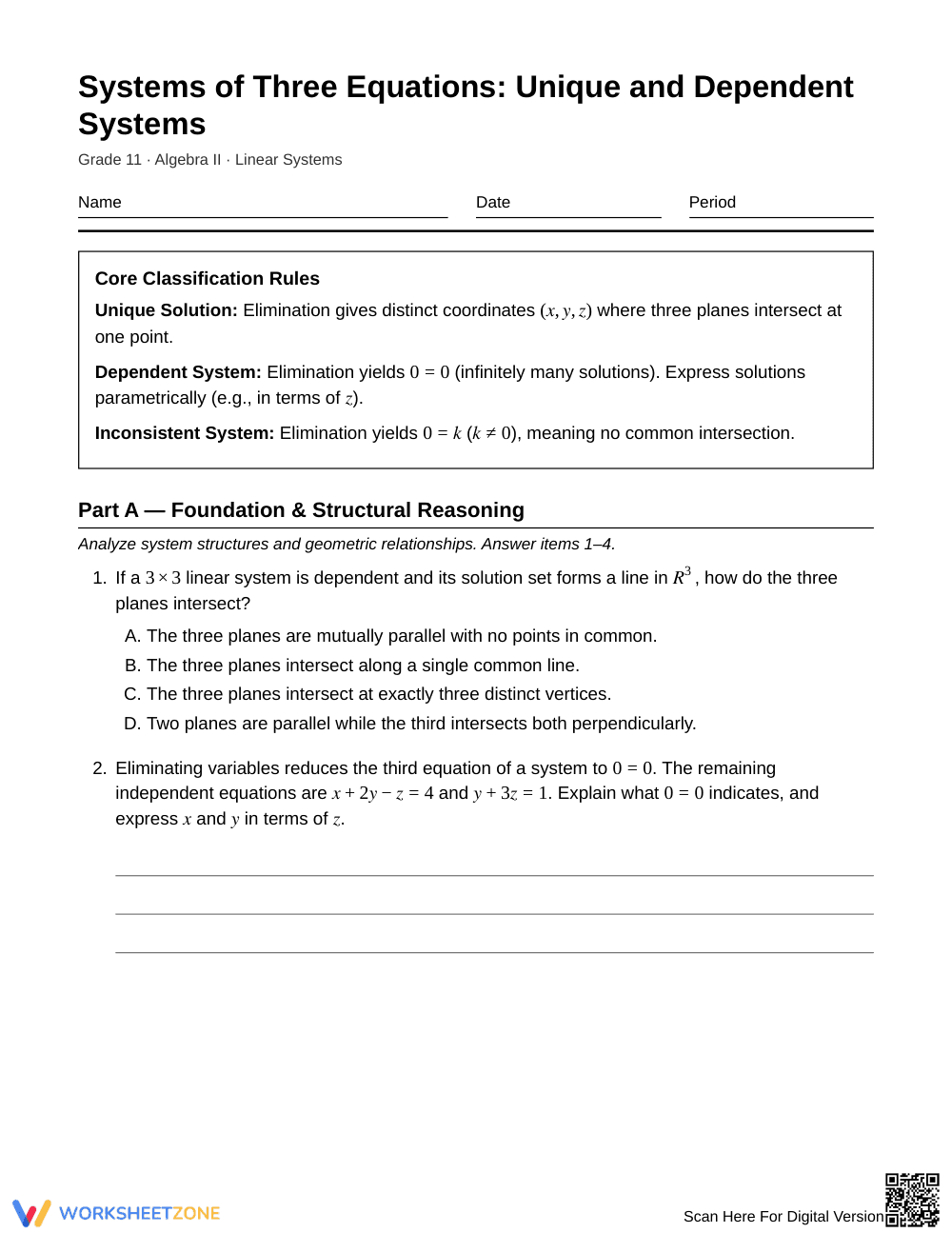
This linear systems worksheet equips Grade 11 Algebra II students to classify and solve unique and dependent 3×3 systems. Across 16 rigorous problems, students examine geometric plane intersections, test for linear dependence, execute algebraic elimination, and express infinite solution sets in parametric form.
At a Glance
- Grade: 11 · Subject: Algebra II
- Standard: High School Algebra — Solve multi-variable systems algebraically and interpret unique versus dependent solution sets
- Skill Focus: Mix Unique and Dependent Systems
- Format: 5 pages · 16 problems · Answer key included · PDF
- Best For: Linear systems practice and assessment prep
- Time: 45–60 minutes
What's Inside
This 5-page printable resource includes a Core Classification Rules reference guide defining unique, dependent, and inconsistent systems. Across 16 varied problems, students complete structural conceptual proofs, algebraic elimination with free parameters, and real-world modeling applications. A 3-page step-by-step answer key provides complete derivations.
Skill Progression
- Guided practice (Part A, 4 items): Students analyze structural properties, connecting plane intersections to algebraic conditions such as linear dependence and 0=0 results.
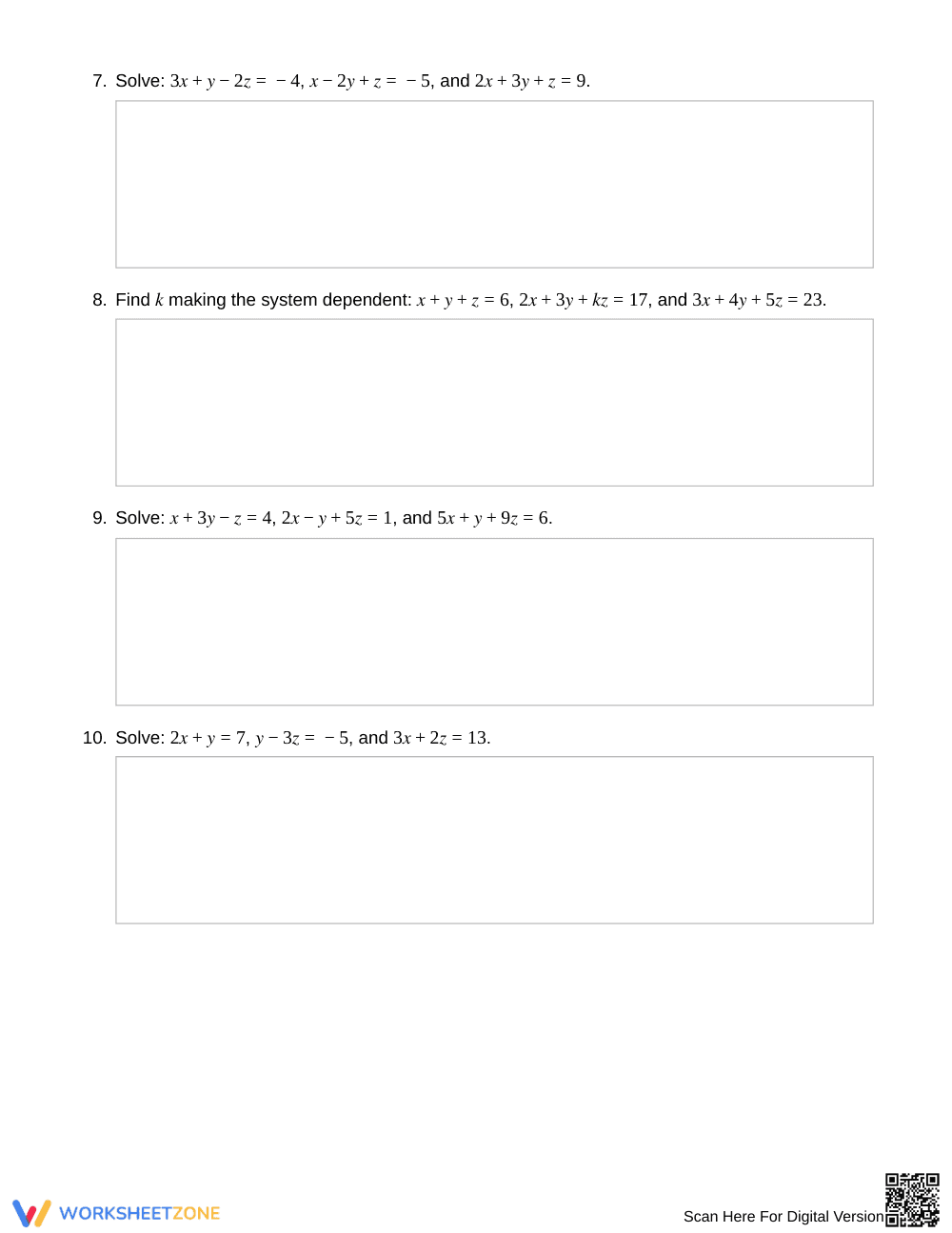
- Supported practice (Part B, 8 items): Learners solve three-variable systems algebraically, determining unique coordinate triples or expressing infinite solutions parametrically using a free variable.
- Independent practice (Part C, 4 items): Students construct and solve systems from applied contexts—acid blending, production times, and polynomial arches—evaluating non-negative variable intervals.
This sequence follows the gradual-release model, advancing students from conceptual foundations to procedural fluency and independent mathematical modeling.
Standards Alignment
This resource aligns with high school algebra standards for multi-variable linear systems: solve systems in three variables algebraically, identify dependent systems yielding infinitely many solutions, and represent solutions parametrically. Supporting standards cover modeling real-world constraints using linear equations. Both standard codes can be copied directly into lesson plans, IEP goals, or district curriculum mapping tools.
How to Use It
Deploy this worksheet after direct instruction on Gaussian elimination. For formative assessment during class, assign Parts A and B to verify that students correctly parameterize dependent equations when encountering 0=0 rather than labeling them with no solution. Assign Part C as collaborative problem-solving or homework. Completion typically requires 45 to 60 minutes.
Who It's For
This activity serves Grade 11 Algebra II and Pre-Calculus students mastering linear systems. For differentiated support, pair struggling learners with visual plane intersection diagrams. Advanced learners can explore non-negative domain boundaries in Part C or apply matrix row operations.
According to research by Fisher & Frey (2014) on the gradual release of responsibility, structured instructional problem sequences that systematically transition students from conceptual analysis to procedural application foster significantly deeper retention in advanced high school mathematics. This 5-page Grade 11 Algebra II resource exemplifies that methodology across 16 rigorous mathematical tasks focused on solving unique and dependent systems of three linear equations. By pairing foundational geometric reasoning regarding intersecting planes with algebraic elimination, parametric representations, and authentic modeling problems, the material ensures secondary students do not merely execute algorithmic steps mechanically. Instead, learners systematically diagnose linear dependence, verify solution validity across intersecting equations, and define viable parametric domains for real-world variables. This deliberate balance between structural reasoning and computation provides educators with an empirically supported instructional tool for developing lasting mastery in multi-variable linear algebra.


