


























Views
Downloads

Essential Grade 5 Vocabulary Alphabetical Order Worksheet
Paste this activity's link or code into your existing LMS (Google Classroom, Canvas, Teams, Schoology, Moodle, etc.).
Students can open and work on the activity right away, with no student login required.
You'll still be able to track student progress and results from your teacher account.
This Grade 5 English Language Arts worksheet strengthens academic vocabulary and organizational skills through a hands-on "Pictionary" sorting activity. By combining visual cues with formal definitions, students master ten essential tier-two terms while refining their ability to organize information alphabetically. It provides a structured way to understand abstract concepts.
At a Glance
- Grade: 5 · Subject: ELA
- Standard:
L.5.6— Acquire and use accurately grade-appropriate general academic and domain-specific words and phrases- Skill Focus: Alphabetical Order · Academic Vocabulary
- Format: 2 pages · 10 problems · No-prep activity · PDF
- Best For: Literacy centers, science integration, sub plans
- Time: 15–20 minutes
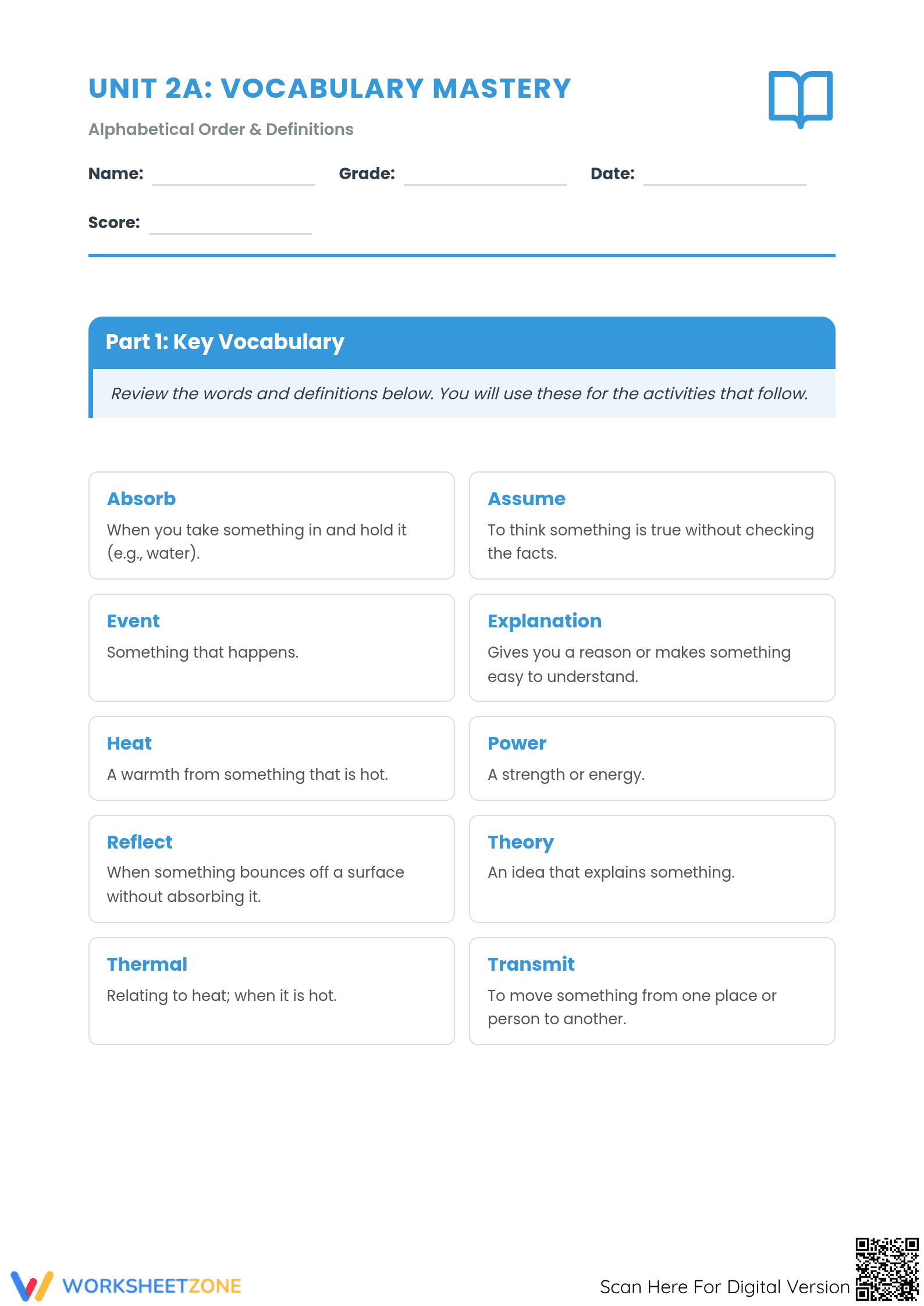
The download consists of two distinct pages designed for a tactile learning experience. The first page features a clean, organized grid where students arrange their final work. The second page contains ten high-interest graphics paired with clear, student-friendly definitions for academic terms such as "Thermal," "Transmit," "Theory," and "Absorb." This multi-sensory approach ensures that students engage with both the meaning and the structure of new language.
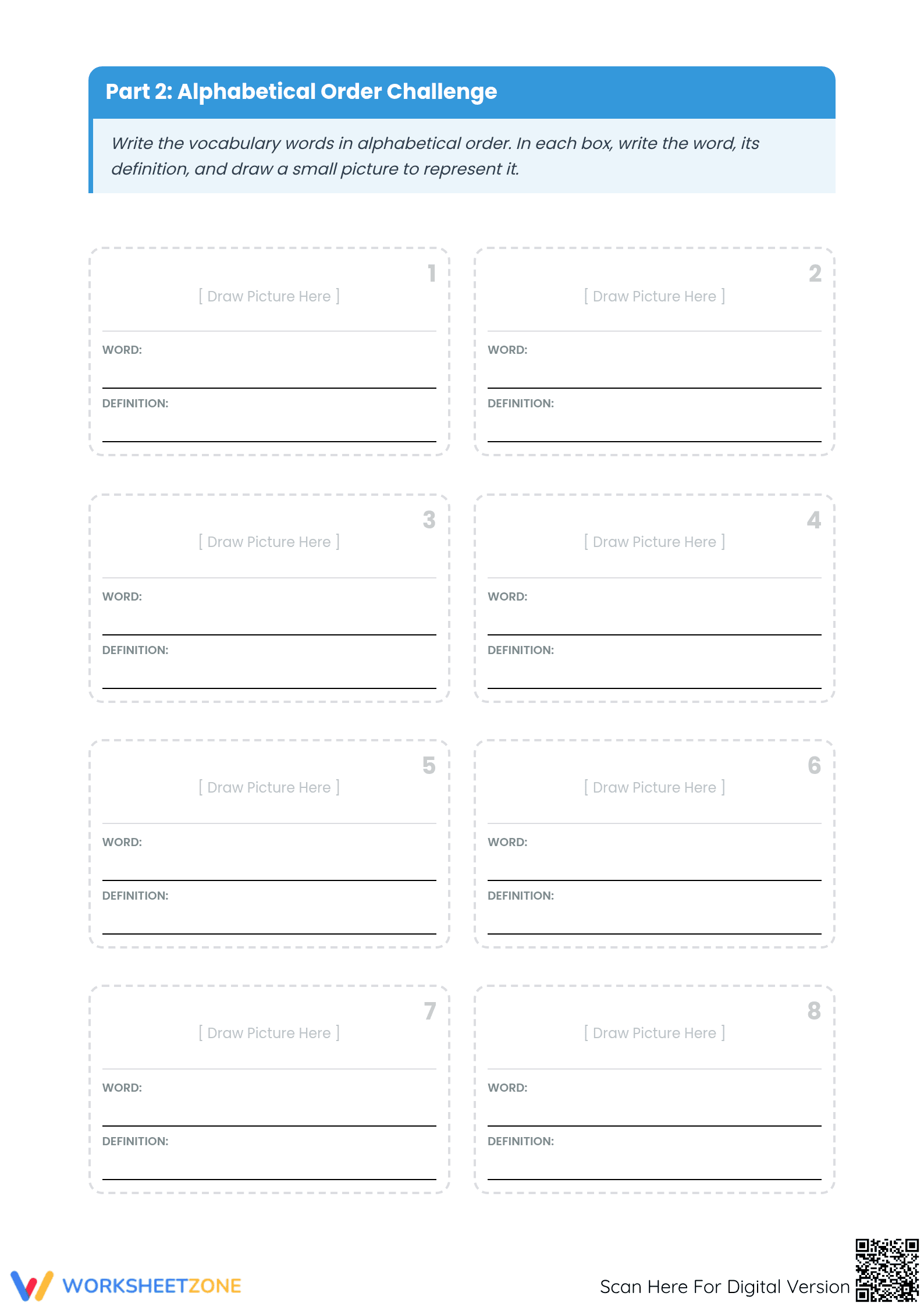
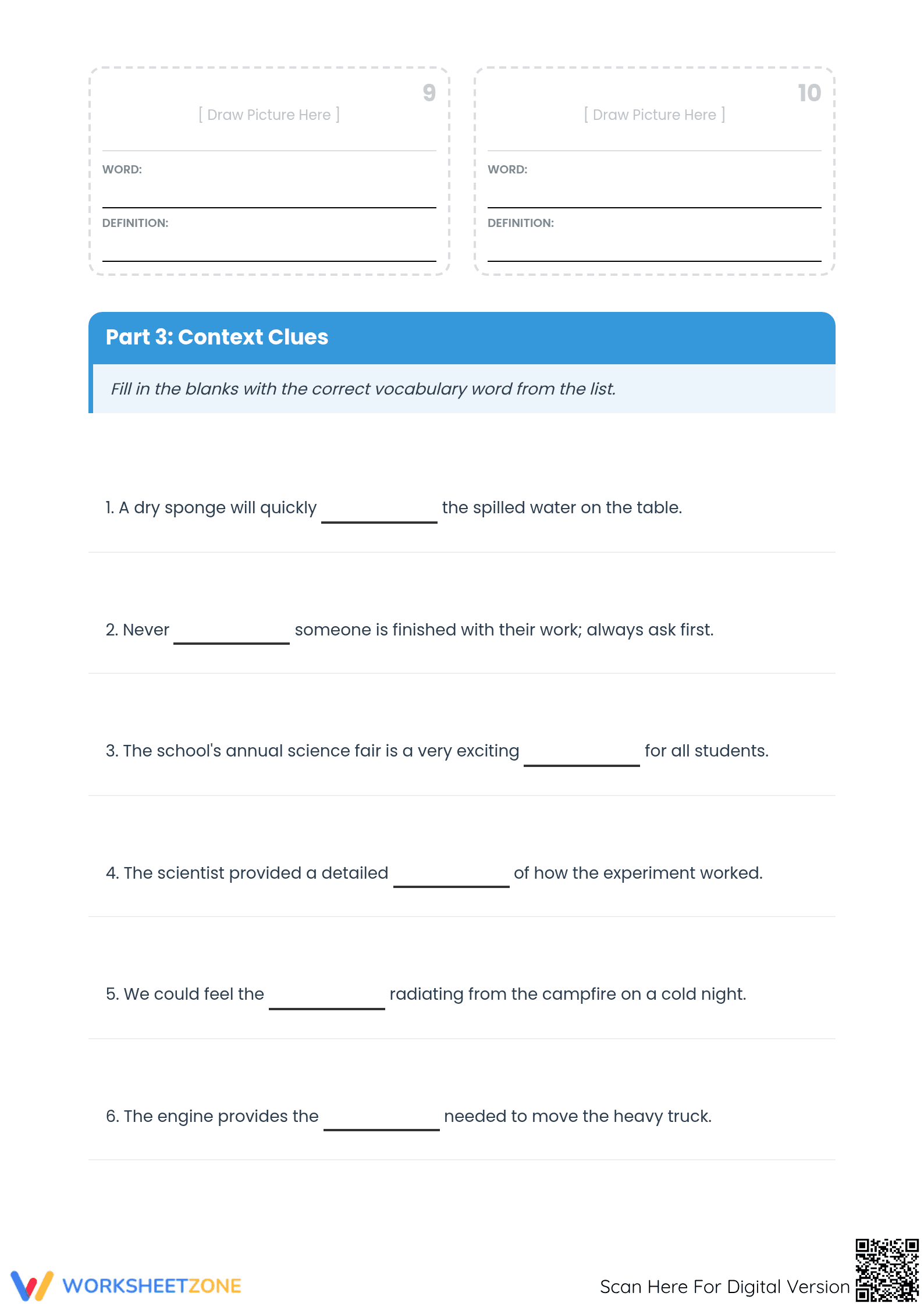
Implement this activity in three simple steps. First, print the two-page PDF (30 seconds). Second, distribute materials with scissors and glue sticks (under 1 minute). Finally, students work independently to cut out definitions and arrange them in alphabetical sequence in the provided grid. Total teacher preparation time is less than two minutes, making it an ideal choice for morning work, literacy centers, or last-minute substitute teacher folders.
This resource is explicitly aligned to `L.5.6`, which requires students to acquire and use accurately grade-appropriate general academic words and phrases. It also touches upon `L.5.4.c` as students must confirm the precise meaning of words like "assume" and "event" to pair them with the correct visual representation. These standard codes can be copied directly into lesson plans, IEP goals, or district curriculum mapping tools to ensure instructional compliance and rigor.
Use this worksheet as a cross-curricular bridge during a physical science unit on energy or heat. It serves as an excellent formative assessment for identifying students who struggle with alphabetizing beyond the first letter (e.g., distinguishing between "theory" and "thermal"). For a quick extension, ask students to write an original sentence using three of the words after they have successfully glued them into the alphabetical grid.
This activity is specifically designed for 5th-grade learners, though it is highly effective for English Language Learners (ELLs) who benefit from the strong visual scaffolding provided by the Pictionary-style graphics. It pairs naturally with non-fiction science passages or direct instruction lessons focused on energy transfer and scientific inquiry, providing the necessary repetition for long-term vocabulary retention.
Rigorous vocabulary instruction is a cornerstone of academic success. According to Fisher & Frey (2014), integrating visual representations with word definitions enhances the "dual coding" of information, leading to higher retention. This worksheet leverages that research by requiring students to actively process ten academic terms—including "thermal" and "theory"—within the framework of alphabetical organization. Aligned with L.5.6, the activity moves beyond simple memorization to promote cognitive engagement through sorting and classification. By mastering these domain-specific words, Grade 5 students build the linguistic foundation needed for complex texts. This approach mirrors the NAEP's emphasis on deep word knowledge as a primary predictor of reading comprehension and academic achievement. As students categorize terms like "transmit" and "absorb," they develop the precise language required for success in both English Language Arts and integrated science curricula.


