


























Views
Downloads



Dependent Clause Punctuation Worksheet | Grade 6-7 Essential
Paste this activity's link or code into your existing LMS (Google Classroom, Canvas, Teams, Schoology, Moodle, etc.).
Students can open and work on the activity right away, with no student login required.
You'll still be able to track student progress and results from your teacher account.
This Grade 6 and 7 grammar resource focuses on the specific mechanics of comma placement when using dependent clauses. Students learn to distinguish between introductory clauses that require a comma and trailing clauses that do not. By mastering these punctuation rules, learners significantly improve their sentence-level clarity and writing sophistication.
At a Glance
- Grade: 6-7 · Subject: ELA Grammar
- Standard:
CCSS.ELA-LITERACY.L.7.2— Demonstrate command of the conventions of standard English capitalization, punctuation, and spelling- Skill Focus: Comma usage with dependent clauses
- Format: 3 pages · 16 problems · Answer key included · PDF
- Best For: Independent practice or grammar bell-ringers
- Time: 20–30 minutes
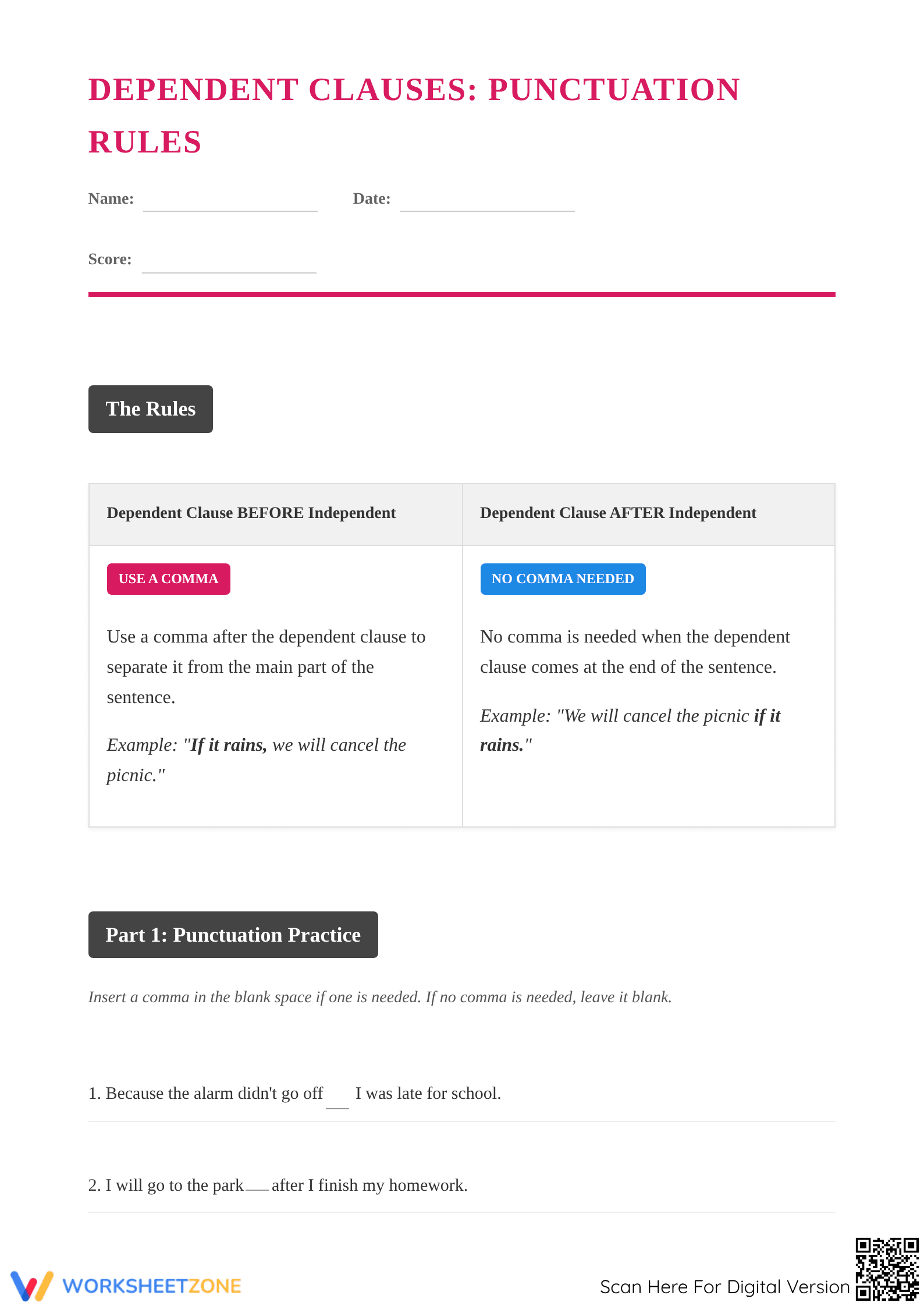
The packet contains three pages of instructional content and practice. It begins with a clear "The Rules" reference table that provides visual examples of comma usage for both preceding and following clauses. The 16 total tasks are divided into three distinct sections, accompanied by a full answer key for immediate feedback or self-grading.
Skill Progression
- Guided Practice: Part 1 provides 8 sentences where students must decide whether to insert a comma in a designated blank space based on clause position.
- Supported Practice: Part 2 requires students to rewrite 4 sentences, moving the dependent clause to the beginning of the sentence and applying the correct punctuation.
- Independent Practice: Part 3 challenges students to identify and underline the dependent clause within 4 complex sentences without visual cues.
This structure follows a gradual-release model, moving from simple recognition to active sentence manipulation and identification.
Standards Alignment
This worksheet aligns with `CCSS.ELA-LITERACY.L.7.2`, which requires students to demonstrate command of the conventions of standard English punctuation. Specifically, it addresses the use of commas to set off introductory elements and the understanding of sentence structure. This standard code can be copied directly into lesson plans, IEP goals, or district curriculum mapping tools.
How to Use It
Use this worksheet as a formative assessment after a direct instruction lesson on complex sentences. It works effectively as a quiet bell-ringer or a homework assignment to reinforce comma rules. Teachers should observe Part 2 closely; if students struggle to rewrite the sentences with correct punctuation, it indicates a need for further modeling of introductory phrases. Expected completion time is 20 to 30 minutes.
Who It's For
This resource is designed for middle school students in grades 6 and 7. It is particularly helpful for English Language Learners (ELL) who are navigating the nuances of English syntax. It pairs naturally with an anchor chart on subordinating conjunctions or a reading passage focused on complex sentence variety.
Research by Fisher & Frey (2014) emphasizes that sentence-level manipulation, such as the rewriting tasks found in this resource, is critical for developing syntactic fluency in adolescent writers. By isolating the specific rule of comma usage with dependent clauses, this worksheet provides the targeted repetition necessary for students to internalize punctuation conventions. The inclusion of 16 varied tasks ensures that students encounter multiple subordinating conjunctions, including "because," "although," and "unless," which helps generalize the skill across different writing contexts. According to the CCSS.ELA-LITERACY.L.7.2 framework, mastering these introductory elements is a prerequisite for more advanced rhetorical choices in high school composition. This structured approach provides a clear evidence base for student progress in grammar and mechanics, making it a reliable tool for both general education classrooms and targeted intervention groups.


