


























Views
Downloads

Pumpkin Size Sort Worksheet | Printable Grade K Math
Paste this activity's link or code into your existing LMS (Google Classroom, Canvas, Teams, Schoology, Moodle, etc.).
Students can open and work on the activity right away, with no student login required.
You'll still be able to track student progress and results from your teacher account.
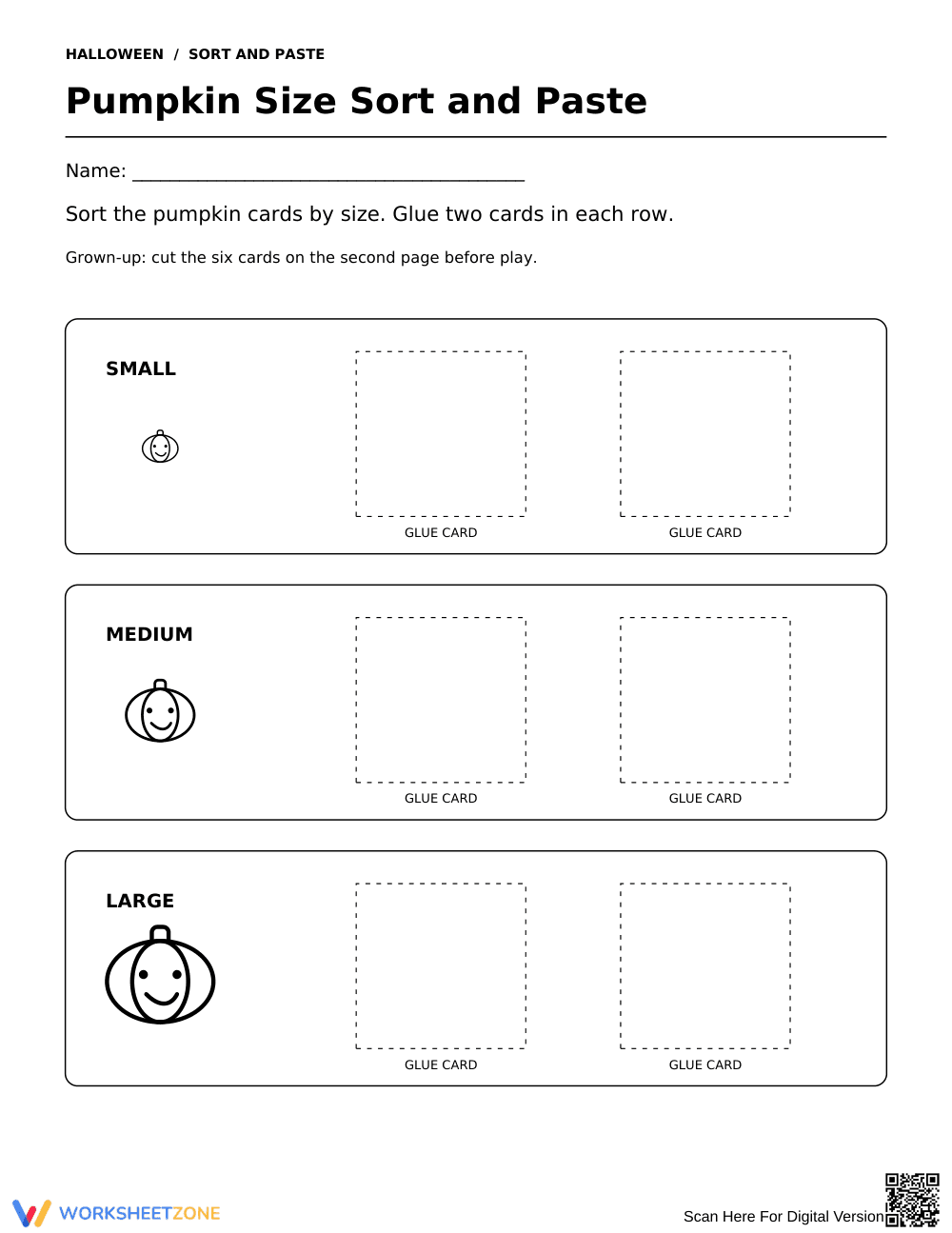
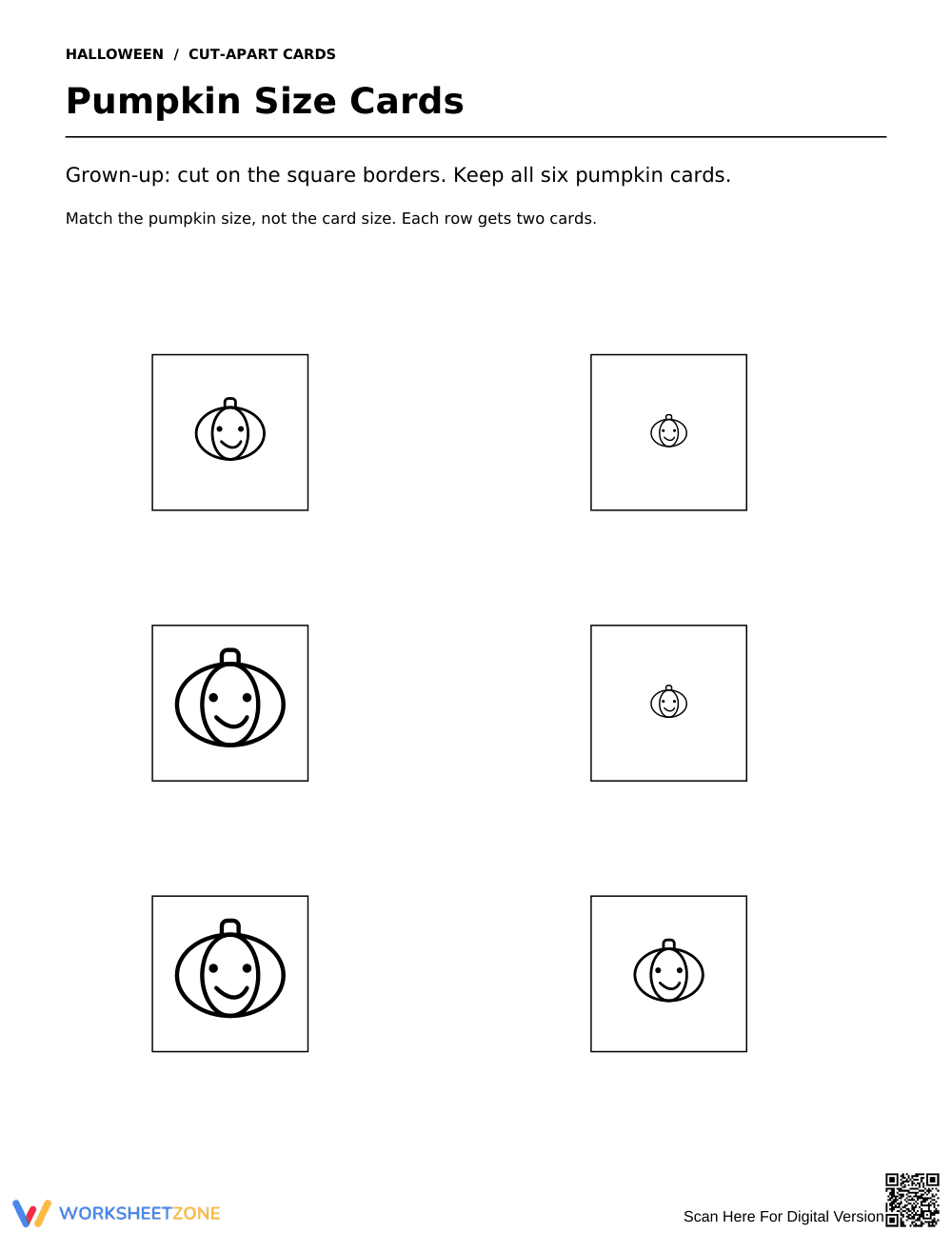
This hands-on sorting worksheet builds early measurement and classification skills by having kindergarten learners categorize festive pumpkins by relative scale. Students compare visual dimensions to sort six pumpkin cards into designated small, medium, and large rows, establishing foundational mathematical reasoning through concrete visual discrimination.
At a Glance
- Grade: Kindergarten · Subject: Early Math
- Standard:
CCSS.MATH.CONTENT.K.MD.B.3— Classify objects into given categories and sort by attributes- Skill Focus: Size classification and visual discrimination
- Format: 2 pages · 6 problems · Cut-and-paste sorting mat · PDF
- Best For: Fall math centers and guided practice
- Time: 15–20 minutes
What's Inside
This two-page printable activity features a structured sorting mat on the first page and six uniform cut-apart cards on the second page. The sorting board provides visual anchor icons alongside clear labels for small, medium, and large categories. Learners cut out the cards and match each pumpkin graphic to its corresponding category based on size rather than card perimeter.
Skill Progression
- Guided practice (2 items): Learners examine the anchor icons in each row to identify the baseline size reference with teacher modeling.
- Supported practice (2 items): Students compare medium-sized pumpkins against visual cues, receiving verbal prompts to verify proportional differences.
- Independent practice (2 items): Children sort and paste the remaining cards autonomously, verifying that exactly two items occupy each category box.
This structured layout applies the gradual-release framework, enabling young learners to transition smoothly from observation to independent classification.
Standards Alignment
Primary Standard: `CCSS.MATH.CONTENT.K.MD.B.3` — Classify objects into given categories; count the numbers of objects in each category and sort the categories by count. Supporting Standard: `CCSS.MATH.CONTENT.K.MD.A.2` emphasizes directly comparing two objects with a measurable attribute in common to see which object has more or less of the attribute. Both standard codes can be copied directly into lesson plans, IEP goals, or district curriculum mapping tools.
How to Use It
Deploy this activity during small-group instruction after introducing comparative size vocabulary, or place it in an independent fall math station. As students arrange their cards before pasting, observe whether they overlay the cards to physically measure dimensions or rely on visual scanning. The complete cut-and-paste activity typically takes 15 to 20 minutes to complete.
Who It's For
This printable resource is designed for preschool and kindergarten students developing foundational spatial awareness and fine motor cutting skills. For differentiated support, pre-cut the cards for learners with emerging motor control or pair this worksheet with physical plastic pumpkins for tactile comparison before completing the sorting sheet.
Kindergarten mathematics standards require young students to categorize objects into discrete groups based on measurable physical attributes, establishing early conceptual groundwork for data analysis and geometric reasoning. According to Fisher & Frey (2014), structured sorting tasks that transition smoothly from guided modeling to tactile manipulation significantly reinforce attribute recognition and foundational academic vocabulary retention in early childhood learners. This two-page instructional activity directly targets CCSS.MATH.CONTENT.K.MD.B.3 by challenging students to evaluate relative dimensions across six illustrated items and sort them into small, medium, and large categories. By isolating the size variable across uniform square cards, the visual exercise prevents perceptual confusion and ensures learners actively analyze size differences rather than outer card boundaries. Incorporating clear visual anchors alongside hands-on cut-and-paste tasks provides the scaffolded practice essential for mastering early classification benchmarks across diverse preschool and elementary classroom settings.


