


























Views
Downloads




Essential PSR Math Revision: Grade 6 Standards Aligned
Paste this activity's link or code into your existing LMS (Google Classroom, Canvas, Teams, Schoology, Moodle, etc.).
Students can open and work on the activity right away, with no student login required.
You'll still be able to track student progress and results from your teacher account.
This comprehensive revision worksheet ensures Grade 6 students achieve total mastery of core mathematical domains through a structured assessment format. By covering everything from decimal operations to geometric volume, this tool provides a clear diagnostic of student readiness for standardized testing. Students will demonstrate their proficiency across multiple-choice and constructed-response formats to ensure full curriculum coverage.
At a Glance
- Grade: 6 · Subject: Math
- Standard:
CCSS.MATH.CONTENT.6.NS.B.3— Fluently add, subtract, multiply, and divide multi-digit decimals using the standard algorithm- Skill Focus: Multi-Domain Math Revision
- Format: 4 pages · 40 problems · Answer key included · PDF
- Best For: End-of-unit review and standardized test preparation
- Time: 50–60 minutes
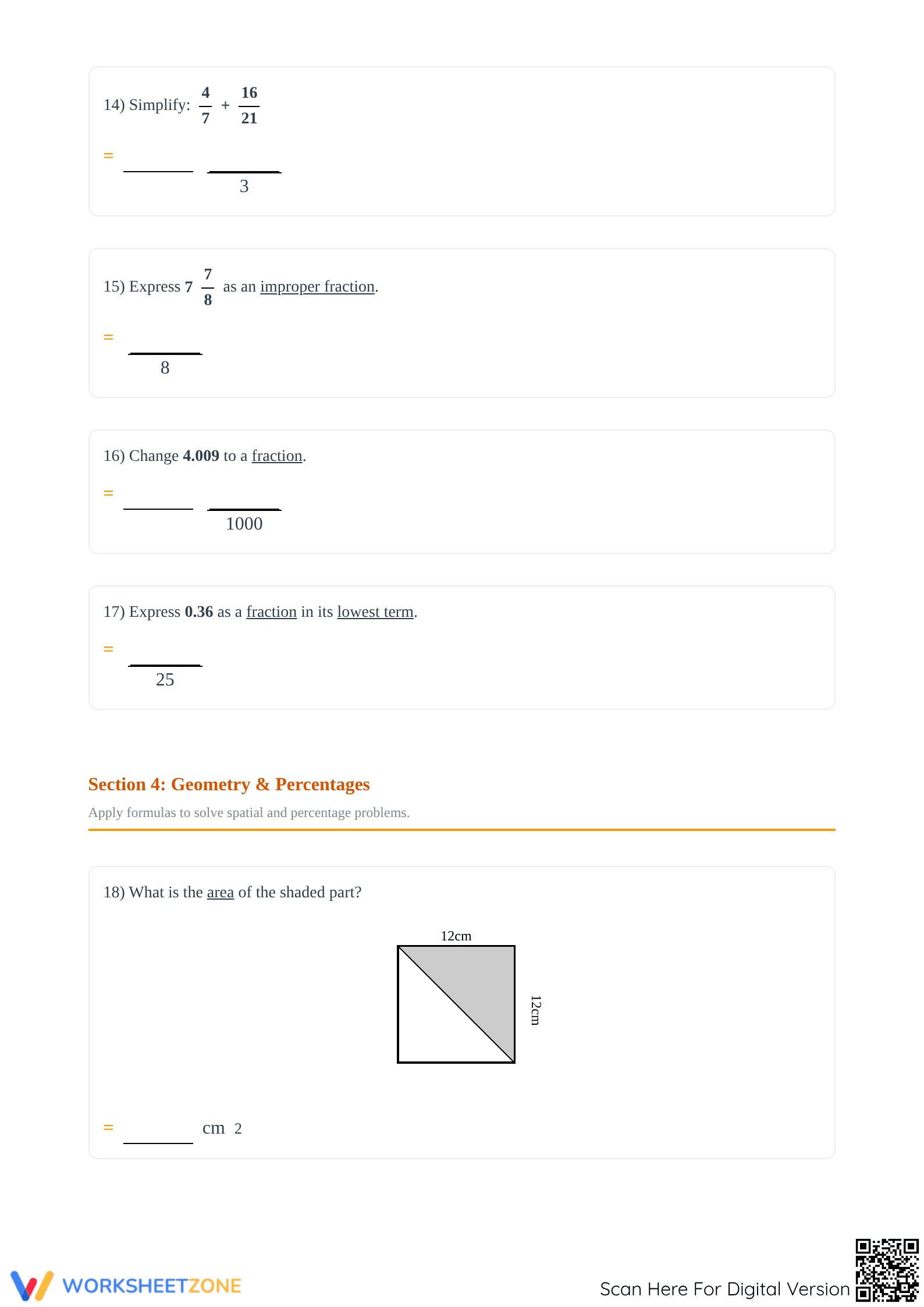
Inside this packet, you will find four high-density pages containing 40 total tasks. Section A features 20 multiple-choice questions that target rapid recall and conceptual recognition of place value, rounding, and percentages. Section B shifts to short-answer constructed responses, requiring students to show their work for complex multi-step problems involving ratios, speed, and algebraic expressions. The inclusion of a full answer key and rubric makes this a complete evaluative solution for any classroom.
Mastery Evidence
- Approaching: Student identifies basic operations and place values but struggles with multi-step word problems or geometric formulas.
- Meeting: Student accurately completes standard algorithms for decimals and fractions while correctly identifying angles and ratios.
- Exceeding: Student solves complex speed and volume problems with 100% accuracy and applies algebraic reasoning to novel situations.
Scores from these targeted sections can be entered directly into gradebooks or used to populate IEP progress notes, providing a data-driven snapshot of student performance levels before high-stakes exams.
This resource is strictly aligned to CCSS.MATH.CONTENT.6.NS.B.3: Fluently add, subtract, multiply, and divide multi-digit decimals using the standard algorithm for each operation. Additionally, it supports measurement and geometry standards by requiring the calculation of volume and perimeter. Both standard codes can be copied directly into lesson plans, IEP goals, or district curriculum mapping tools to ensure administrative compliance and instructional transparency.
For best results, use this worksheet as a summative assessment at the end of a revision cycle. It works exceptionally well during the "You Do" phase of a gradual release model, allowing teachers to observe student independence. While students work, circulate to identify common errors in decimal placement or rounding—a key formative observation tip that can guide the next day's targeted mini-lesson. Expect a completion time of approximately one hour.
This worksheet is designed for general education Grade 6 students, though it serves as an excellent challenge for Grade 5 or a necessary bridge for Grade 7 students needing remedial support. It pairs naturally with an anchor chart on the order of operations or a decimal conversion table. The varied task difficulty ensures that every learner has a path toward demonstrating their mathematical growth.
According to research from RAND AIRS 2024, the use of standards-aligned revision materials significantly correlates with higher scores on standardized assessments by reducing cognitive load during the actual testing window. This Grade 6 revision tool, aligned specifically to CCSS.MATH.CONTENT.6.NS.B.3, provides the exact type of retrieval practice recommended by Fisher & Frey (2014) for long-term retention of mathematical algorithms. By presenting 40 tasks across four pages, the worksheet forces students to switch between different cognitive domains—such as geometry, number sense, and algebra—which mirrors the rigor of state-level exams. Educational specialists note that constructed responses in Section B allow for better diagnostic tracking of student misconceptions compared to simple multiple-choice formats alone. Using these 40 problems as a benchmark ensures that instructional time is optimized for the specific sub-skills where students show the most significant gaps in mastery before the final assessment date.


