


























Views
Downloads
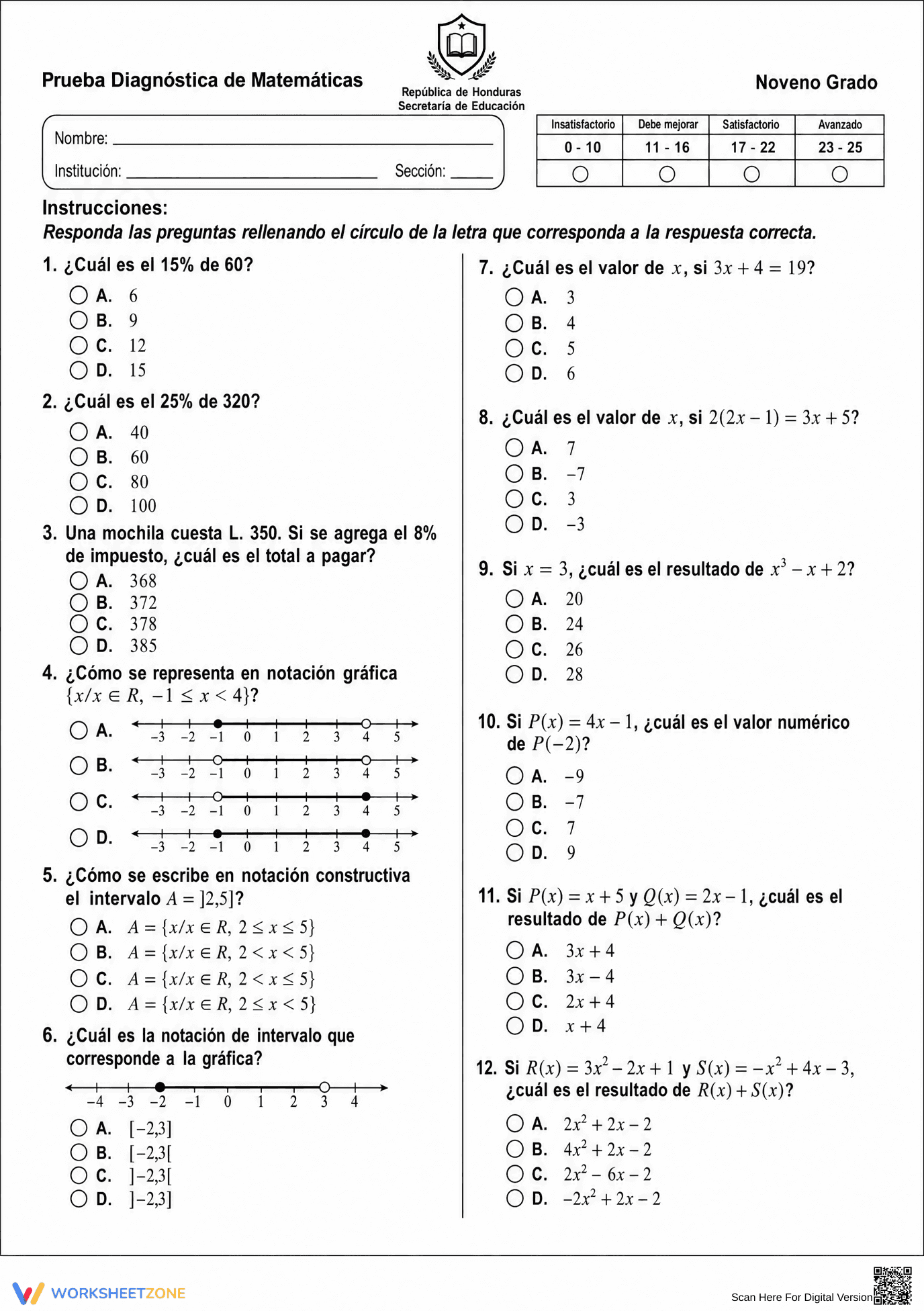

HSA-REI.B.3 Worksheet: Algebra Diagnostic — Grade 9 Aligned
Paste this activity's link or code into your existing LMS (Google Classroom, Canvas, Teams, Schoology, Moodle, etc.).
Students can open and work on the activity right away, with no student login required.
You'll still be able to track student progress and results from your teacher account.
This Spanish-language Grade 9 math diagnostic worksheet evaluates students' foundational algebra skills, ensuring they are prepared for high school mathematics. By assessing core competencies like solving linear equations, evaluating functions, and understanding interval notation, educators can pinpoint exact areas where students need targeted intervention or accelerated challenges.
At a Glance
- Grade: 9 · Subject: Math
- Standard:
HSA-REI.B.3— Solve linear equations and inequalities in one variable- Skill Focus: Algebra Fundamentals
- Format: 1 page · 12 problems · Spanish language · PDF
- Best For: Beginning-of-year assessment
- Time: 25–35 minutes
Inside this comprehensive diagnostic tool, educators will find 12 multiple-choice problems designed to test a variety of pre-algebra and algebra concepts. The task types range from calculating percentages and interpreting graphical inequalities to solving multi-step linear equations and adding polynomials. The worksheet features a built-in scoring header, allowing teachers to quickly categorize student performance into distinct proficiency levels.
This assessment is structured to provide clear evidence of student mastery across essential algebraic domains. The integrated rubric at the top of the page categorizes scores into four tiers: Unsatisfactory, Needs Improvement, Satisfactory, and Advanced. Each of the 12 tasks maps directly to critical sub-skills, from basic percentage calculations to complex polynomial operations. Because the scoring system is already formatted on the page, results can be entered directly into gradebooks or used to update IEP progress notes with minimal administrative overhead.
This diagnostic aligns primarily with HSA-REI.B.3, requiring students to solve linear equations and inequalities in one variable, including equations with coefficients represented by letters. It also touches upon foundational polynomial operations and function evaluation. Both standard codes can be copied directly into lesson plans, IEP goals, or district curriculum mapping tools.
Deploy this worksheet during the first week of a Grade 9 algebra course to establish a baseline of student knowledge before direct instruction begins. As students work through the problems, observe their approach to interval notation and polynomial addition to identify common misconceptions early. It is also highly effective as a mid-year formative assessment to measure growth. Expect students to complete this diagnostic within a 25 to 35-minute window.
This resource is specifically designed for ninth-grade students enrolled in Algebra I or foundational high school math courses, particularly in bilingual or Spanish-speaking classrooms. The clear multiple-choice format provides built-in scaffolding for English Language Learners (ELLs) who are testing their math content knowledge in their native language. It pairs perfectly with introductory algebra anchor charts or a comprehensive review lesson on linear equations.
Integrating structured diagnostic assessments aligned to HSA-REI.B.3 is critical for ensuring students can successfully solve linear equations and inequalities in one variable. According to EdReports 2024, utilizing clear, standards-aligned formative assessments at the beginning of instructional units significantly improves targeted intervention strategies and overall student outcomes in secondary mathematics. By identifying specific knowledge gaps in foundational algebra concepts—such as interval notation and polynomial operations—educators can tailor their instruction to meet diverse learner needs. This Spanish-language diagnostic tool provides the exact data required to implement these evidence-based instructional adjustments. Regular use of such targeted evaluations ensures that all students maintain a trajectory toward mathematical proficiency and high school graduation requirements.


