


























Views
Downloads

Proven Transform Errors Worksheet | Grade 12 Precalculus
Paste this activity's link or code into your existing LMS (Google Classroom, Canvas, Teams, Schoology, Moodle, etc.).
Students can open and work on the activity right away, with no student login required.
You'll still be able to track student progress and results from your teacher account.
This Grade 12 Precalculus worksheet trains students to isolate, critique, and correct complex transformation-order mistakes and domain fallacies across polynomial, radical, rational, and transcendental functions. By diagnosing flawed student claims and reconstructing canonical forms, learners solidify rigorous analytical precision and eliminate habitual errors before entering college-level calculus coursework.
At a Glance
- Grade: 12 · Subject: Precalculus
- Standard:
HSF-BF.B.3— Identify transformation effects on parent graphs and determine correct domain constraints.- Skill Focus: Correct Transformation-Order and Domain Errors
- Format: 5 pages · 10 problems · Answer key included · PDF
- Best For: Advanced precalculus error analysis and review
- Time: 45–60 minutes
What's Inside
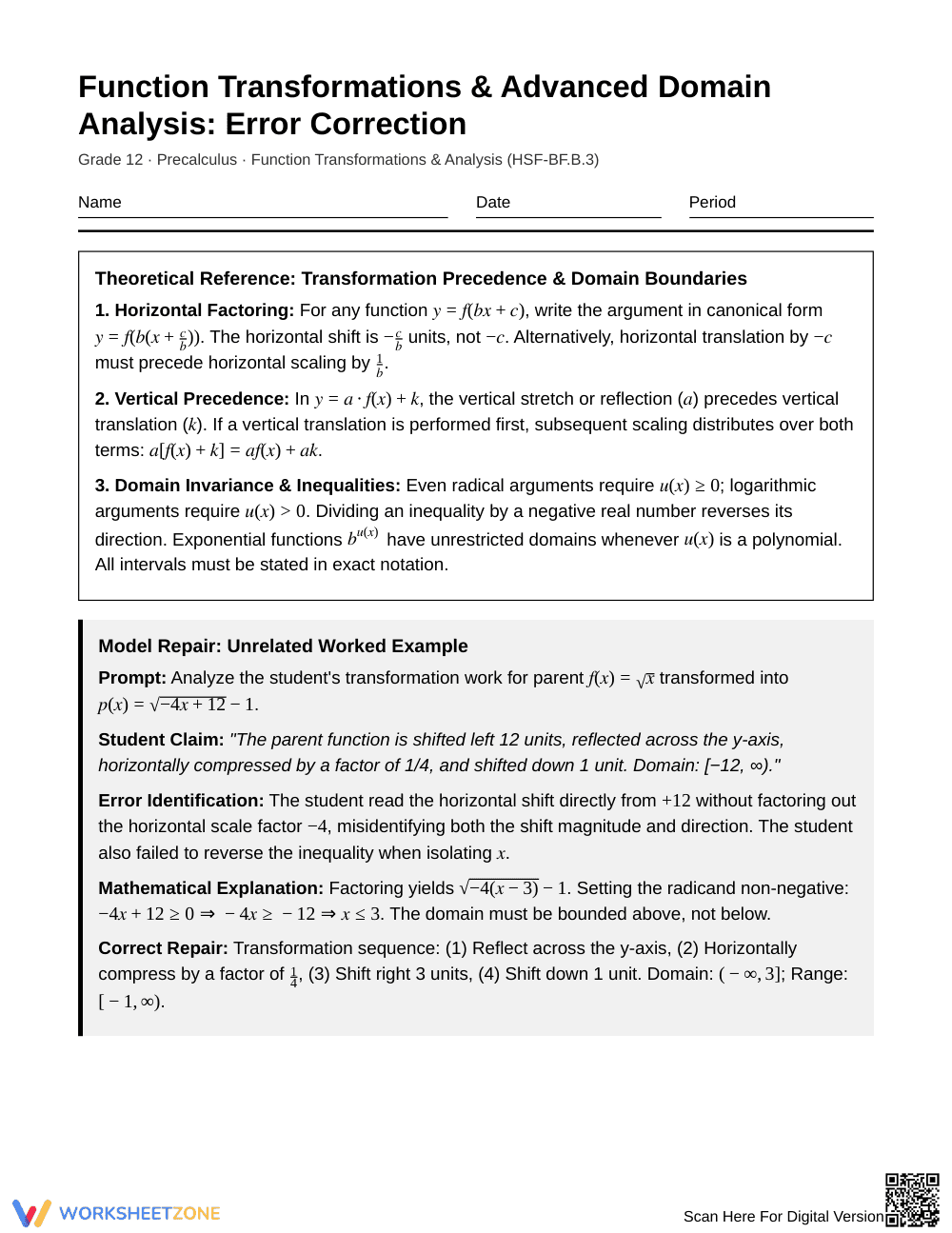
The 5-page student document opens with a theoretical reference guide reviewing horizontal factoring, vertical precedence, and inequality reversal, followed by a fully worked model repair. Ten rigorous error-analysis prompts span three specialized sections, accompanied by a comprehensive 3-page answer key detailing algebraic proofs, factored canonical forms, corrected coordinate mappings, and interval notations.
Skill Progression
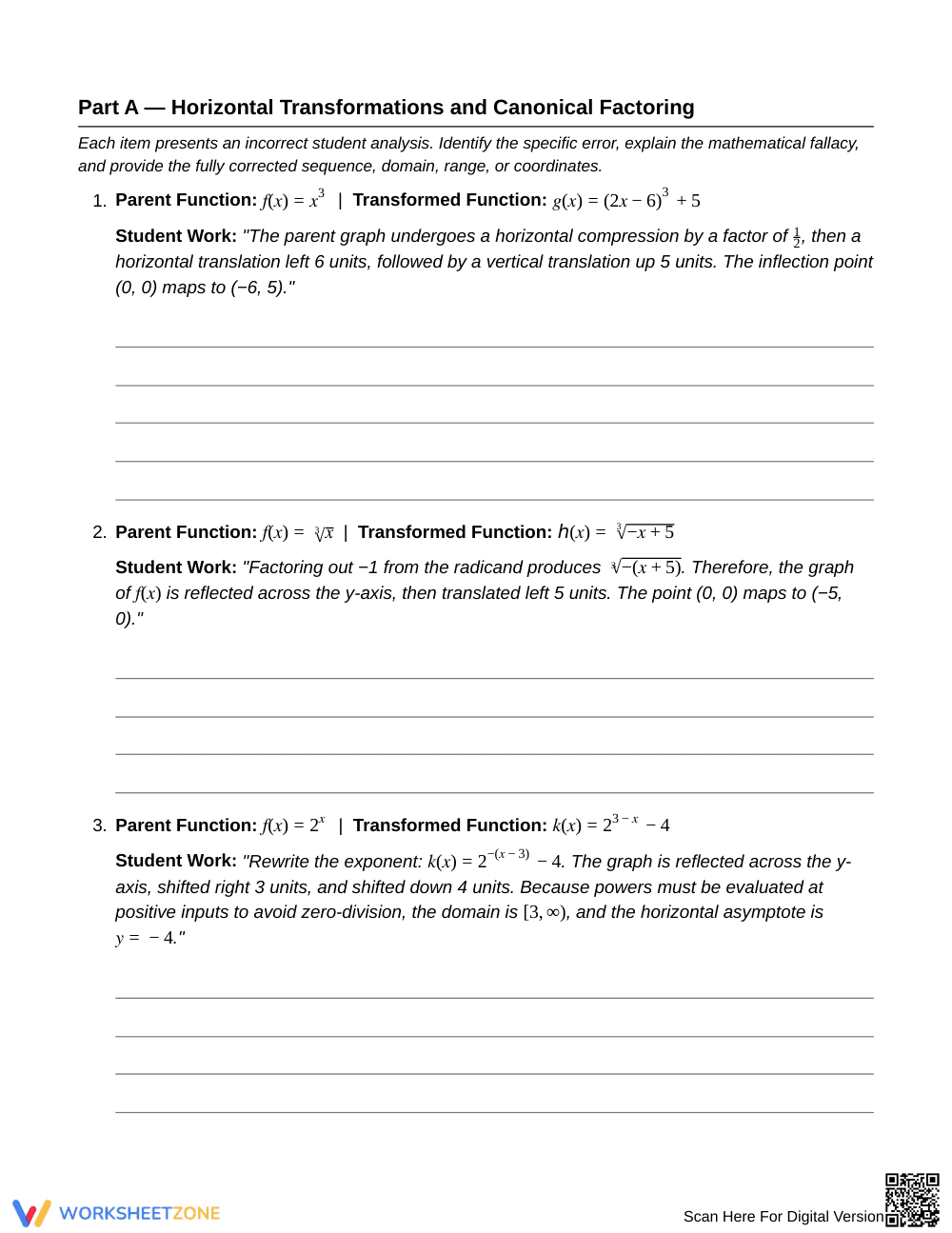
- Guided practice (Part A, 4 problems): Students critique horizontal shifts and horizontal scalings, factoring out horizontal coefficients into canonical form to repair misstated shift directions and polynomial inflection points.
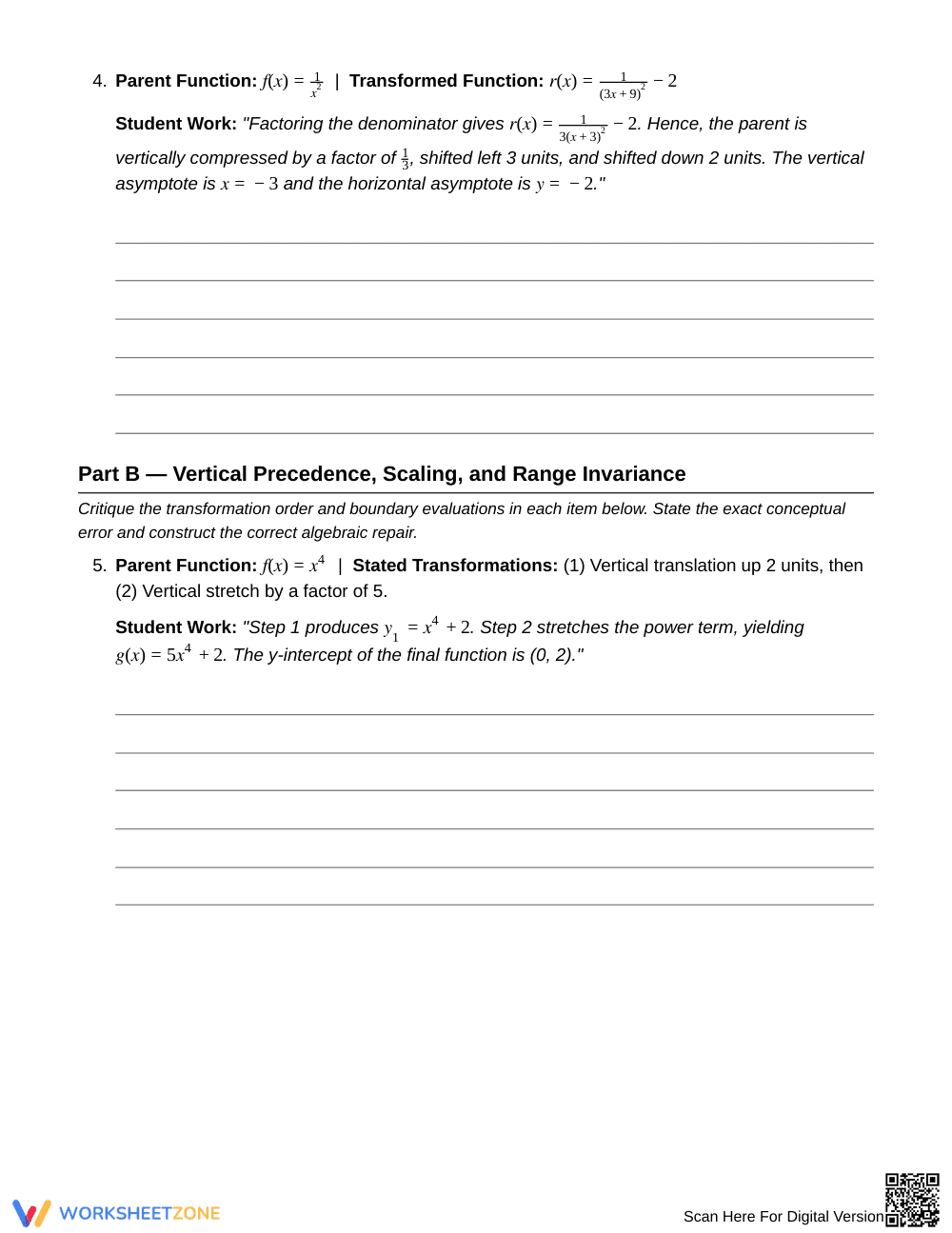
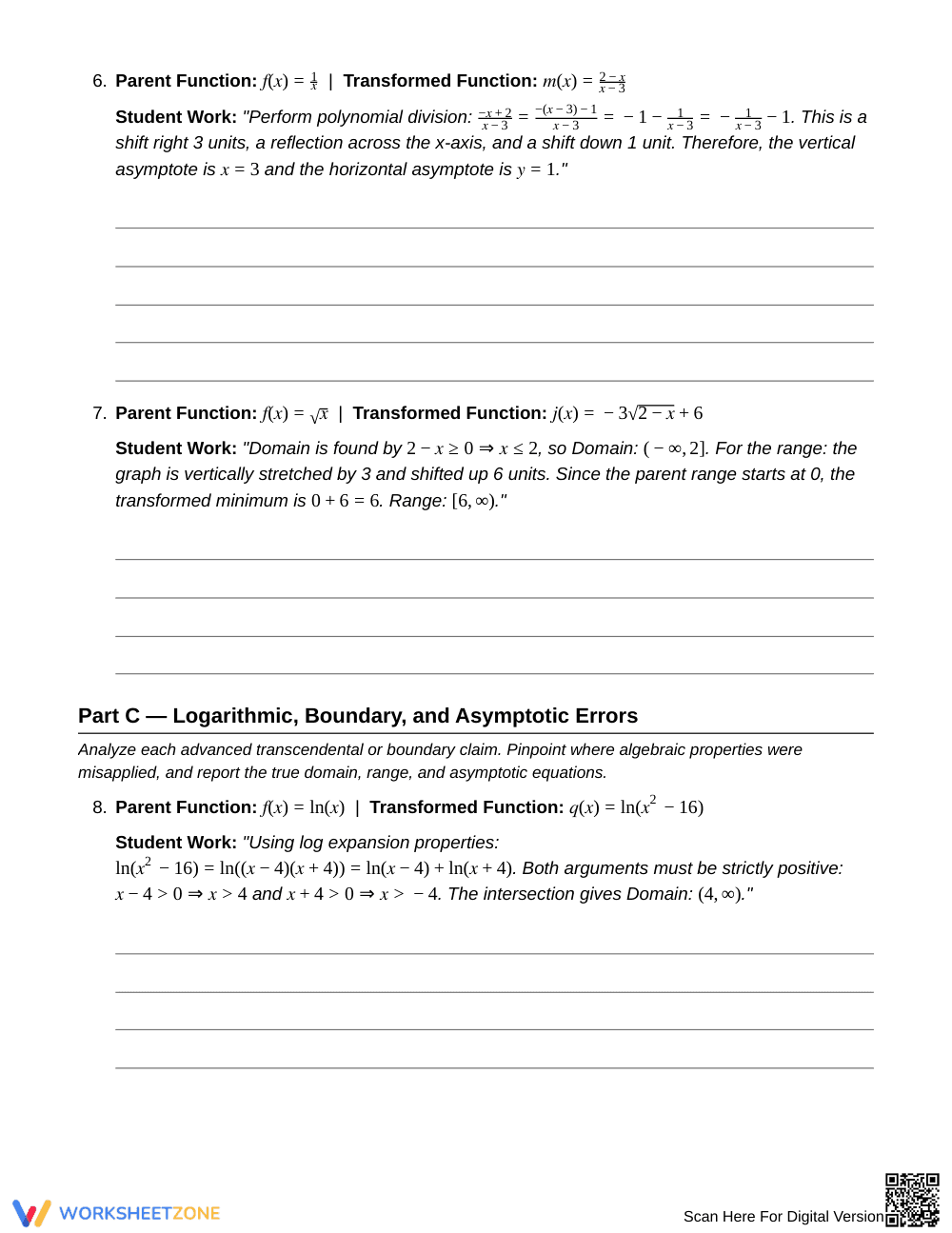
- Supported practice (Part B, 3 problems): Students evaluate vertical transformation precedence, distribution of vertical stretches over vertical translations, and non-intuitive range shifts involving reflected radical and rational graphs.
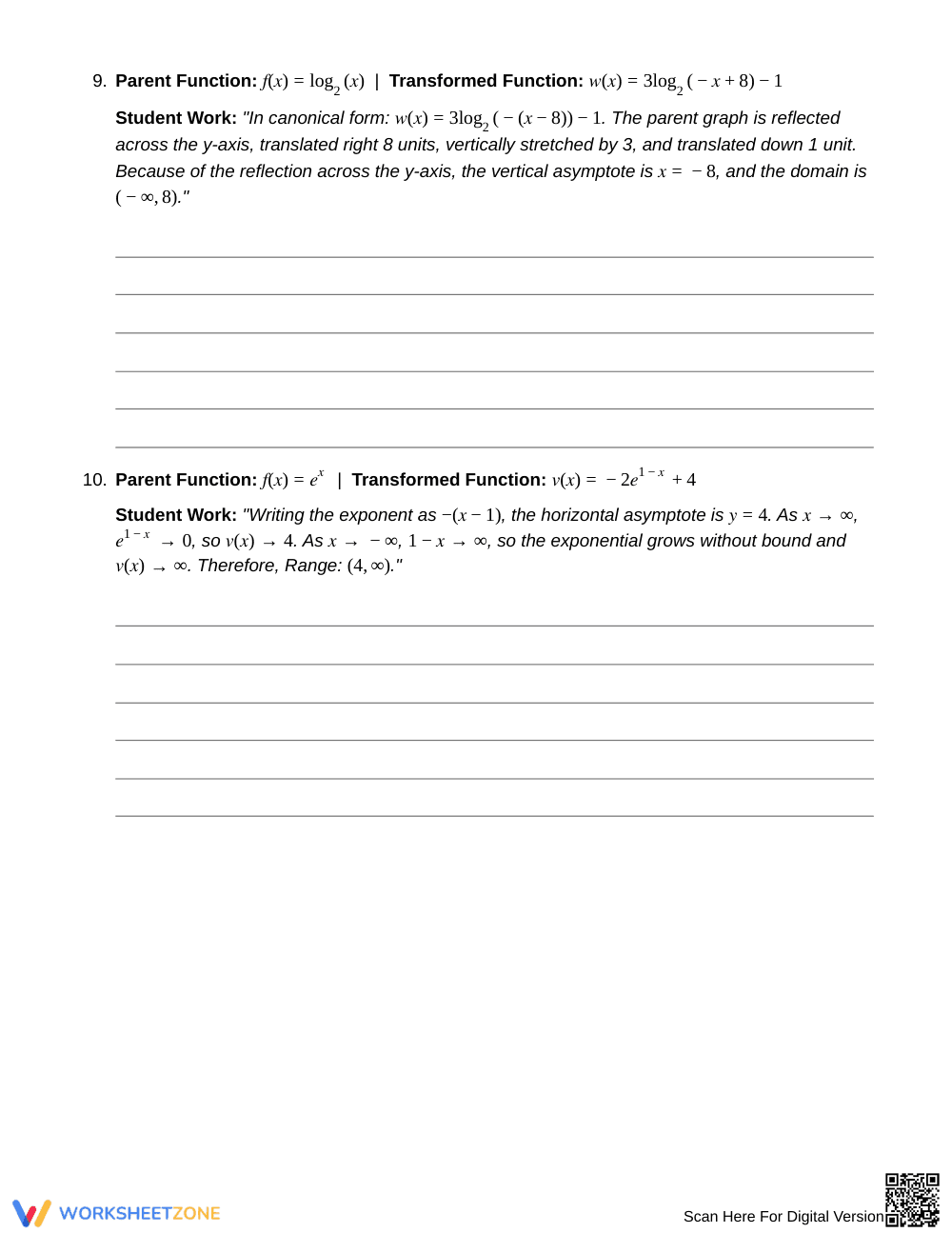
- Independent practice (Part C, 3 problems): Students tackle advanced transcendental relations, untangling logarithmic arguments, exponential asymptotic bounds, and compound inequalities that require sign reversal.
This gradual-release progression moves students from scaffolded canonical factoring to independent transcendental proofs.
Standards Alignment
This worksheet directly aligns to HSF-BF.B.3: "Identify the effect on the graph of replacing f(x) by f(x) + k, k f(x), f(kx), and f(x + k) for specific values of k." It also supports HSF-IF.B.5 by requiring students to relate calculated domains to composite functions. Both standard codes can be copied directly into lesson plans, IEP goals, or district curriculum mapping tools.
How to Use It
Deploy this activity after direct instruction on horizontal factoring and transformations, before unit summative tests. Facilitate peer critique in pairs or assign individual error repairs during a 45- to 60-minute block. For formative assessment, examine whether students distribute vertical stretches over prior translations in Part B, or if they misapply radical and logarithmic inequalities.
Who It's For
This resource serves Grade 12 Precalculus and Honors Algebra II students preparing for AP Calculus. It provides structured analytical intervention for learners prone to sign errors in horizontal transformations. Pair this worksheet directly with a parent-function graph gallery or transformation reference sheet for targeted scaffolding.
Mastering function transformations under standard HSF-BF.B.3 requires students to discern how algebraic modifications reshape parent graphs, especially when horizontal factoring dictates shift direction and scaling order. Research by Fisher & Frey (2014) underscores that structured error analysis accelerates mathematical reasoning by prompting students to articulate the conceptual rationale behind procedural errors rather than merely repeating mechanical algorithms. In this Grade 12 Precalculus resource, learners critique authentic student misconceptions across 10 multi-part prompts, diagnosing why premature translations distort function behavior. By rewriting arguments in canonical factored form, calculating exact asymptotic boundaries, and adjusting inequality directions during radical and logarithmic domain evaluations, students transform fragile procedural recall into robust analytical mastery. This systematic approach ensures learners evaluate functions critically, verify algebraic boundary conditions accurately, and build the prerequisite fluency required for advanced limit calculations and differential calculus.


