




























Views
Downloads



Proven Sinusoid Modeling Worksheet | Grade 12 Precalculus

Paste this activity's link or code into your existing LMS (Google Classroom, Canvas, Teams, Schoology, Moodle, etc.).
Students can open and work on the activity right away, with no student login required.
You'll still be able to track student progress and results from your teacher account.
This Grade 12 Precalculus worksheet equips students to construct sinusoidal functions from extrema and timing constraints. Learners analyze real-world periodic contexts—including ocean tides, thermal cycles, and mechanical oscillations—to derive amplitude, midline, period, and phase shifts analytically. The rigorous progression ensures students master periodic modeling and function parameterization with algebraic precision.
At a Glance
- Grade: 12 · Subject: Precalculus
- Standard:
HSF-TF.B.5— Model periodic relationships using amplitude, frequency, and midline- Skill Focus: Construct a Sinusoid from Extrema and Timing Constraints
- Format: 4 pages · 6 problems · Answer key included · PDF
- Best For: Periodic modeling and trigonometry assessment
- Time: 45–60 minutes
What's Inside
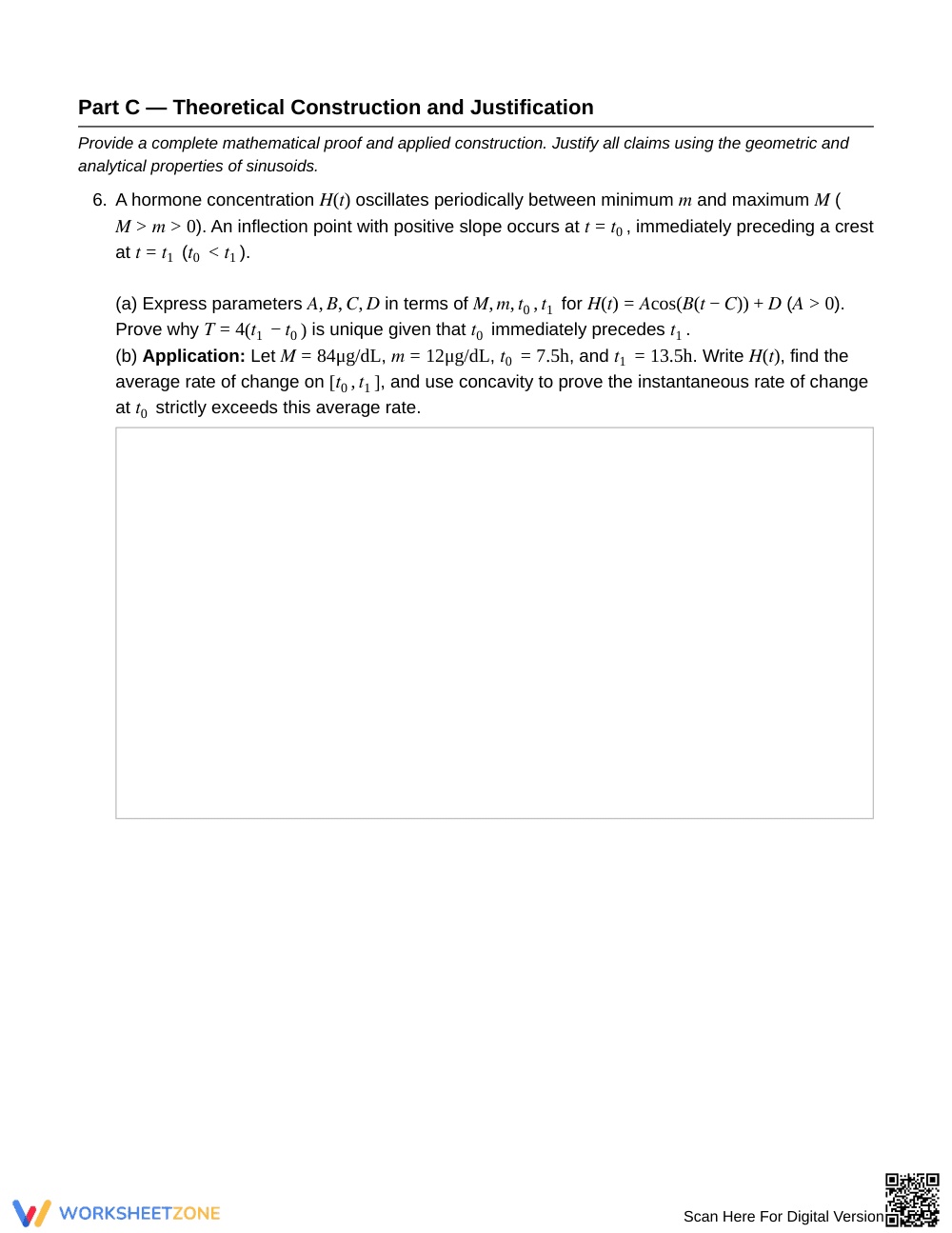
The 4-page worksheet includes a reference box of parameter formulas, followed by 6 multi-step problems spanning tidal data, greenhouse temperatures, mechanical piston displacement, alternating voltage, and buoy motion. It concludes with a theoretical proof and rate-of-change analysis, supported by a 3-page worked solution key.
Skill Progression
- Guided practice (Part A, Problems 1–2): Structured tasks guide students to extract amplitude, midline, period, and phase shifts from given extrema before evaluating secondary values.
- Supported practice (Part B, Problems 3–5): Independent scenarios prompt students to isolate timing constraints, interpret multi-cycle extrema, and solve interval inequalities.
- Independent practice (Part C, Problem 6): An advanced theoretical challenge requires general symbolic parameter derivations and concavity proofs.
This sequence implements a gradual-release model, moving learners from guided constraint extraction to autonomous algebraic proof.
Standards Alignment
This worksheet aligns directly with HSF-TF.B.5: Choose trigonometric functions to model periodic phenomena with specified amplitude, frequency, and midline. Additionally, it supports HSF-BF.A.1 by having students build functions that model contextual relationships. Both standard codes can be copied directly into lesson plans, IEP goals, or district curriculum mapping tools.
How to Use It
Assign this worksheet after direct instruction on sinusoidal transformations. Use Part A for collaborative paired practice, then assign Parts B and C for independent mastery. For formative assessment, verify whether students recognize that two subsequent crests represent two complete periods in Problem 5. Expected completion time is 45 to 60 minutes.
Who It's For
This resource serves Grade 12 Precalculus and Trigonometry students preparing for calculus-level modeling. Differentiate by providing an annotated transformation reference for struggling students, or challenge advanced learners to complete Part C entirely without numerical scaffolding. Pair this worksheet with an interactive graphing simulation on harmonic motion.
According to research from Fisher & Frey (2014) on effective instructional scaffolding, student achievement in advanced mathematical problem-solving increases significantly when complex modeling tasks follow a purposeful gradual-release structure. This 4-page Precalculus worksheet targets HSF-TF.B.5 by directing Grade 12 students to construct sinusoidal functions from extrema and timing constraints across 6 multi-step problems. Students begin with explicit parameter derivations for real-world tidal and thermal oscillations, progress to multi-step engineering applications involving interval inequalities, and conclude with general analytical proofs. Grounding abstract periodic parameters like angular frequency and horizontal shift in tangible physical constraints ensures durable conceptual understanding rather than rote formula substitution. The included step-by-step 3-page answer key provides transparent worked solutions, making this resource an effective tool for rigorous modeling instruction, formative evaluation, and standards-aligned assessment in secondary mathematics curricula across diverse classroom settings.


