




























Views
Downloads



Proven Phase Shift Errors Worksheet | Grade 12 Precalculus

Paste this activity's link or code into your existing LMS (Google Classroom, Canvas, Teams, Schoology, Moodle, etc.).
Students can open and work on the activity right away, with no student login required.
You'll still be able to track student progress and results from your teacher account.
Mastering sinusoidal transformations requires diagnosing algebraic and graphical pitfalls. This Precalculus worksheet equips Grade 12 students to analyze, explain, and correct frequent misconceptions in trigonometric phase shifts and angular frequencies. Across 10 rigorous error-analysis prompts, learners solidify their understanding of period formulas, horizontal factoring, and sinusoidal modeling.
At a Glance
- Grade: 12 · Subject: Precalculus
- Standard: Graph trigonometric functions and determine period, frequency, and phase shift transformations accurately
- Skill Focus: Correct Phase-Shift and Frequency Errors
- Format: 5 pages · 10 problems · Answer key included · Printable PDF
- Best For: Advanced error correction, transformation mastery, and exam review
- Time: 45–60 minutes
What's Inside
This 5-page worksheet provides 10 error-analysis tasks across two distinct parts. It opens with standard definitions and a worked model showing the three-step correction protocol: locate, explain, and correct. Part A delivers 5 algebraic prompts targeting horizontal factoring and symmetry. Part B presents 5 contextual modeling scenarios using tides, springs, and graphs. A 2-page detailed answer key provides complete mathematical corrections.
Skill Progression
- Guided practice (Model): Students review standard formulas and an annotated worked example illustrating how to locate false periods, explain missing factorizations, and write accurate corrections.
- Supported practice (Part A, Problems 1–5): Learners analyze 5 algebraic prompts, isolating misconceptions in factored forms, horizontal stretches, and symmetry with prompt scaffolding.
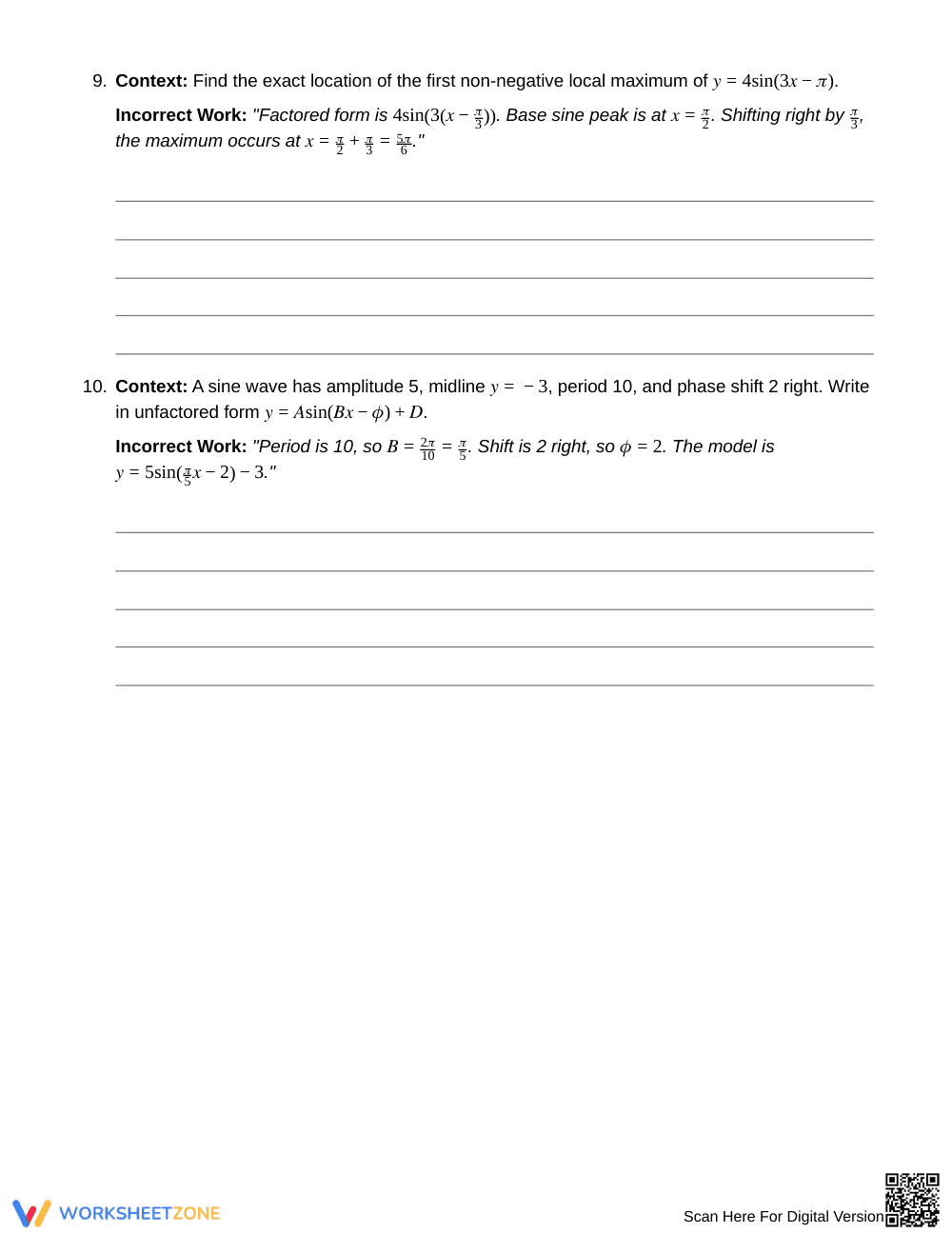
- Independent practice (Part B, Problems 6–10): Students critique 5 applied problems independently, resolving errors in tide equations, harmonic motion, and wave extrema without hints.
This sequence follows a gradual-release framework, moving learners from guided error analysis to independent critique.
Standards Alignment
This worksheet addresses advanced Precalculus standards requiring students to graph trigonometric functions and analyze period, midline, amplitude, and phase shift transformations. Students critique mathematical reasoning by analyzing factored versus unfactored sinusoidal arguments. Both standard codes can be copied directly into lesson plans, IEP goals, or district curriculum mapping tools.
How to Use It
Use this resource after direct instruction on horizontal sinusoidal transformations. Assign Part A for paired review, allowing students to discuss algebraic errors. Use Part B as an individual checkpoint for modeling. Formatively observe whether students set inner arguments to zero or mistakenly extract shifts without factoring. Completion takes 45 to 60 minutes.
Who It's For
This activity suits Grade 12 Precalculus students and advanced Algebra II students preparing for AP Calculus. It supports students who confuse period with angular frequency and stretches high performers. Pair this worksheet with an anchor chart detailing standard sinusoidal forms.
According to Fisher & Frey (2014), engaging students in structured error analysis fosters deeper metacognitive awareness and solidifies conceptual mastery across complex STEM domains. In advanced secondary mathematics, identifying and correcting misconceptions surrounding trigonometric phase shifts and frequency values is critical for developing mathematical fluency. When learners evaluate non-factored sinusoidal expressions, such as failing to factor the horizontal scale coefficient out of the argument, they confront the root causes of procedural missteps rather than merely memorizing algorithmic formulas. This Grade 12 Precalculus worksheet implements targeted error-correction protocols across 10 structured tasks, requiring students to isolate misconceptions, articulate mathematical explanations, and compute precise transformed values. By systematically bridging theoretical graph transformations and contextual wave modeling, this resource ensures students cultivate rigorous analytical habits, supporting sustained achievement in higher-level calculus coursework and standardized mathematical assessments.


