


























Views
Downloads




Proven pH Prediction Defense Worksheet | Grade 11 Chemistry
Paste this activity's link or code into your existing LMS (Google Classroom, Canvas, Teams, Schoology, Moodle, etc.).
Students can open and work on the activity right away, with no student login required.
You'll still be able to track student progress and results from your teacher account.
This Grade 11 Chemistry worksheet prepares students to construct rigorous, evidence-based justifications for aqueous solution pH calculations. Learners evaluate thermodynamic constants, test the mathematical defensibility of simplifying modeling assumptions such as the 5% rule, and refute common conceptual misconceptions regarding acid-base equilibrium.
At a Glance
- Grade: 11 · Subject: Chemistry
- Standard:
Acids & Bases Equilibrium— Calculate pH and justify chemical assumptions in equilibrium systems- Skill Focus: Defend a pH Prediction with Assumptions
- Format: 6 pages · 8 problems · Answer key included · PDF
- Best For: Advanced chemistry unit review and AP prep
- Time: 45–60 minutes
What's Inside
This comprehensive 6-page printable worksheet features 8 multi-tiered equilibrium problems divided into three analytical stages. It includes a reference box of thermodynamic constants, conductivity and pH data comparison tables, equilibrium expression calculations, and an extensive 4-page detailed answer key with complete mathematical derivations.
Skill Progression
- Guided Practice (Part A, 2 tasks): Students analyze empirical data tables comparing electrical conductivity and pH to differentiate strong versus weak acids, identifying controlled variables and distinguishing solute concentration from acid strength.
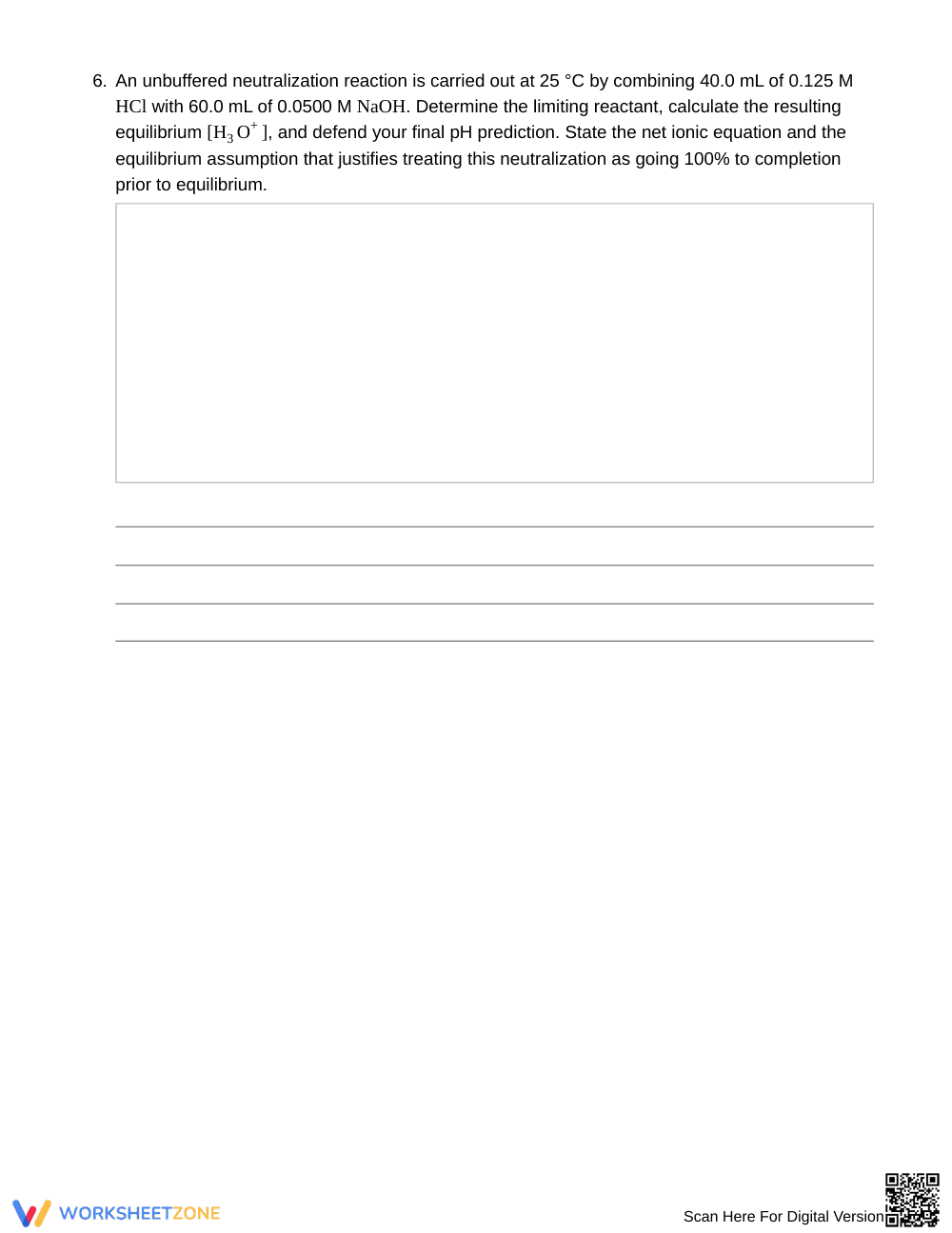
- Supported Practice (Part B, 4 tasks): Learners calculate hydronium concentration, pOH, and pH across weak acids, strong diprotic bases, weak bases, and unbuffered neutralization reactions while explicitly validating mathematical assumptions via the 5% rule.
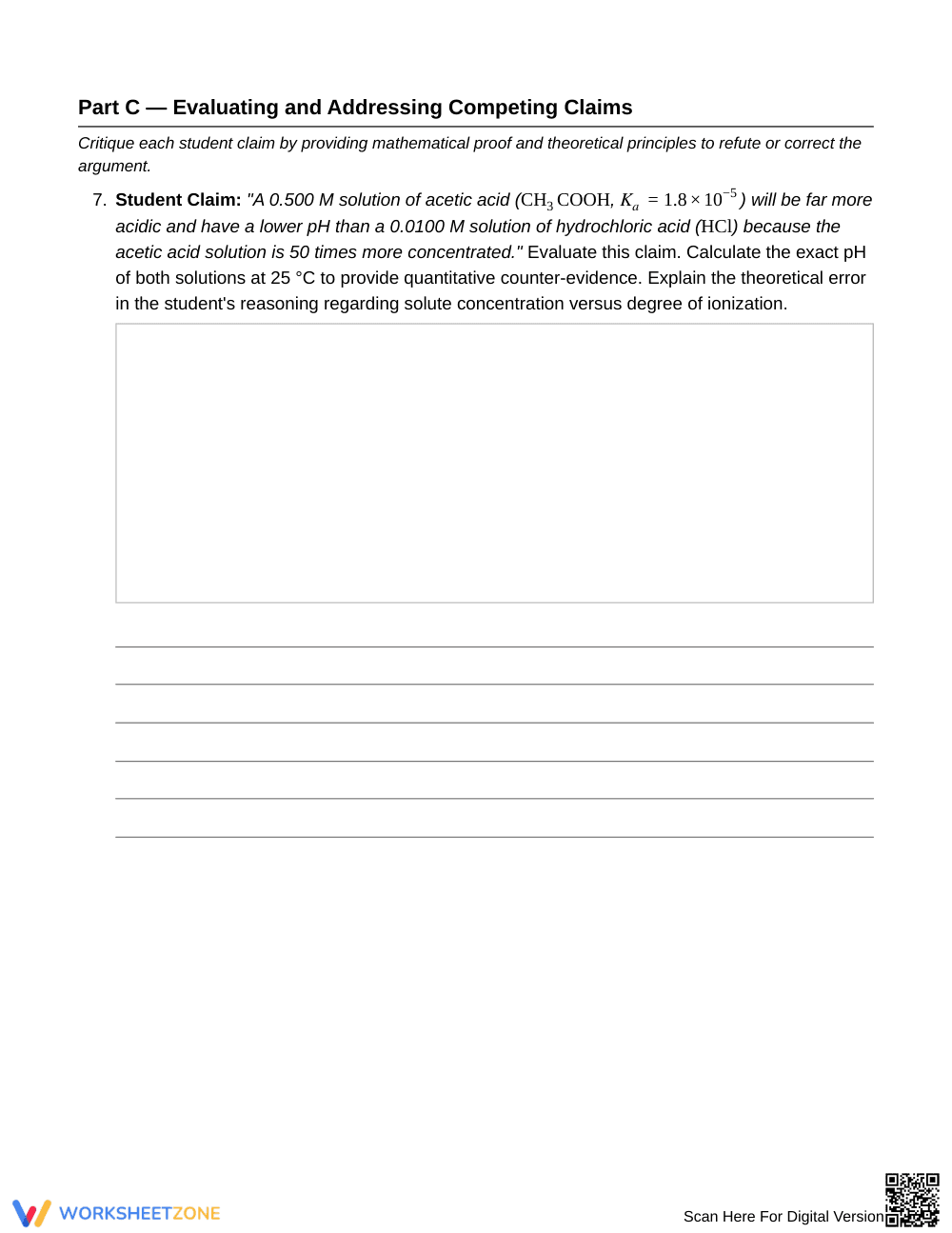
- Independent Practice (Part C, 2 tasks): Students critique and refute authentic student misconceptions, using quantitative proofs to disprove claims regarding concentration versus acid strength and water autoionization in ultra-dilute acids.
This structured progression reflects the gradual release of responsibility framework, moving learners from empirical evidence identification to independent theoretical critique.
Standards Alignment
This resource aligns with advanced high school chemistry standards governing chemical equilibrium, acid ionization constants ($K_a$), base ionization constants ($K_b$), and the autoionization of water ($K_w$). Students formulate mathematical models of dynamic equilibrium and evaluate the validity of boundary approximations. The standard learning objectives can be copied directly into lesson plans, IEP goals, or district curriculum mapping tools.
How to Use It
Deploy this worksheet after direct instruction on weak acid-base equilibria and ICE tables. During the lesson, circulate while students complete Part B to verify that they test percent ionization rather than blindly applying the 5% rule approximation. It functions effectively as a collaborative small-group problem set or an individual summative assessment, requiring 45 to 60 minutes for completion.
Who It's For
Designed for Grade 11 Honors Chemistry and Advanced Placement Chemistry students mastering aqueous ionic equilibria. Pair this worksheet with an interactive titration laboratory or an equilibrium modeling anchor chart to reinforce theoretical calculations with physical observations.
Fisher & Frey (2014) demonstrate that structured cognitive scaffolding through guided problem-solving accelerates procedural mastery in quantitative science disciplines. This worksheet targets the core analytical skill of defending aqueous pH predictions by requiring students to justify mathematical approximations against empirical boundaries. By confronting common student errors directly—such as calculating a basic pH for an ultra-dilute strong acid—learners develop robust conceptual frameworks that link Le Chatelier's principle and thermodynamic constants to real-world solution behavior. Incorporating explicit verification of the 5% rule and stoichiometric reaction mechanisms ensures students build rigorous scientific reasoning habits. The 8 structured tasks and comprehensive 4-page answer key provide the evidentiary feedback loop necessary for measurable gains in high school chemical equilibrium proficiency.


