




























Views
Downloads




Proven Nonconsecutive Terms Worksheet | Grade 11 Algebra II

Paste this activity's link or code into your existing LMS (Google Classroom, Canvas, Teams, Schoology, Moodle, etc.).
Students can open and work on the activity right away, with no student login required.
You'll still be able to track student progress and results from your teacher account.
This Grade 11 Algebra II worksheet trains students to infer explicit arithmetic and geometric rules from nonconsecutive terms. High school learners analyze given term pairs, solve for fundamental parameters such as common differences and ratios, and construct generalized formulas to evaluate higher-order series and real-world models with mathematical precision.
At a Glance
- Grade: 11 · Subject: Algebra II
- Standard:
HSF-LE.A.2— Construct linear and exponential functions given nonconsecutive terms or input-output pairs- Skill Focus: Infer a Rule from Nonconsecutive Terms
- Format: 5 pages · 14 problems · Answer key included · PDF
- Best For: Advanced skill practice and test review
- Time: 45–60 minutes
What's Inside
The 5-page worksheet includes 14 multi-step problems organized into three sections with a reference formula box. Students determine explicit formulas, complete tables, calculate finite partial sums, compare financial growth models, and solve algebraic constraint puzzles. A 4-page answer key provides complete derivations and solutions.
Skill Progression
- Guided Practice (Problems 1–4): Students find common parameters (a_1, d, g_1, r) and write explicit rules from given term pairs.
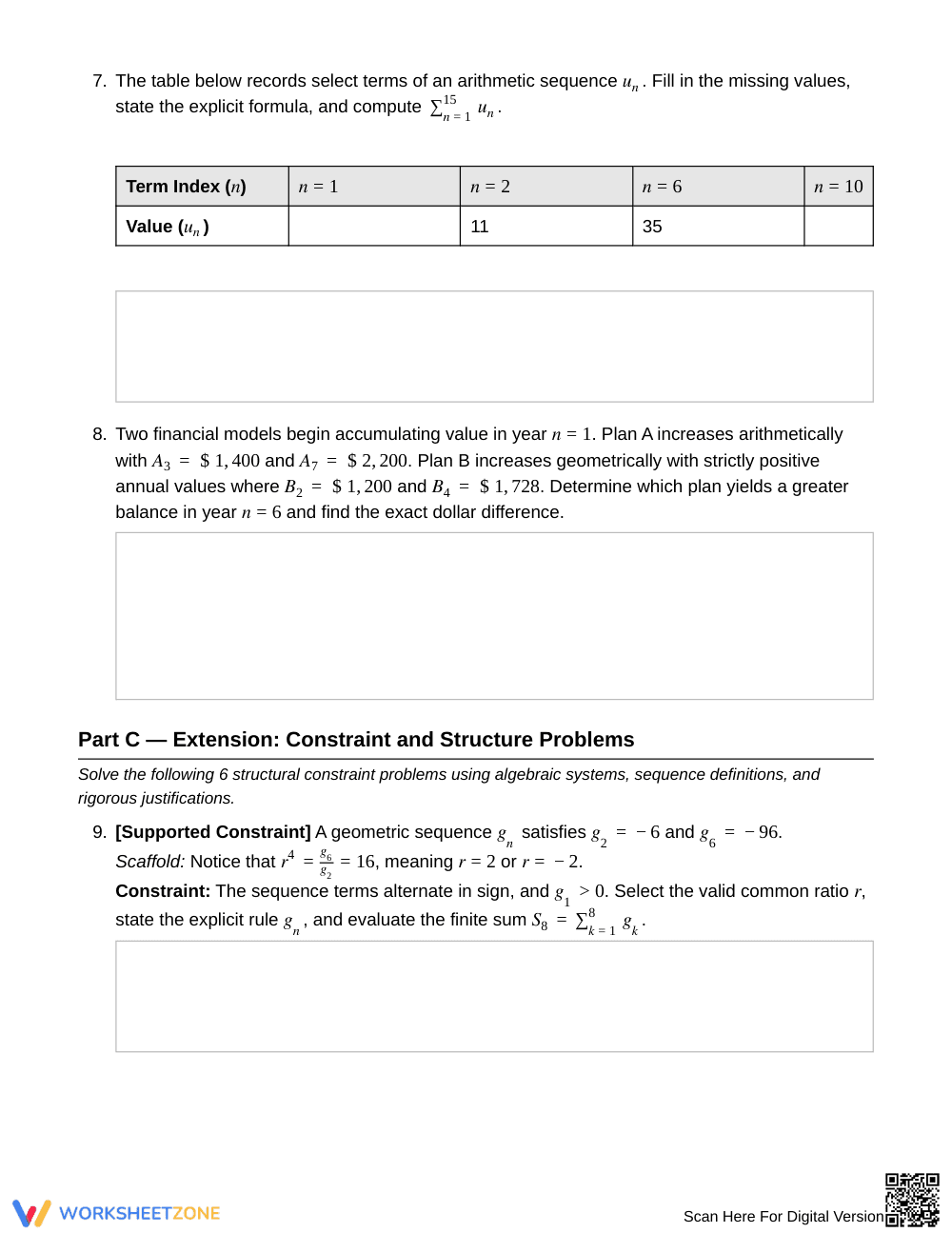
- Supported Practice (Problems 5–8): Learners evaluate partial sums, complete tabular sequences, and compare arithmetic and geometric growth in financial contexts.
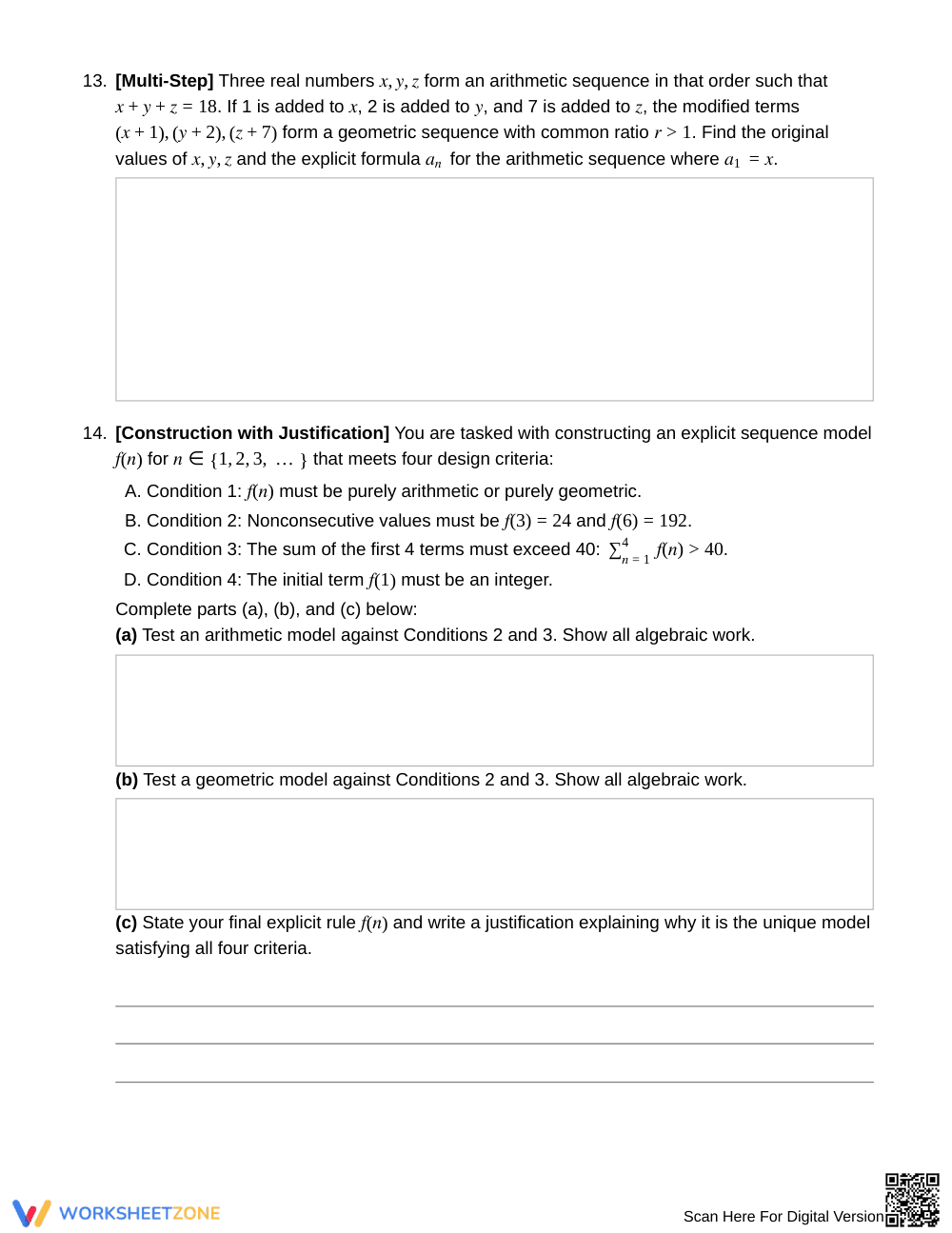
- Independent Practice (Problems 9–14): Students solve constraint puzzles, systems of sequence equations, and multi-step model justifications.
This sequence follows a gradual-release model, moving from guided formula application to independent structural analysis.
Standards Alignment
This worksheet aligns with primary standard HSF-LE.A.2: Construct linear and exponential functions, including arithmetic and geometric sequences, given two input-output pairs. It also supports HSA-CED.A.1 through creating equations in one variable to solve for term indices. Both standard codes can be copied directly into lesson plans, IEP goals, or district curriculum mapping tools.
How to Use It
Assign this resource after direct instruction on nonconsecutive sequence formulas. As a formative assessment tip, check Problem 9 to confirm students evaluate both positive and negative roots for alternating sequences. Expected completion time is 45 to 60 minutes.
Who It's For
This worksheet is ideal for Grade 11 Algebra II and Precalculus students preparing for unit exams. Differentiate by pairing it with an anchor chart of arithmetic and geometric formula structures.
Mastering sequence modeling under standard HSF-LE.A.2 requires students to move beyond routine term-by-term iteration to infer explicit rules from nonconsecutive terms. According to research on structured instructional scaffolding by Fisher & Frey (2014), gradual-release frameworks that systematically transition from direct parameter identification to complex structural constraints significantly deepen conceptual transfer and procedural fluency in secondary algebra. By requiring students to calculate common differences and ratios across separated indices, this worksheet cultivates rigorous algebraic reasoning, equation-solving precision, and functional synthesis. High school students actively connect discrete arithmetic progressions to linear functions and geometric sequences to exponential models, establishing critical algebraic foundations for advanced precalculus, AP calculus, and discrete mathematics curricula. This targeted practice ensures high school learners build durable analytical problem-solving habits, self-monitoring strategies, and mathematical confidence across diverse classroom and assessment contexts.


