




























Views
Downloads



Proven Height & Distance Trig Worksheet | Grade 10 Geometry

Paste this activity's link or code into your existing LMS (Google Classroom, Canvas, Teams, Schoology, Moodle, etc.).
Students can open and work on the activity right away, with no student login required.
You'll still be able to track student progress and results from your teacher account.
This Grade 10 geometry worksheet trains students to model real-world height and distance scenarios using right triangle trigonometry. High school learners set up trigonometric ratios, calculate elevations and depressions, and evaluate engineering constraints across 10 multi-step modeling problems. Students move from basic single-triangle configurations to complex two-triangle systems requiring precise algebraic setups and verified geometric reasoning.
At a Glance
- Grade: 10 · Subject: Geometry
- Standard:
HSG-SRT.C.8— Use trigonometric ratios and the Pythagorean Theorem to solve applied right triangle problems- Skill Focus: Model Height or Distance with Trigonometry
- Format: 5 pages · 10 problems · Answer key included · PDF
- Best For: Guided practice and applied modeling assessment
- Time: 45–60 minutes
The 5-page student packet includes a dedicated modeling reference header containing key sine, cosine, tangent formulas, and observer eye-level guidelines. A fully worked example demonstrates how to factor surveyor transit height into elevation equations. Students complete 10 problems split into single-triangle direct modeling, two-triangle systems involving angles of depression and elevation, and constraint-based engineering evaluations. A comprehensive 3-page answer key provides complete algebraic solutions, geometric diagrams, and constraint verifications.
Skill Progression
- Guided practice (Part A — 2 problems): Direct modeling with explicit right-triangle configurations, supported by reference equations and an eye-level worked example to calculate tower heights and cable anchors.
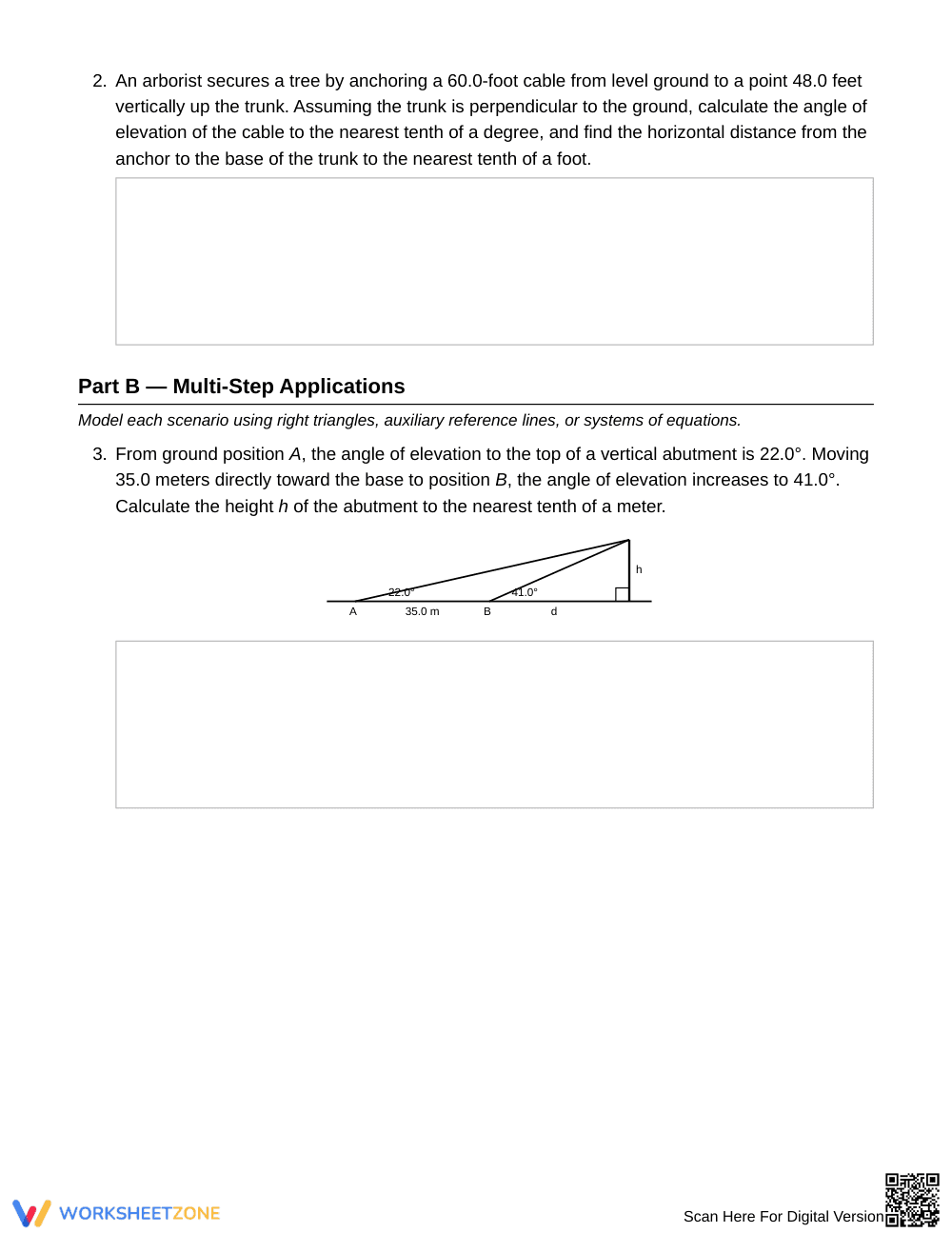
- Supported practice (Part B — 6 problems): Multi-step geometric scenarios requiring auxiliary lines, dual angles of elevation and depression, bearings, and similar-triangle checks without pre-drawn diagrams.
- Independent practice (Part C — 2 problems): Real-world constraint evaluations where students apply trigonometric inequalities to assess ramp slopes and crane reach safety against strict building codes.
This structured progression utilizes a gradual-release architecture, transitioning students from scaffolded visual models to independent mathematical decision-making.
Standards Alignment
This resource aligns directly with Common Core State Standard HSG-SRT.C.8: "Use trigonometric ratios and the Pythagorean Theorem to solve right triangles in applied problems." Additionally, it supports HSG-MG.A.3 by challenging students to apply geometric methods to solve design problems and engineering criteria. Both standard codes can be copied directly into lesson plans, IEP goals, or district curriculum mapping tools.
How to Use It
Implement this worksheet immediately after direct instruction on right-triangle trigonometry ratios and angles of elevation or depression. Use Part A during mid-lesson checks to ensure students measure angles from horizontal baselines rather than vertical axes. Part B and Part C serve as rigorous small-group collaborative investigations or formal post-unit assessments, with an expected completion time of 45 to 60 minutes.
Who It's For
Designed for Grade 10 Geometry students, this resource suits general education classrooms, honors geometry sections, and physics students learning vector resolution. To support emerging bilinguals and struggling learners, provide highlighters to trace horizontal reference lines and given sides. Pair this resource with an anchor chart detailing angle of elevation versus depression before assigning Part B.
Rigorous mathematical modeling under standard HSG-SRT.C.8 requires students to translate contextual height and distance scenarios into precise right triangle trigonometric equations. Grounded in the gradual-release framework established by Fisher & Frey (2014), this 10-problem instructional resource systematically builds student autonomy from direct single-ratio setups to multi-triangle systems and real-world constraint analysis. By embedding worked examples that address persistent geometric misconceptions—such as misidentifying angles of depression or omitting surveyor eye levels—the materials ensure learners bridge conceptual understanding and procedural fluency. Students not only compute unknown side lengths and elevation angles but also validate engineering criteria against legal slope limitations and crane clearance boundaries. This targeted instructional sequence enables tenth-grade geometry students to internalize authentic trigonometric modeling workflows, producing verifiable mastery that transfers effectively to advanced pre-calculus coursework, standardized state assessments, and applied technical pathways.


