




























Views
Downloads




Proven Graphing Half-Planes Worksheet | Grade 9 Algebra I

Paste this activity's link or code into your existing LMS (Google Classroom, Canvas, Teams, Schoology, Moodle, etc.).
Students can open and work on the activity right away, with no student login required.
You'll still be able to track student progress and results from your teacher account.
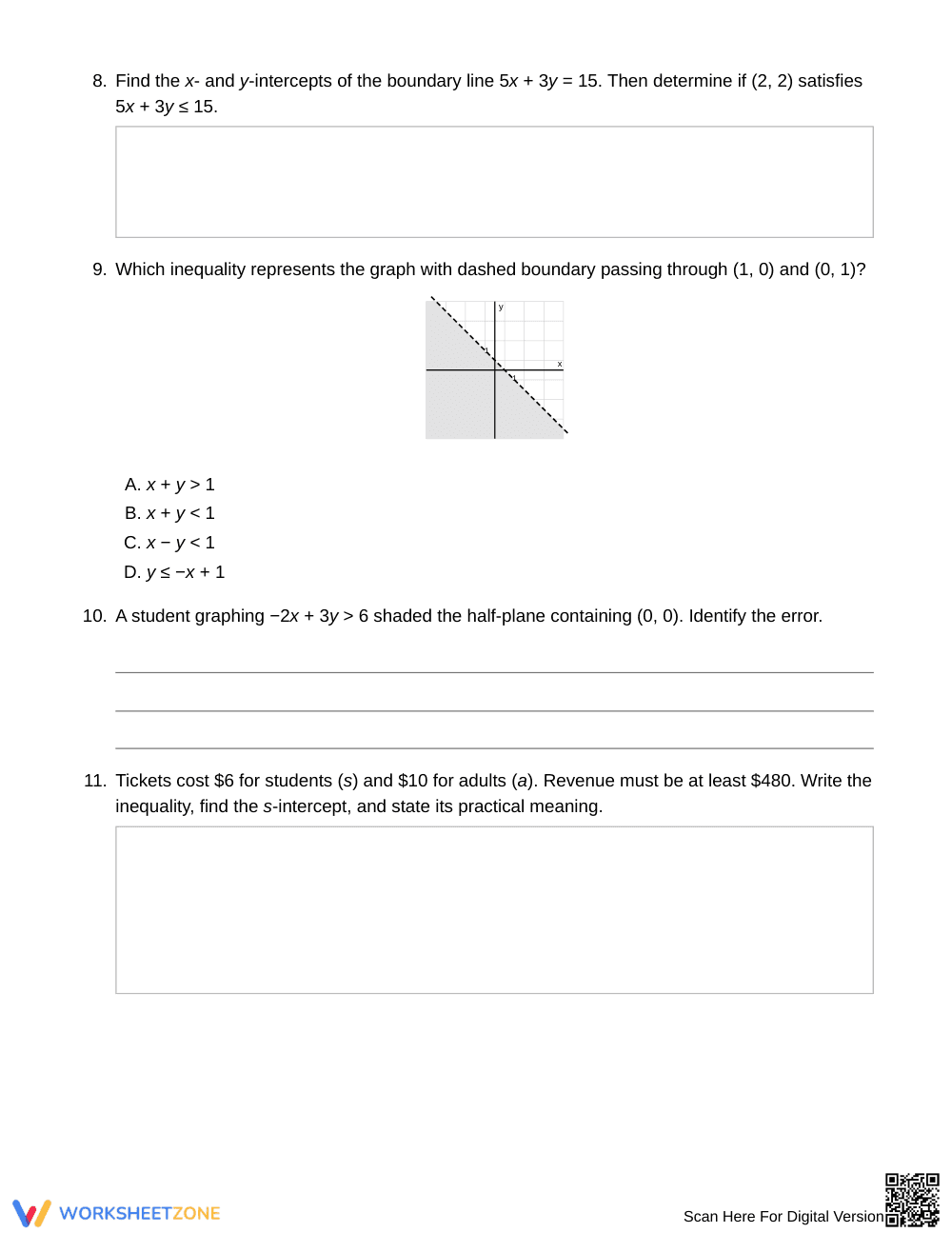
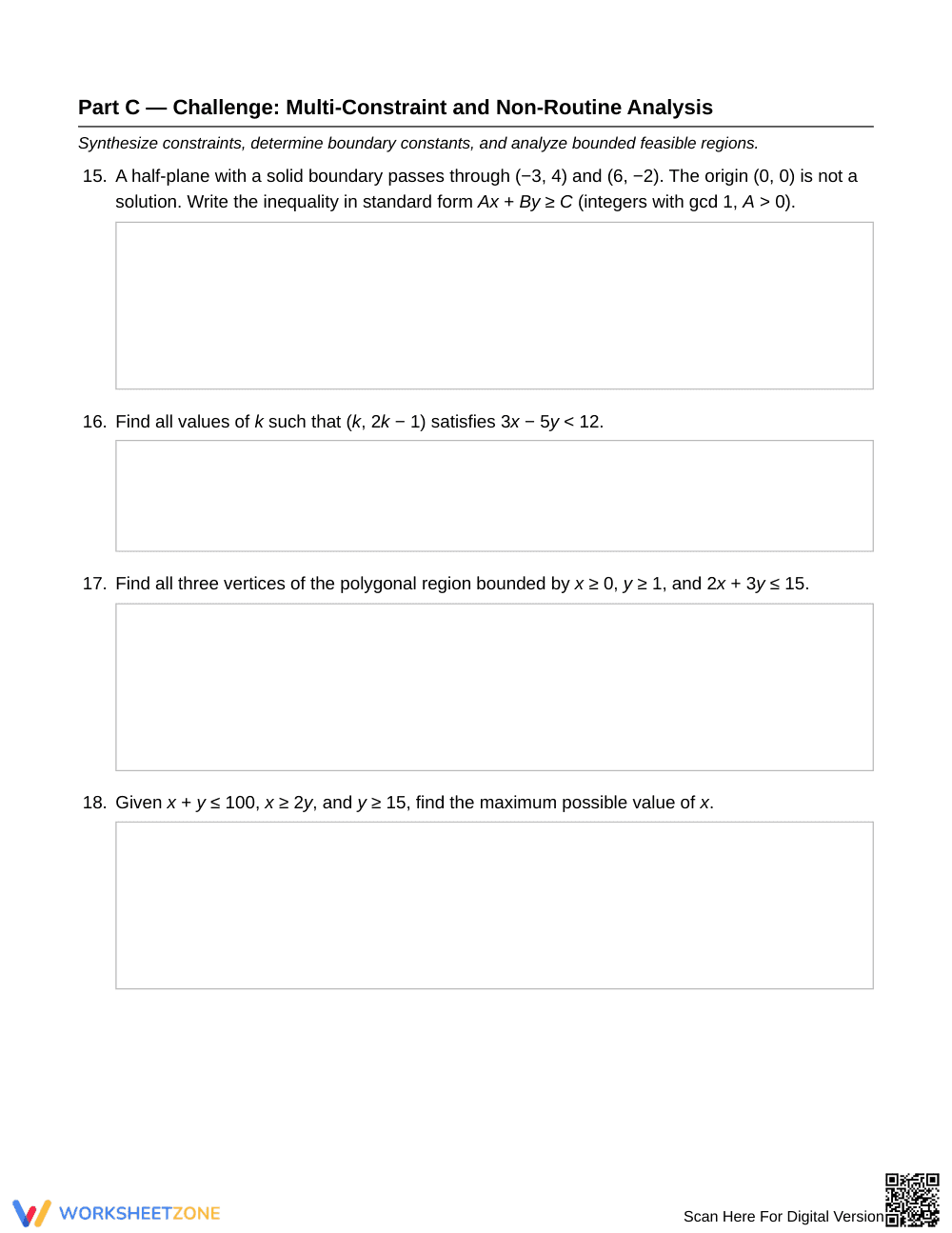
This Algebra I worksheet provides targeted practice for graphing two-variable linear inequalities and identifying solution half-planes. Students progress from testing coordinate points and graphing boundary lines to analyzing multi-constraint systems and solving feasible region problems. Clear boundary rules ensure students master inequality representations on coordinate planes.
At a Glance
- Grade: 9 · Subject: Algebra I
- Standard:
HSA-REI.D.12— Graph the solution set of a linear inequality in two variables as a half-plane- Skill Focus: Graph a Two-Variable Half-Plane
- Format: 5 pages · 18 problems · Answer key included · PDF
- Best For: Core algebra instruction, targeted remediation, and review
- Time: 45–60 minutes
What's Inside
This 5-page resource includes 18 tasks organized across three progressive parts, featuring an opening rule box and a 2-page answer key. Students complete coordinate graph sketching, test-point evaluations, error analysis, real-world constraint modeling, and boundary vertex calculations. Visual items feature dedicated coordinate grids for direct shading.
Skill Progression
- Guided practice (Part A, 4 problems): Reviews boundary rules, tests candidate points like (0, 0), and matches inequalities to graphs with direct visual support.
- Supported practice (Part B, 10 problems): Develops fluency through slope-intercept conversions, vertical lines, error analysis, ticket revenue modeling, and systems of half-planes.
- Independent practice (Part C, 4 problems): Synthesizes skills through non-routine tasks, including standard-form boundary equations, parameter constraints, and polygonal feasible region vertices.
This sequence implements gradual-release methodology, guiding students from supported foundational rules to complex, autonomous problem solving.
Standards Alignment
This worksheet aligns directly to HSA-REI.D.12: Graph the solutions to a linear inequality in two variables as a half-plane, and graph the solution set to a system of linear inequalities. It also supports HSA-CED.A.3 by representing practical constraints using inequalities. Both standard codes can be copied directly into lesson plans, IEP goals, or district curriculum mapping tools.
How to Use It
Use this worksheet after direct instruction for targeted partner practice, or assign it as an independent review station. Formative assessment tip: observe whether students remember to reverse inequality symbols when dividing by negative values in Part B. Expected student completion time is 45 to 60 minutes.
Who It's For
This worksheet serves Grade 9 Algebra I students learning linear inequalities and older students reviewing coordinate graphing. The top rule box accommodates students needing memory supports, while Part C extends honors learners. Pair this resource with a visual anchor chart illustrating solid versus dashed boundaries.
Mastering two-variable linear inequalities under HSA-REI.D.12 requires students to graph solution half-planes, differentiate solid and dashed boundaries, and verify candidate points using algebraic test methods. According to Fisher & Frey (2014), implementing a gradual-release instructional model significantly deepens conceptual understanding when procedural tasks transition deliberately into complex, non-routine application. This 18-problem Algebra I resource operationalizes that research through a scaffolded three-tier structure that shifts learners from basic boundary identification to multi-constraint feasible region analysis. By integrating visual coordinate grids with rigorous algebraic transformations, the worksheet bridges visual reasoning and symbolic manipulation. Formative checks embedded throughout the problem sets enable high school educators to identify common misconceptions, such as incorrect sign reversal or misidentified origin tests, before students progress to linear programming. The resulting practice delivers reliable evidence of student mastery across standard secondary mathematics benchmarks.


