




























Views
Downloads


Proven Function Transforms Worksheet | Grade 12 Precalculus

Paste this activity's link or code into your existing LMS (Google Classroom, Canvas, Teams, Schoology, Moodle, etc.).
Students can open and work on the activity right away, with no student login required.
You'll still be able to track student progress and results from your teacher account.
Mastering function transformations requires students to connect algebraic parameters with geometric behaviors and domain restrictions. This comprehensive worksheet delivers 16 targeted analytical problems designed to help Grade 12 Precalculus students evaluate horizontal shifts, vertical dilations, reflections, and domain boundaries across radical, rational, exponential, and logarithmic functions.
At a Glance
- Grade: 12 · Subject: Precalculus
- Standard:
HSF-BF.B.3— Identify effects of replacing f(x) with f(x+k), k f(x), f(kx), and f(x)+k- Skill Focus: Transformation Parameters and Domain Effects
- Format: 5 pages · 16 problems · Answer key included · PDF
- Best For: Advanced function analysis and exam preparation
- Time: 45–60 minutes
What's Inside
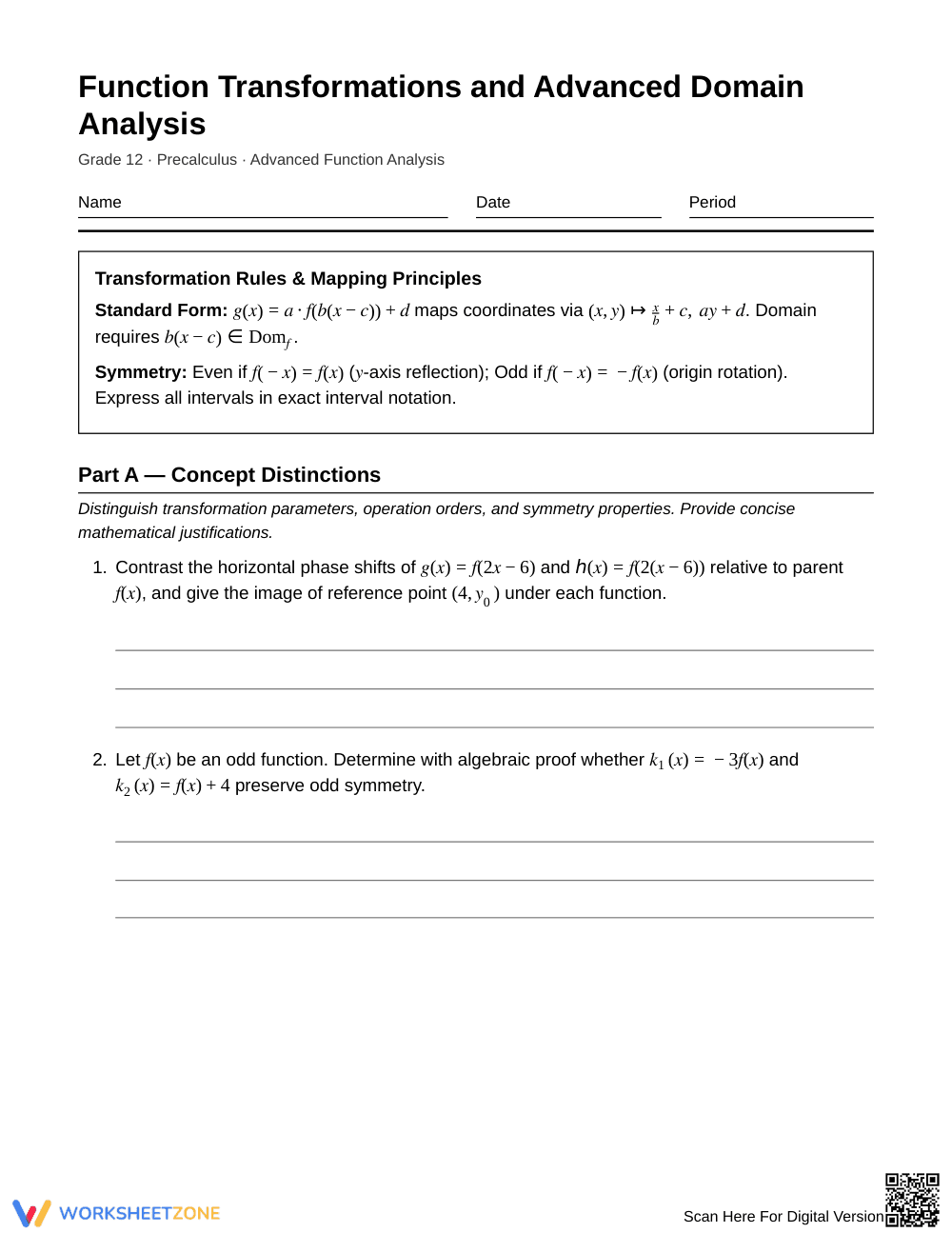
This 5-page resource features 16 rigorous analytical tasks, organized into conceptual reasoning, computational applications, and mathematical modeling. The opening section supplies an explicit reference box detailing standard transformation forms, mapping rules, and symmetry definitions. Students complete interval analysis, asymptote identification, extrema classification, and formal algebraic proofs, supported by a 3-page complete answer key detailing every coordinate shift.
Skill Progression
- Guided Practice (Part A, 4 problems): Students analyze foundational distinctions, contrasting factored versus unfactored horizontal phase shifts, verifying symmetry preservation, and exploring reciprocal dilation equivalences with reference box support.
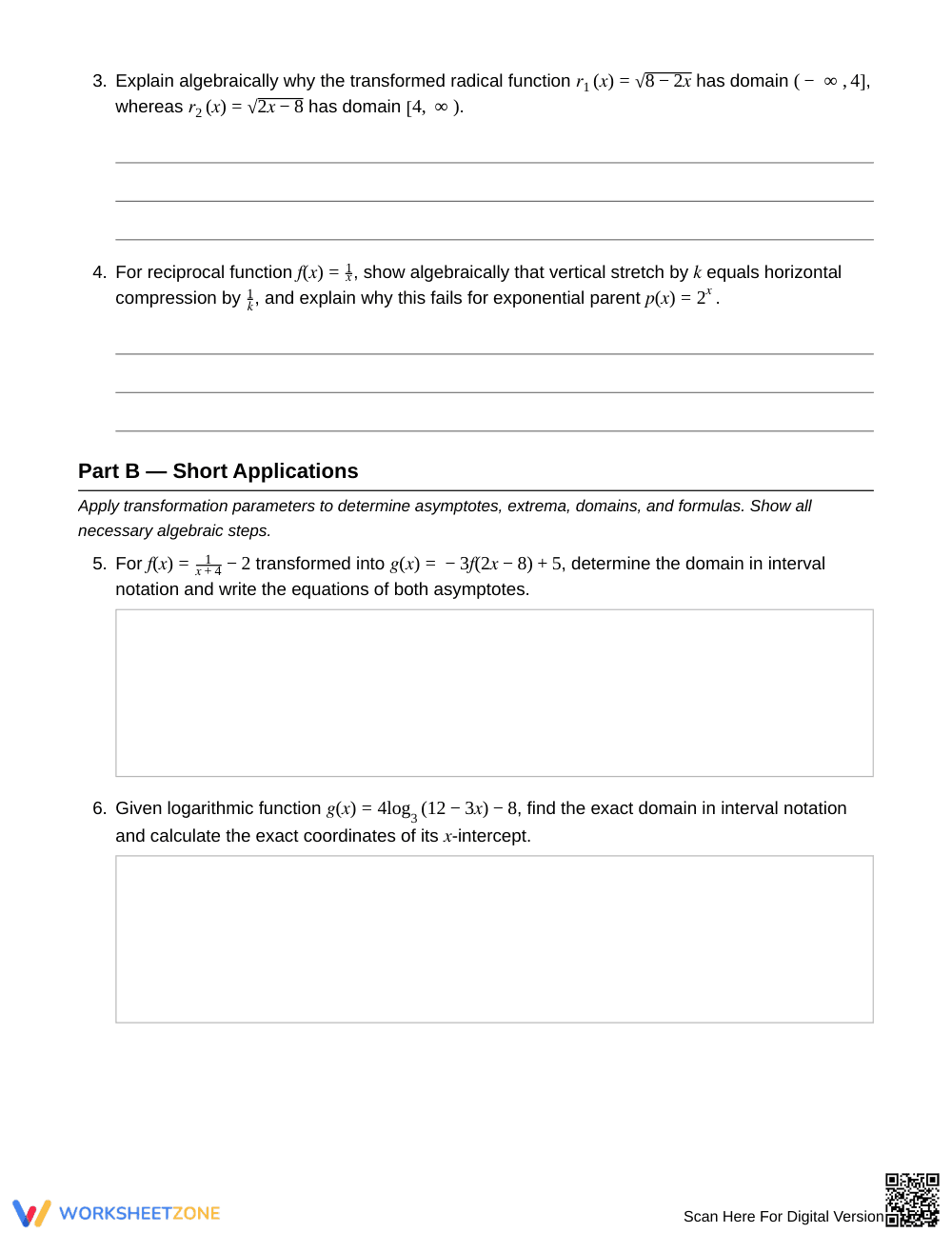
- Supported Practice (Part B, 8 problems): Learners calculate exact domains, horizontal and vertical asymptotes, extrema mappings, and symbolic expressions across radical, logarithmic, and rational functions.
- Independent Practice (Part C, 4 problems): Students construct multi-step algebraic proofs, reconcile alternate transformation orders, and model real-world acoustic decay through standard logarithmic forms.
This sequence establishes a structured gradual-release framework, advancing students from conceptual discrimination to independent functional modeling.
Standards Alignment
This worksheet directly aligns with HSF-BF.B.3: Identify the effect on the graph of replacing f(x) by f(x + k), k f(x), f(kx), and f(x + k) for specific values of k, and find the value of k given the graphs. Supporting standard HSF-IF.B.5 reinforces relating function domains to quantitative relationships. Both standard codes can be copied directly into lesson plans, IEP goals, or district curriculum mapping tools.
How to Use It
Deploy this worksheet after direct instruction on non-rigid transformations and domain restrictions. For formative assessment, examine student work on Part A to observe whether learners factor out horizontal scale coefficients before determining phase shifts. Expect completion within 45 to 60 minutes during an intensive block period, or divide the sections across two consecutive class sessions to reinforce independent homework practice.
Who It's For
Designed for Grade 12 Precalculus and honors-level algebra students, this worksheet offers rigorous practice for college-bound learners preparing for AP Calculus. Pair this assignment with a parent function graphing anchor chart or coordinate mapping demonstration for scaffolding.
According to Fisher & Frey (2014), structured instructional progressions that move intentionally from foundational concept analysis to complex synthesis produce measurable gains in student cognitive independence. This precalculus worksheet operationalizes that pedagogical framework for standard HSF-BF.B.3, which targets identifying the effects of algebraic transformations on parent functions and their restricted domains. By organizing 16 multi-step tasks across conceptual distinctions, application drills, and contextual modeling proofs, the resource scaffolds rigorous analysis of horizontal dilations, coordinate mappings, and boundary behaviors. Learners systematically bridge the gap between procedural symbol manipulation and deep conceptual understanding as they trace how parameter alterations reshape asymptotes, extrema, and interval domains across rational, radical, and transcendental graphs. The resulting instructional workflow provides secondary mathematics educators with a validated instrument for diagnostic tracking, skill consolidation, and standardized assessment readiness across advanced secondary math curricula.


