




























Views
Downloads

Proven Equivalent Evaluation Paths Worksheet | Grade 6 Math

Paste this activity's link or code into your existing LMS (Google Classroom, Canvas, Teams, Schoology, Moodle, etc.).
Students can open and work on the activity right away, with no student login required.
You'll still be able to track student progress and results from your teacher account.
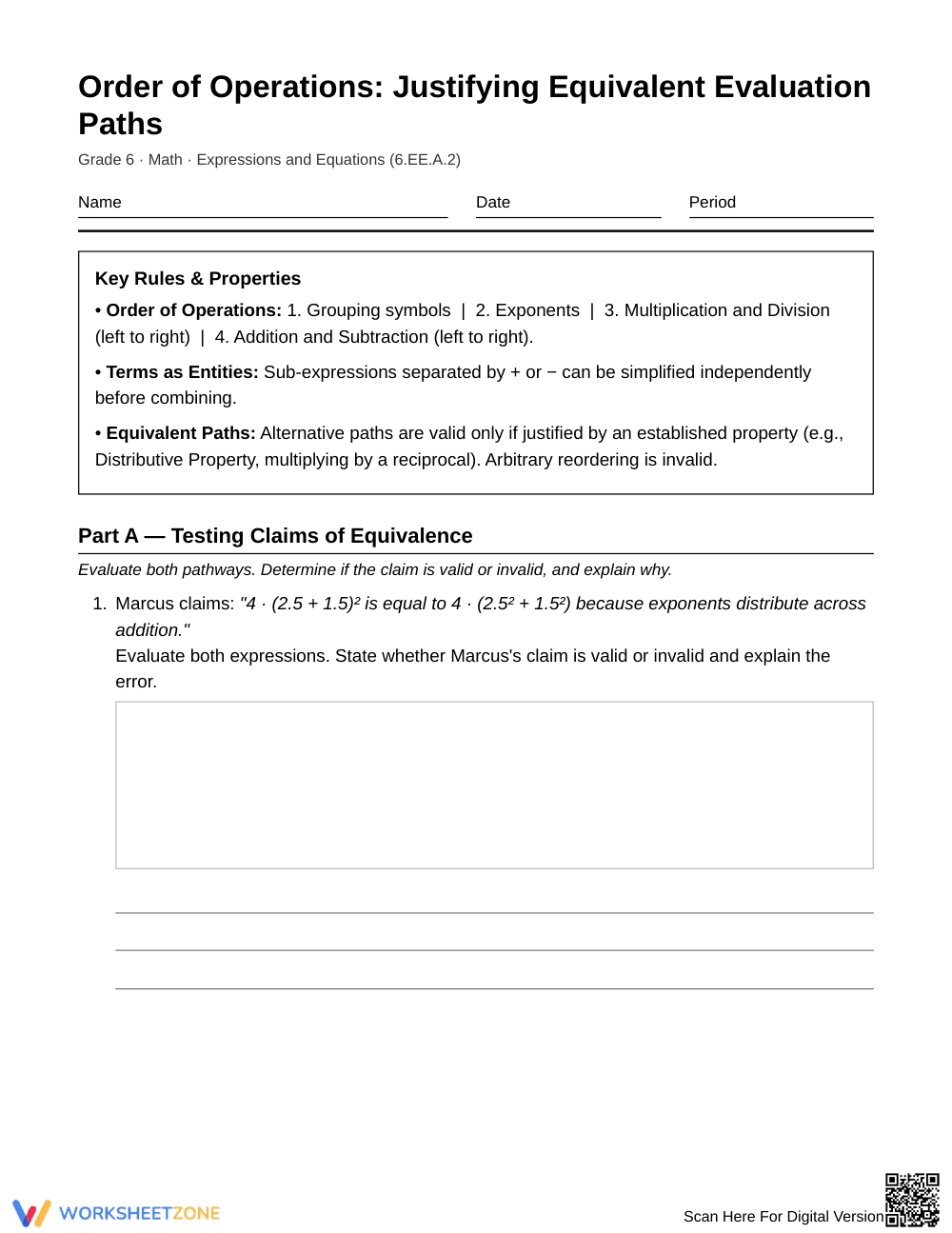
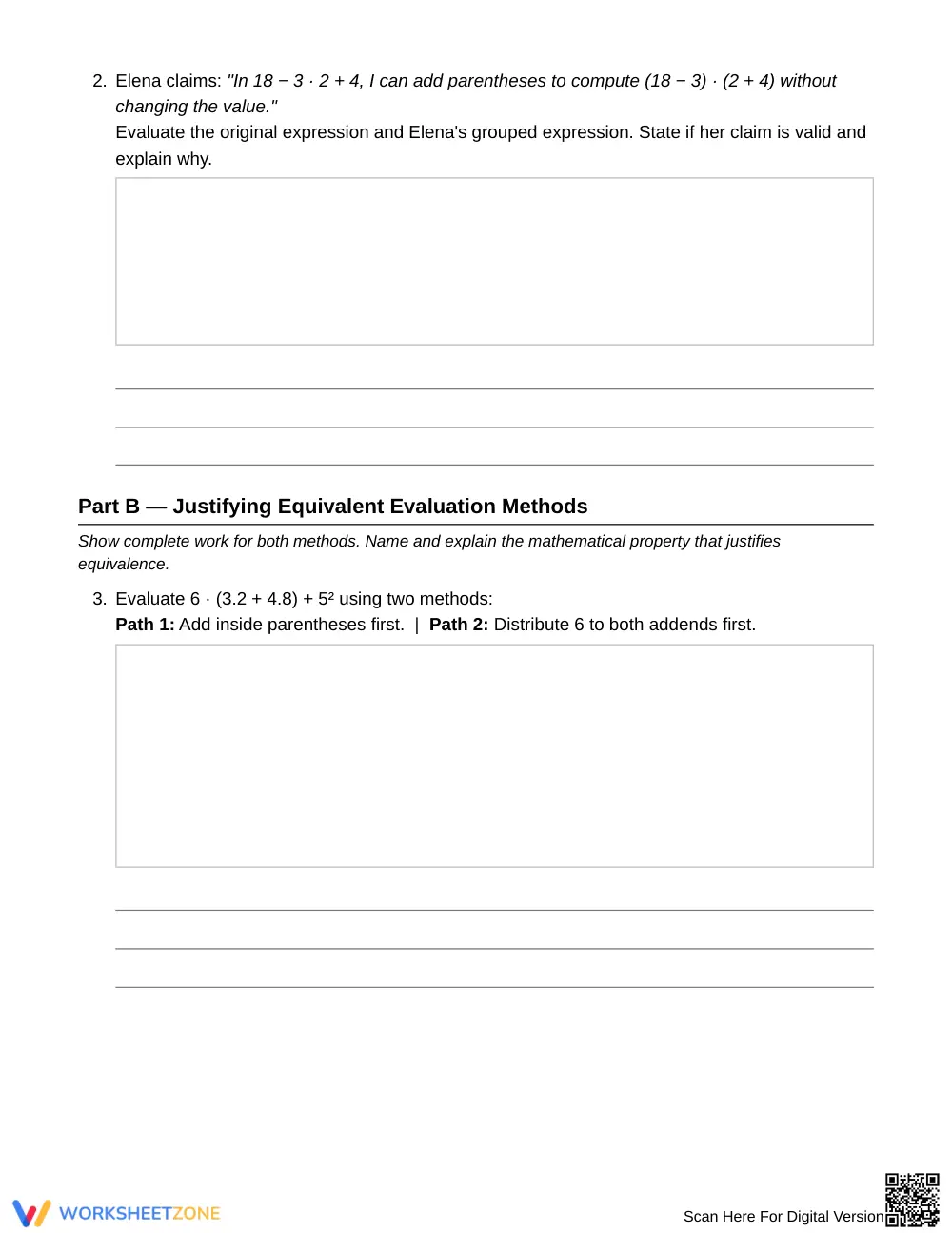
This math worksheet helps sixth-grade students master the order of operations by evaluating expressions and proving mathematical equivalence. Learners analyze pathways, apply properties, and construct counterexamples across eight multi-step tasks to develop procedural fluency and conceptual understanding for expressions with exponents.
At a Glance
- Grade: 6 · Subject: Math
- Standard:
6.EE.A.1— Evaluate numerical expressions involving whole-number exponents- Skill Focus: Justify Two Equivalent Evaluation Paths
- Format: 5 pages · 8 problems · Answer key included · PDF
- Best For: Guided practice and conceptual math intervention
- Time: 30–45 minutes
What's Inside
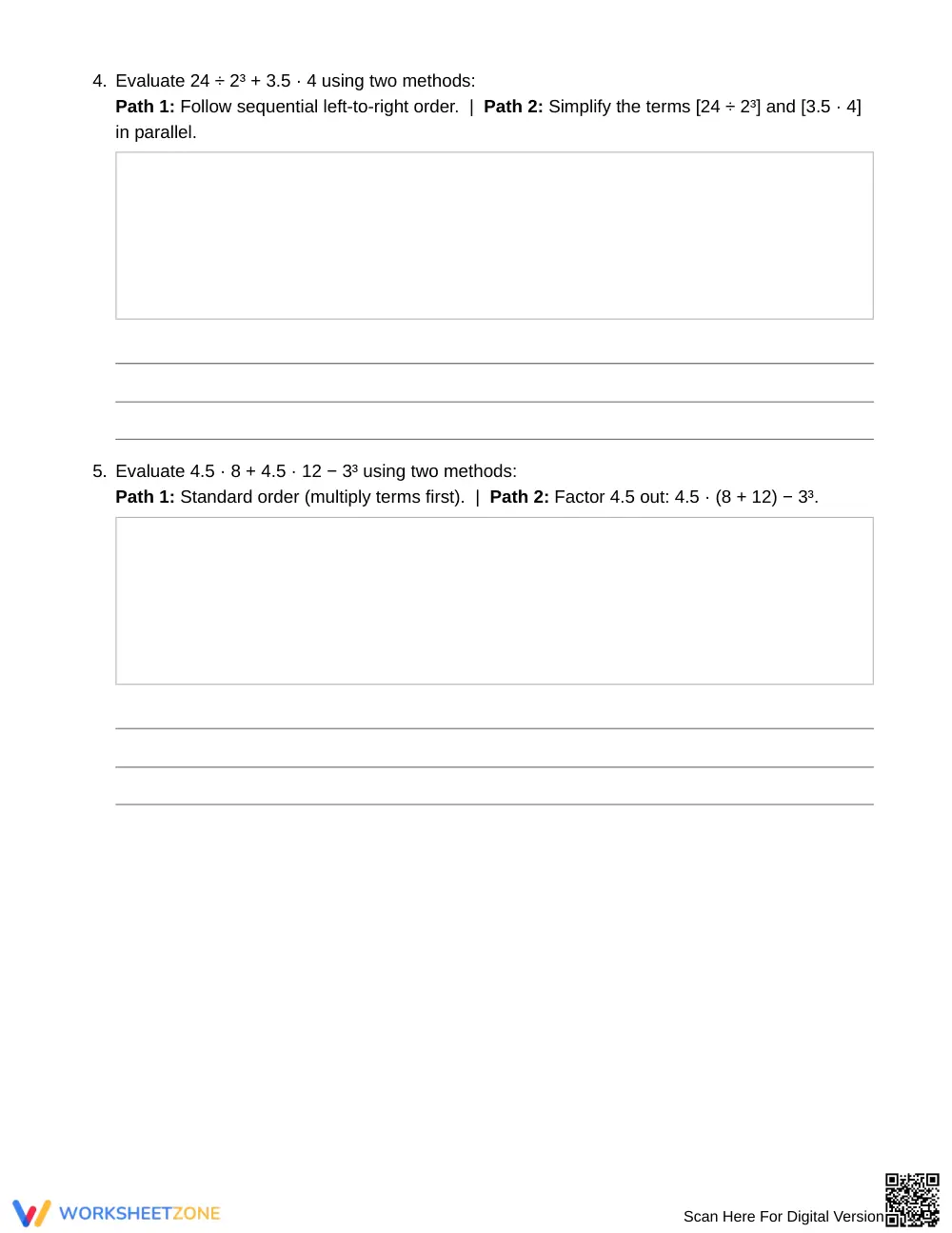
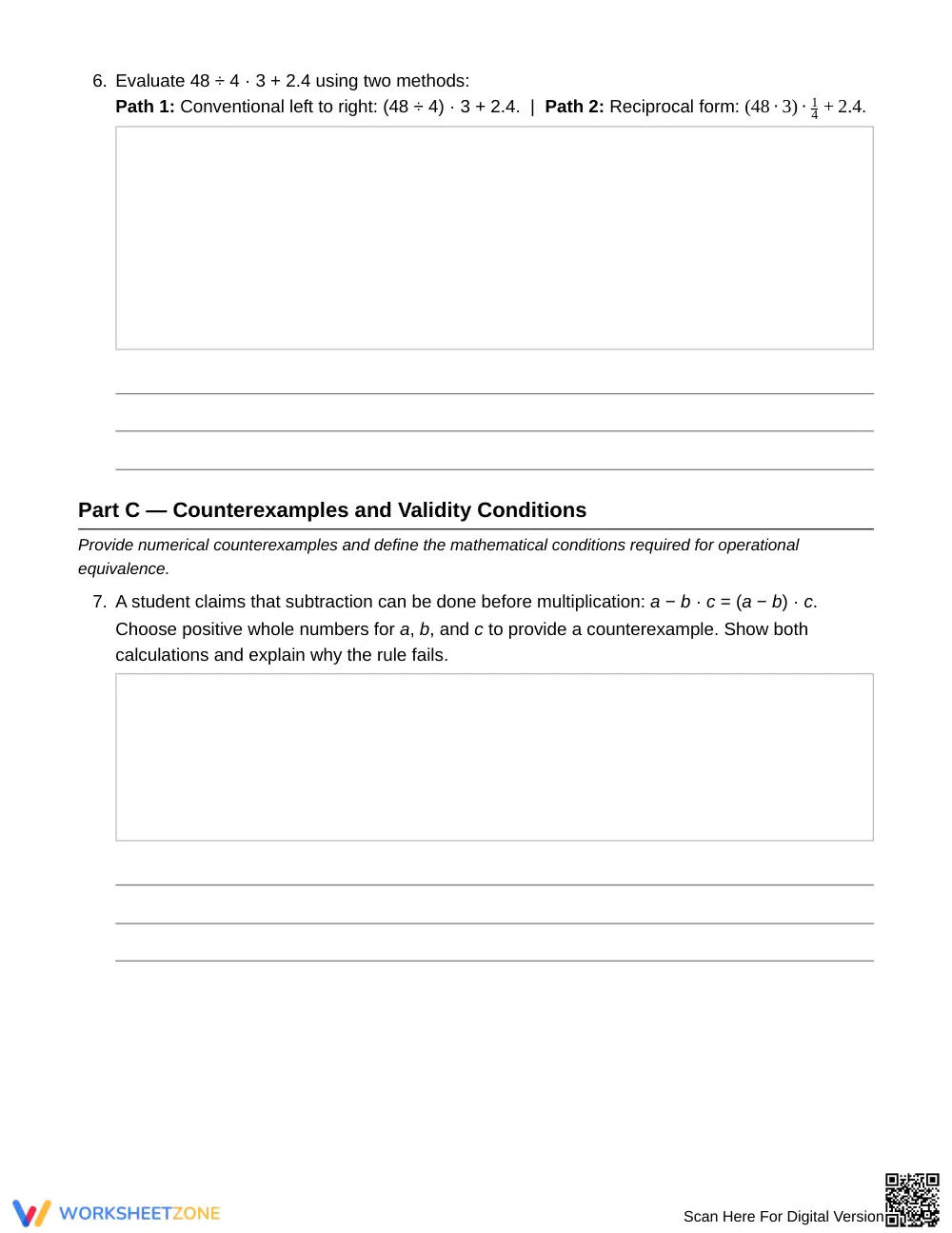
This 5-page printable resource features an anchor reference box and three structured problem sets. Students evaluate alternative operational paths, test peer claims, and create counterexamples. A complete 2-page answer key provides step-by-step solutions, property validations, and explanations for all 8 tasks.
Skill Progression
This resource utilizes a gradual-release model to build mathematical reasoning:
- Guided practice (Part A, Problems 1–2): Students analyze student claims about exponent distribution and parentheses placement, identifying operational errors using the reference box.
- Supported practice (Part B, Problems 3–6): Learners evaluate four expressions via two pathways, naming properties like the distributive property and reciprocal multiplication.
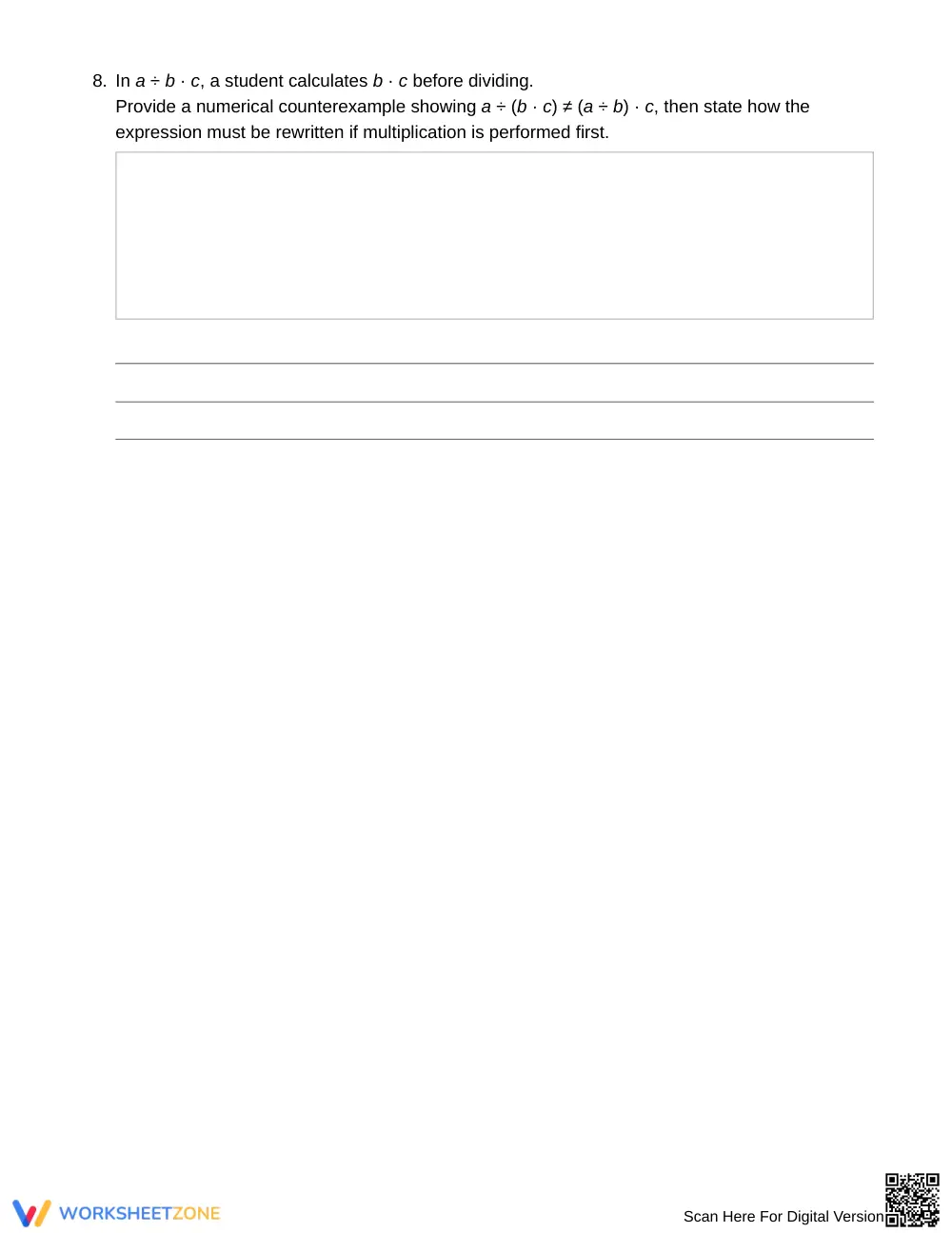
- Independent practice (Part C, Problems 7–8): Students generate numerical counterexamples and formalize validity conditions to disprove incorrect operations without scaffolds.
This I Do, We Do, You Do framework ensures students master conceptual justification before independent proof.
Standards Alignment
This worksheet aligns directly with primary standard 6.EE.A.1, evaluating numerical expressions with whole-number exponents. It supports 6.EE.A.2 by having students identify terms and evaluate expressions. Both standard codes can be copied directly into lesson plans, IEP goals, or district curriculum mapping tools.
How to Use It
Use this worksheet after direct instruction on the order of operations. During guided practice, assign Part B to student pairs using a think-pair-share structure where partners compare different valid evaluation methods. For formative assessment, review Part A to catch common misconceptions regarding exponent distribution across addition. Total completion time is 30 to 45 minutes.
Who It's For
Designed for Grade 6 math classes, advanced Grade 5 acceleration, and Grade 7 intervention. Built-in reference rules scaffold developing learners, while counterexample tasks challenge advanced students. Pair this activity with an order of operations anchor chart or distributive property lesson.
According to empirical research by Fisher & Frey (2014) on the gradual release of responsibility model, shifting students systematically from guided error analysis to independent mathematical justification significantly improves long-term conceptual retention. Grade 6 standard 6.EE.A.1 requires students to write and evaluate numerical expressions involving whole-number exponents, but middle school learners often default to rote, rigid computational sequences without understanding underlying algebraic structures. By prompting students to analyze and justify two equivalent evaluation paths—such as contrasting standard sequential order with distributive property factoring or parallel term simplification—this classroom resource cultivates deep mathematical flexibility. Furthermore, constructing numerical counterexamples directly confronts persistent misconceptions regarding operational order and exponent distribution across addition. This evidence-based instructional structure equips educators with actionable formative assessment data while building the rigorous analytical foundation necessary for secondary algebra readiness and advanced multi-step problem solving.


