




























Views
Downloads


Proven Correlation & Fit Worksheet | Grade 12 Statistics

Paste this activity's link or code into your existing LMS (Google Classroom, Canvas, Teams, Schoology, Moodle, etc.).
Students can open and work on the activity right away, with no student login required.
You'll still be able to track student progress and results from your teacher account.
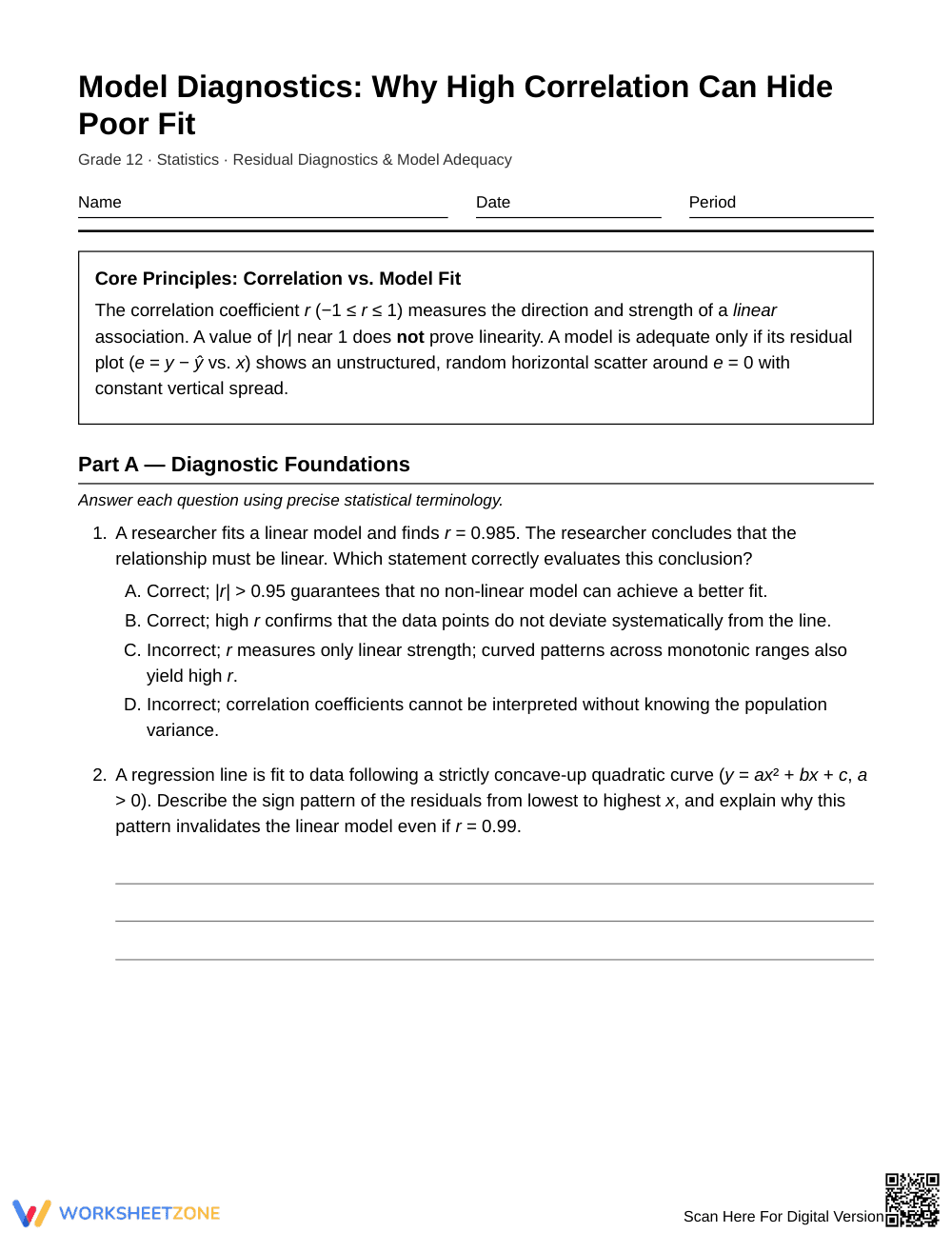
This Grade 12 statistics worksheet teaches students why a high correlation coefficient does not ensure a valid linear model. Learners examine residual plots, detect curvature, analyze leverage points, and contrast competing models to make rigorous diagnostic judgments about bivariate data fit.
At a Glance
- Grade: 12 · Subject: Statistics
- Standard:
HSS-ID.B.6— Assess function fit by plotting and analyzing residuals- Skill Focus: Explaining why high correlation hides poor fit
- Format: 5 pages · 14 problems · Answer key included · PDF
- Best For: AP Statistics regression review
- Time: 45–60 minutes
What's Inside
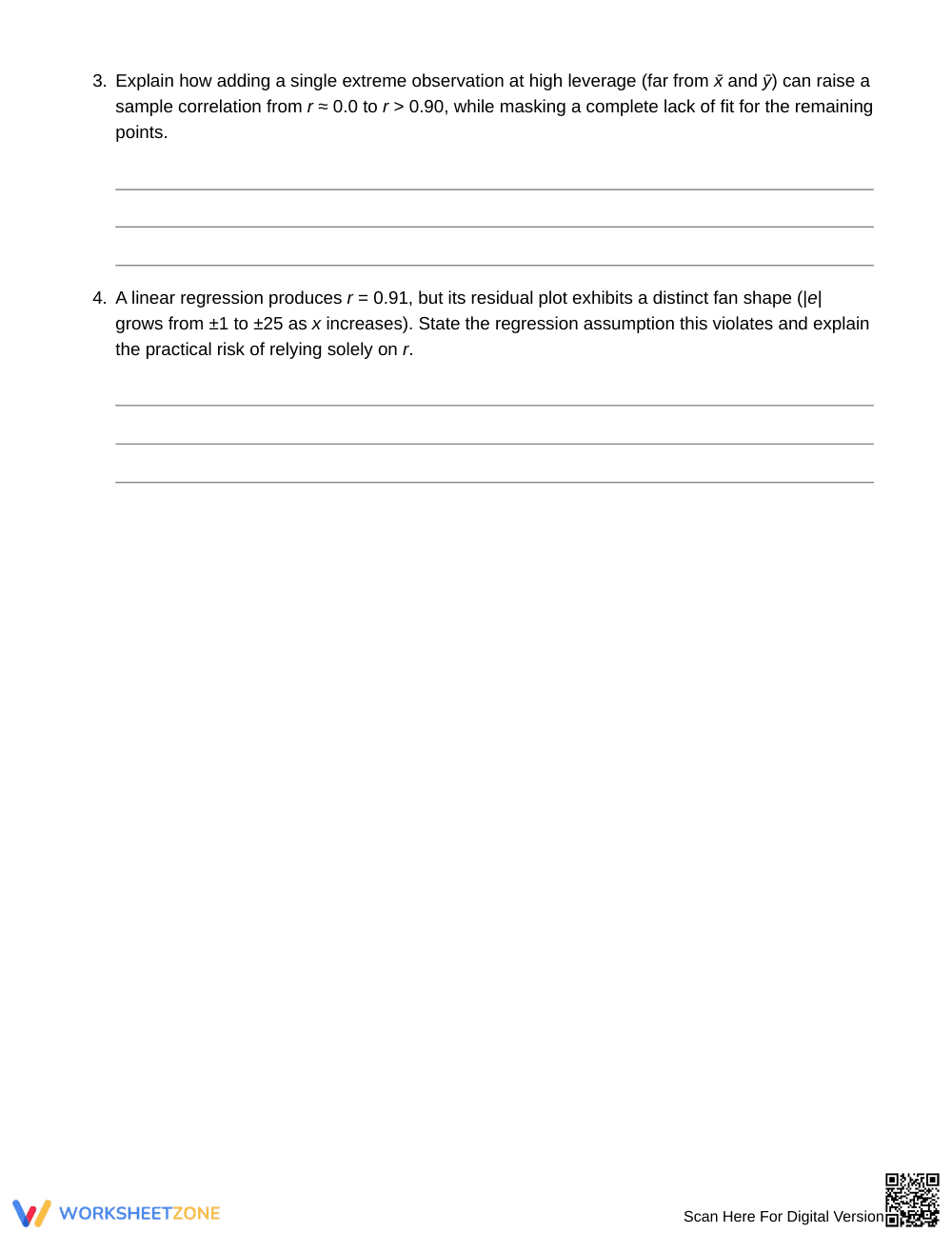
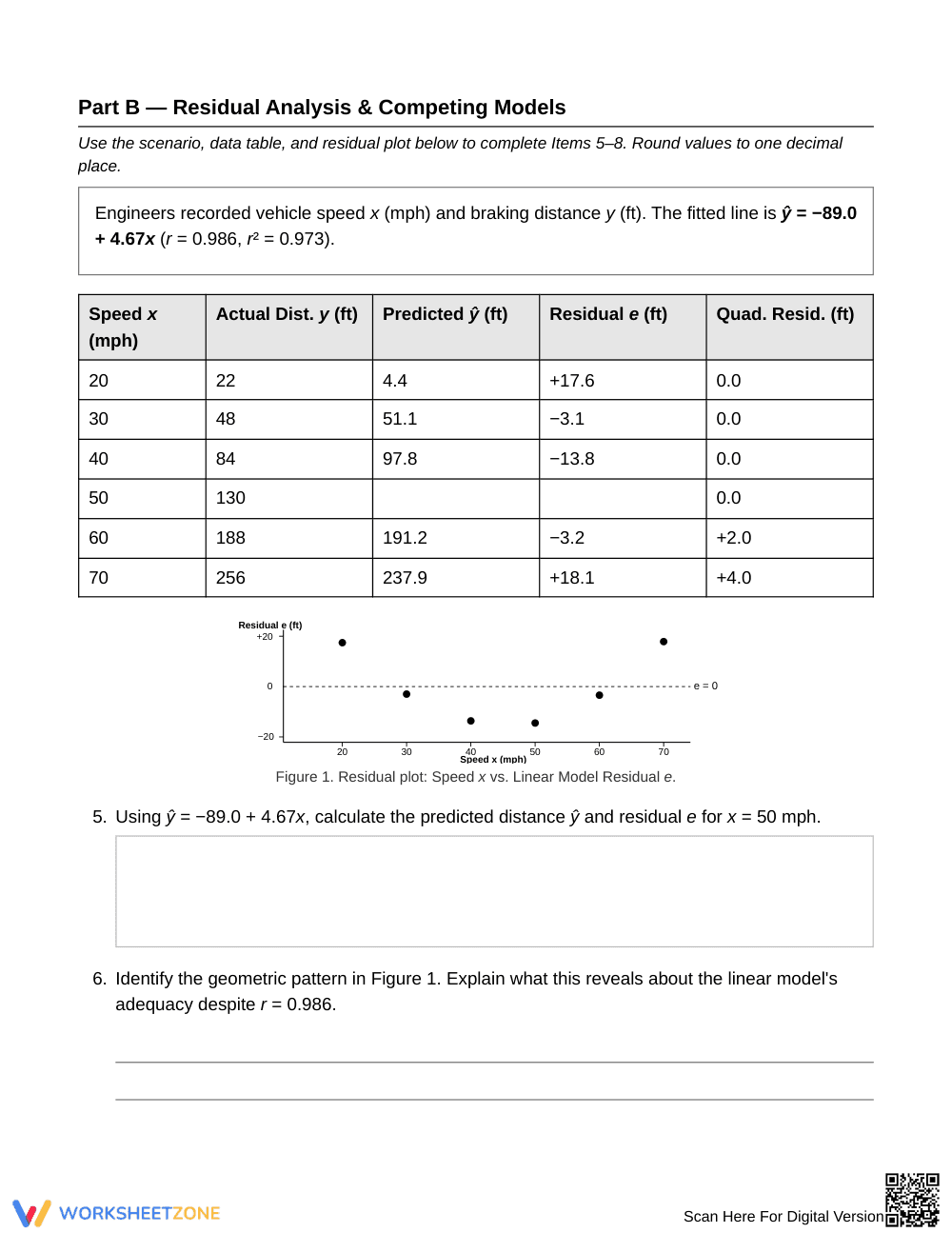
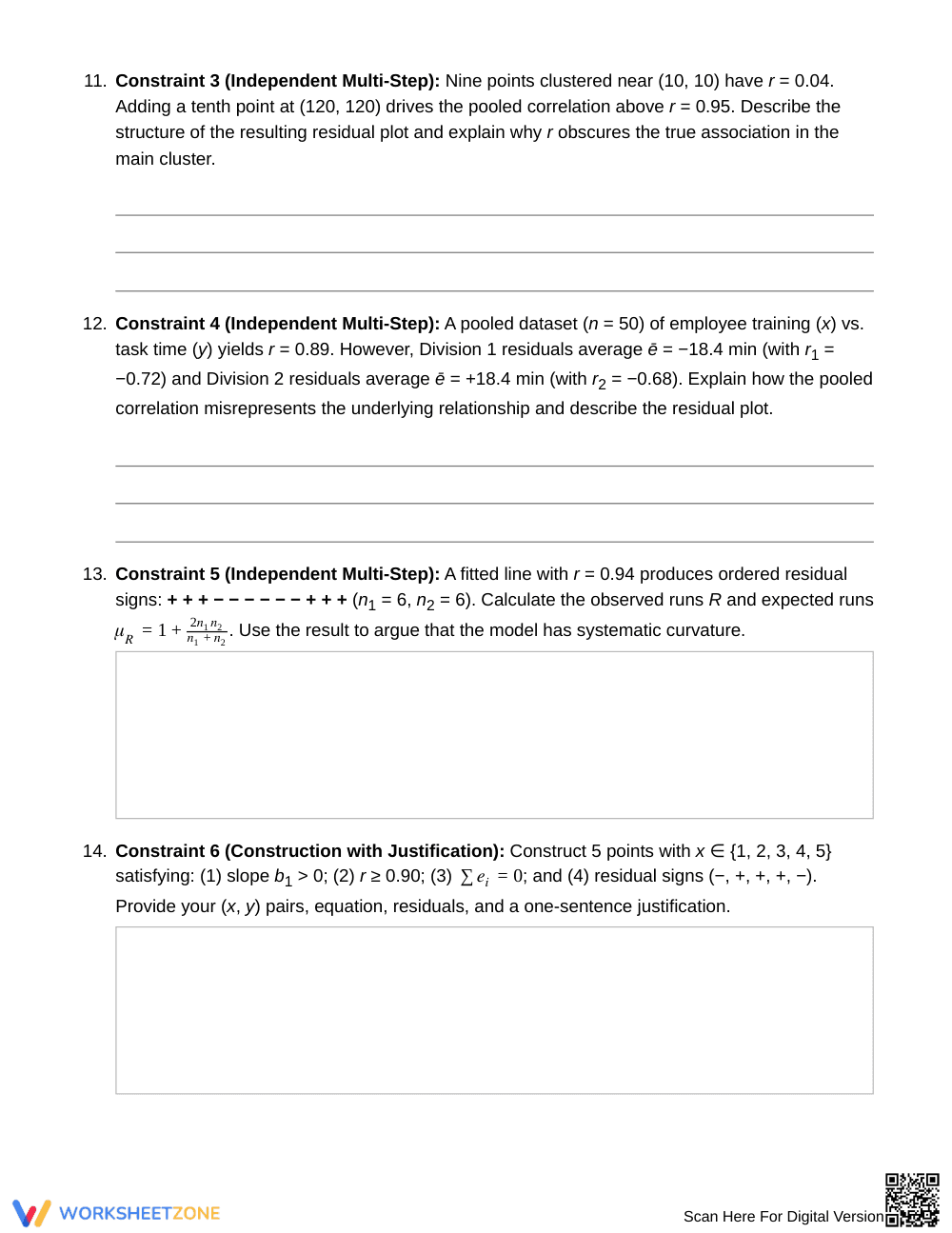
This 5-page worksheet includes 14 diagnostic problems across three progression sections. Students evaluate residual plots, compute prediction errors for vehicle stopping distances, contrast linear versus quadratic fits, and test residual randomness. A complete 3-page answer key provides step-by-step mathematical solutions and diagnostic rationales.
Skill Progression
- Guided practice (Items 1–4): Students review core principles, identify quadratic residual patterns, evaluate high leverage, and spot heteroscedastic fan shapes.
- Supported practice (Items 5–8): Using braking distance data and a residual plot, students compute residuals and contrast linear against quadratic predictions.
- Independent practice (Items 9–14): Students evaluate alternating residuals, log transformations, pooled clusters, runs tests, and construct valid datasets.
This sequence implements gradual release to move students from diagnostic concepts to independent validation.
Standards Alignment
This worksheet aligns directly with `HSS-ID.B.6`: Fit a function to the data; use functions fitted to data to solve problems in the context of the data; and assess the fit of a function by plotting and analyzing residuals. It also reinforces `HSS-ID.B.6a` by testing linear and non-linear model adequacy. Both standard codes can be copied directly into lesson plans, IEP goals, or district curriculum mapping tools.
How to Use It
Assign this activity after direct instruction on linear regression and residual analysis. Use Part B for collaborative pairs analyzing braking distance hazards when relying on r = 0.986. During Part C, formatively check whether students identify non-random residual signs. The activity requires 45 to 60 minutes.
Who It's For
This resource is built for Grade 12 Statistics students mastering model validation. Provide visual scatterplot templates for learners needing extra scaffolding, while challenging advanced students with the formal runs test. Pair this worksheet with an anchor chart illustrating common residual plot patterns.
Under standard HSS-ID.B.6, high school statistics students must evaluate bivariate models beyond descriptive summary statistics by analyzing residual plots and model fit. Research from Fisher & Frey (2014) highlights that guided, phased instructional sequences—moving from structured concept evaluation to independent data construction—significantly deepen conceptual understanding in secondary mathematics. When learners rely strictly on correlation coefficients without evaluating residuals, they overlook systematic non-linearity, extreme leverage points, and non-constant variance. By examining 14 targeted diagnostic problems across 5 pages, students learn to detect curved residual patterns, compute algebraic error terms, and compare competing linear and polynomial fits. This worksheet operationalizes evidence-based regression analysis by challenging students to explain why a correlation near 1.0 does not guarantee linearity. The included 3-page answer key supports immediate instructional feedback, reinforcing robust statistical literacy and data evaluation practices essential for college-level analytical coursework.


