




























Views
Downloads




Proven Conversion Pathways Worksheet | Grade 11 Chemistry

Paste this activity's link or code into your existing LMS (Google Classroom, Canvas, Teams, Schoology, Moodle, etc.).
Students can open and work on the activity right away, with no student login required.
You'll still be able to track student progress and results from your teacher account.
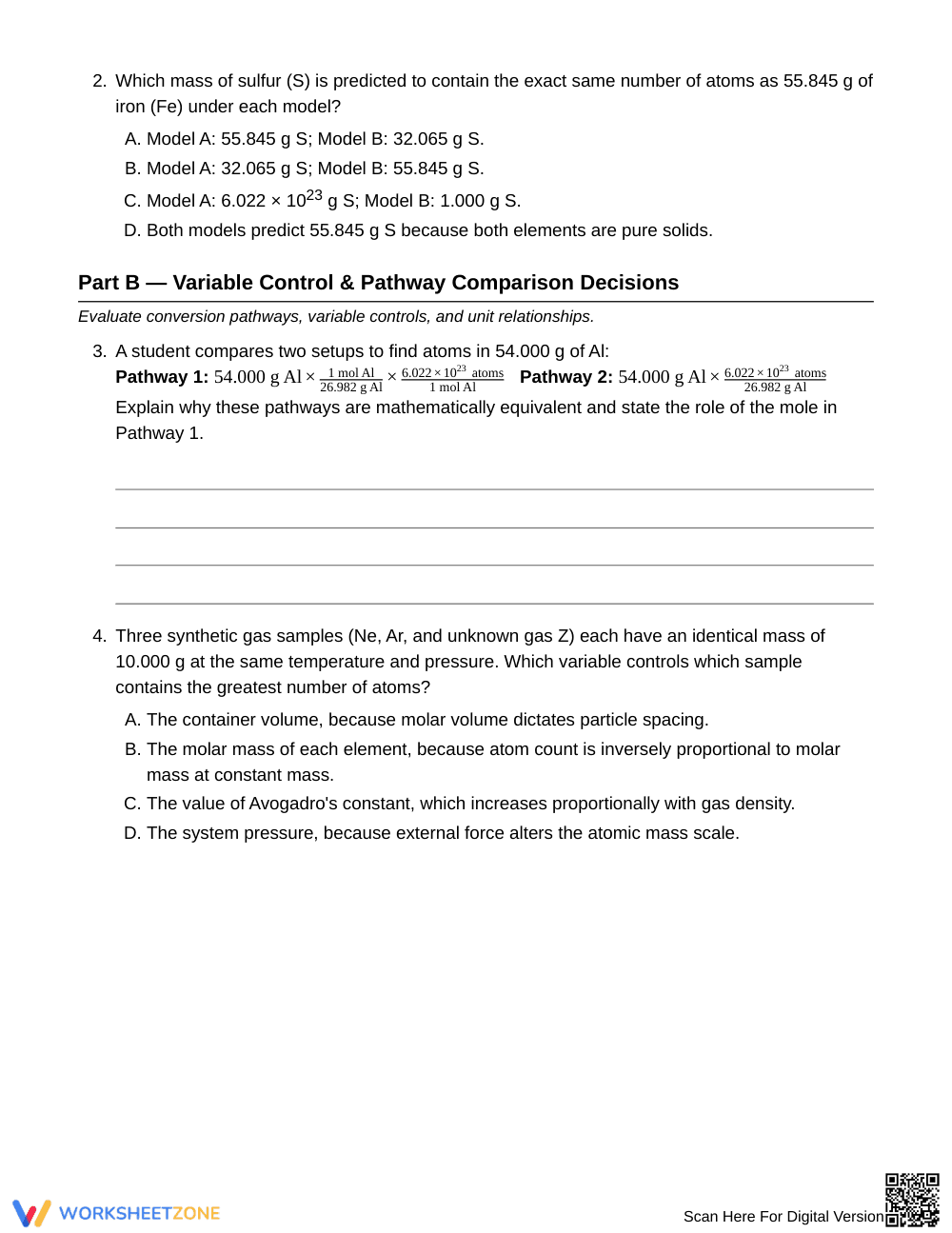
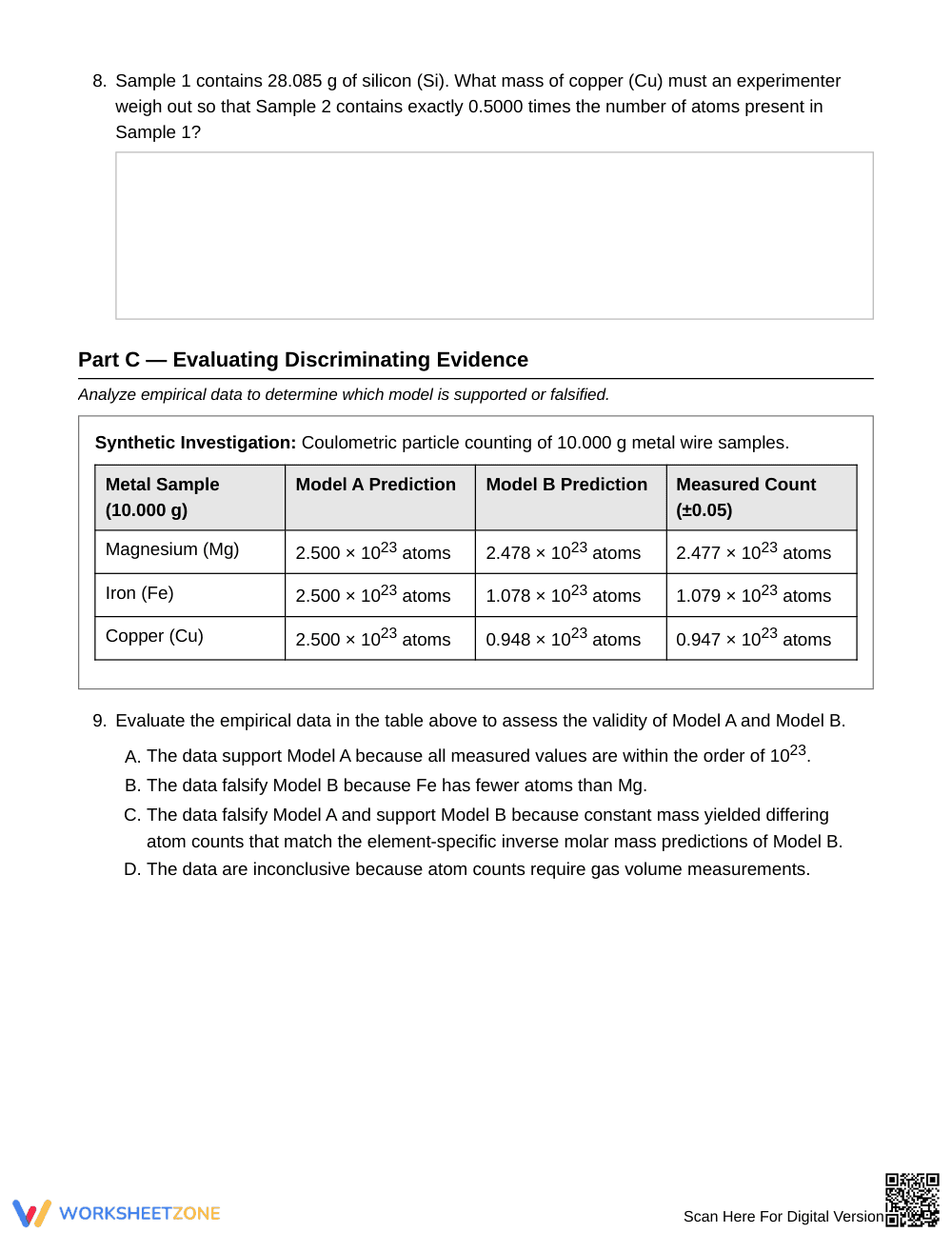
This 5-page chemistry worksheet provides focused quantitative practice for high school students learning to compare equivalent conversion pathways in stoichiometry. Students evaluate competing particulate models, verify dimensional analysis setups, and analyze empirical coulometric data to relate macroscopic mass with particle counts.
At a Glance
- Grade: 11 · Subject: Chemistry
- Standard: High School Chemistry — Calculate and compare particulate quantities across equivalent molar conversion pathways
- Skill Focus: Compare Equivalent Conversion Pathways
- Format: 5 pages · 10 problems · Answer key included · PDF
- Best For: Stoichiometry dimensional analysis and particulate modeling
- Time: 45–55 minutes
The resource contains 10 quantitative problems across three analytical parts. It features an introductory reference table with fundamental constants, formulas, and atomic masses for eleven elements. Students evaluate competing particulate models, compare multi-step conversion pathways, analyze controlled variables, and interpret empirical coulometric data. A 2-page answer key provides step-by-step solutions.
Skill Progression
- Guided practice (Part A — 2 tasks): Students apply contrasting models (Uniform Packing vs. Standard Molar Model) to predict atom counts from sample masses.
- Supported practice (Part B — 6 tasks): Learners verify equivalent dimensional analysis pathways, isolate controlled variables, and identify calculational errors.
- Independent practice (Part C — 2 tasks): Students analyze coulometric data to validate particulate theory and refute flawed claims.
This sequence follows a gradual-release framework, scaffolding analytical modeling toward independent evaluation.
Standards Alignment
Aligned with high school chemistry dimensional analysis and stoichiometry standards for quantitative relationships. Both standard codes can be copied directly into lesson plans, IEP goals, or district curriculum mapping tools.
How to Use It
Assign this worksheet after direct instruction on the mole concept and unit conversions. Use Part A for paired conceptual warm-ups before students independently complete the pathway error analysis in Part B. For formative assessment, check whether students recognize why single-step and two-step molar pathways yield identical values. Expected completion time is 45 to 55 minutes.
Who It's For
This worksheet serves Grade 11 General and Honors Chemistry students developing stoichiometry fluency. The built-in reference table scaffolds atomic mass lookups for struggling learners, while Part C offers advanced empirical data interpretation. Pair this activity with a particulate simulation or direct instruction lesson on Avogadro's constant.
Mastering equivalent conversion pathways in high school chemistry requires students to connect macroscopic mass measurements with particulate atomic counts through structured dimensional analysis. According to Fisher & Frey (2014), instructional frameworks that scaffold mathematical problem-solving through guided modeling, peer evaluation, and independent empirical analysis significantly enhance conceptual retention in STEM disciplines. This 10-problem quantitative worksheet engages Grade 11 chemistry learners in evaluating competing particulate models, calculating multi-step conversions between grams, moles, and atoms, and identifying mathematical errors in standard conversion setups. By analyzing empirical coulometric data and isolating controlled variables across various elements and compounds, students move beyond rote algorithmic execution toward genuine quantitative literacy. The resource provides 5 comprehensive pages of student practice paired with a complete 2-page explanatory answer key, making it an essential diagnostic and instructional tool for high school chemistry classrooms.


