




























1 / 8
0
Views
0
Downloads




0.0
0
Save
0 Likes
Share
Master Properties of Parallelograms
0 Views
0 Downloads

Paste this activity's link or code into your existing LMS (Google Classroom, Canvas, Teams, Schoology, Moodle, etc.).
Students can open and work on the activity right away, with no student login required.
You'll still be able to track student progress and results from your teacher account.
Information
Description
What It Is:
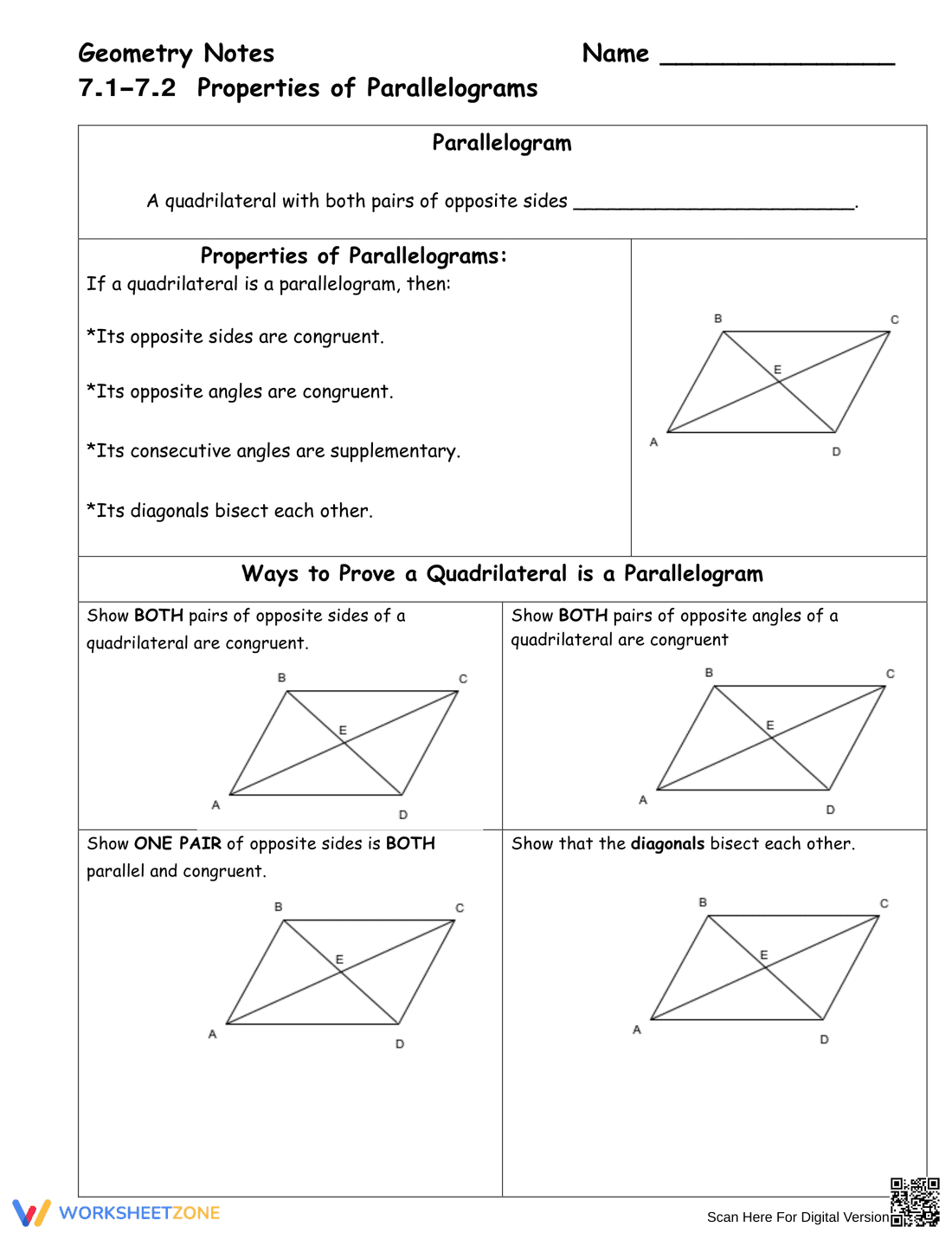
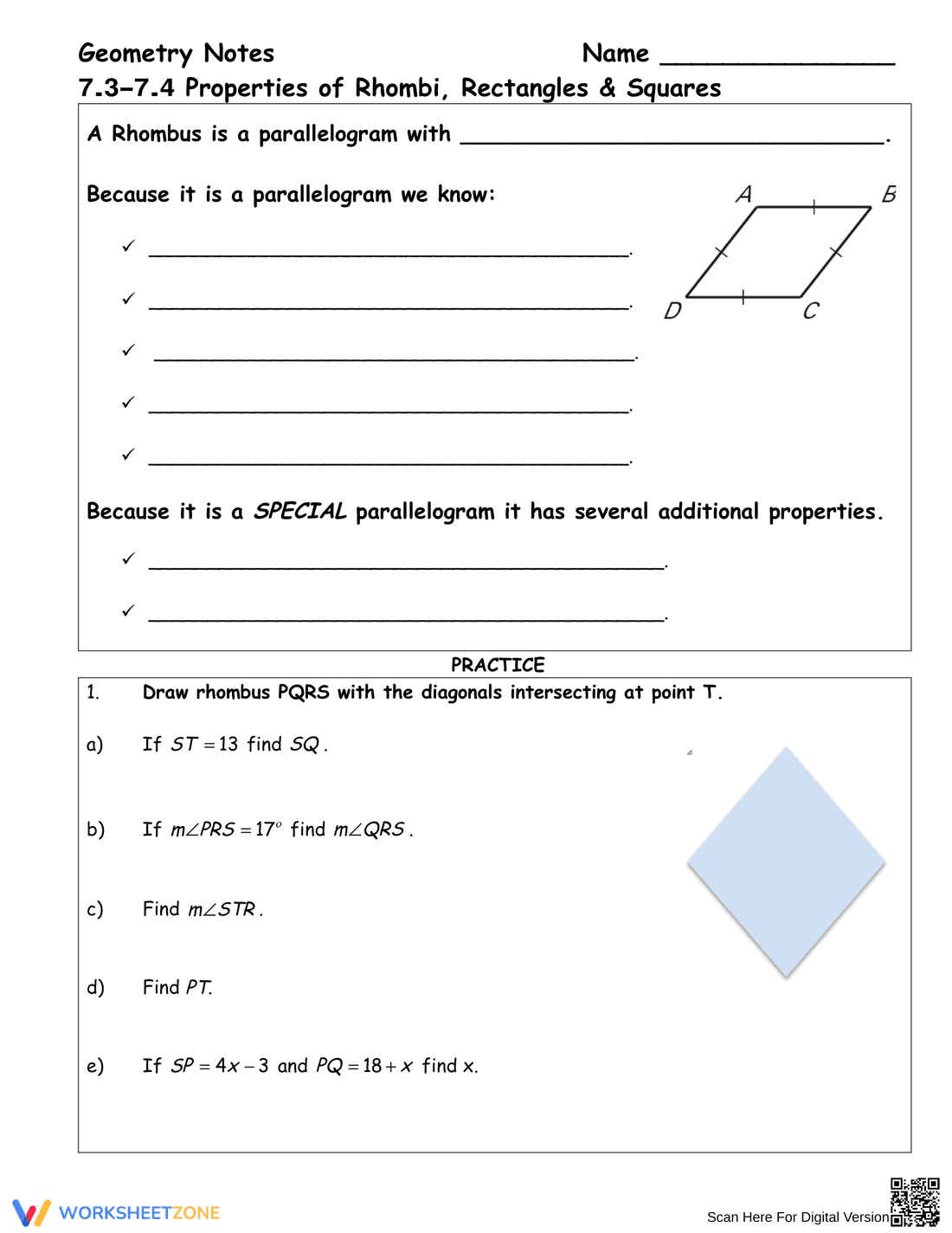
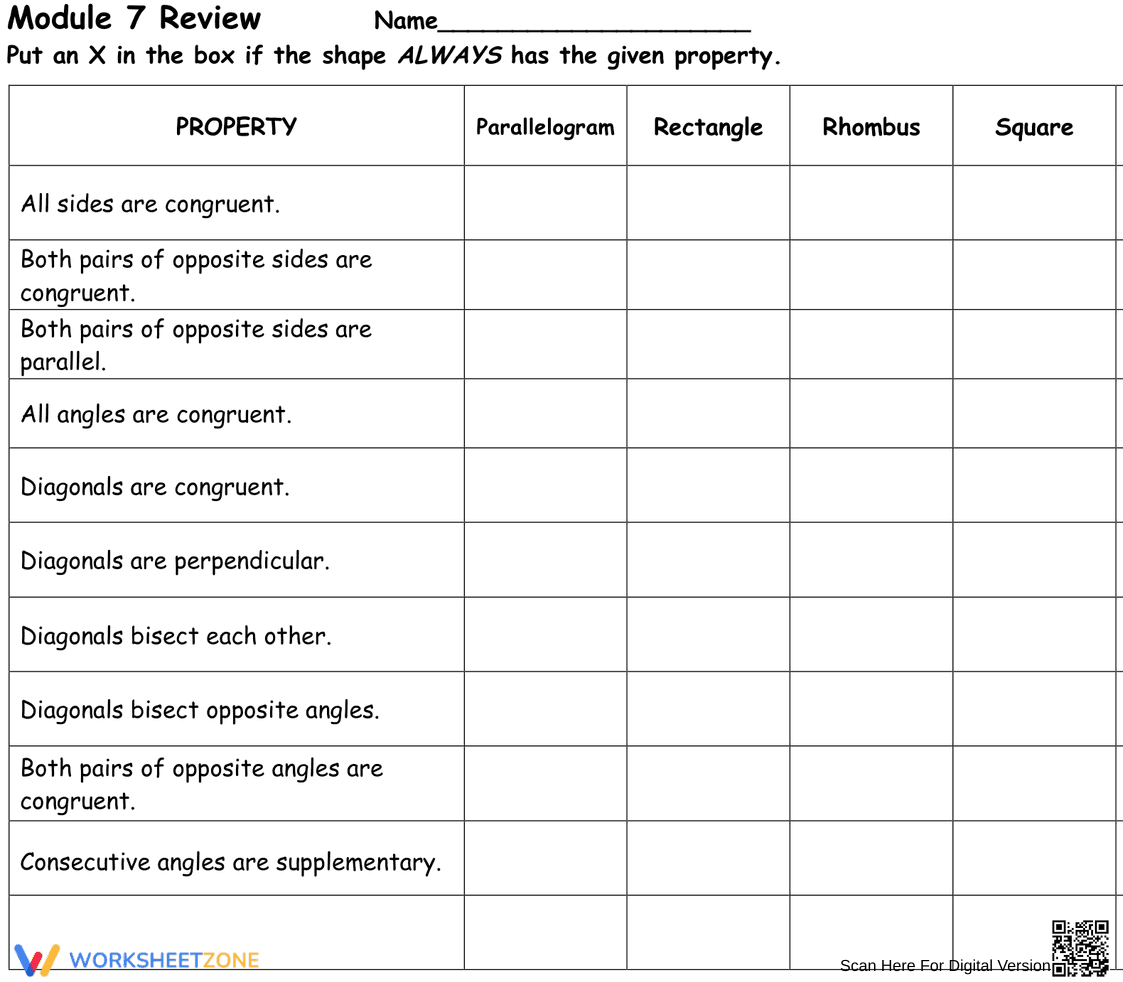
This is a geometry worksheet focusing on parallelograms. It includes a definition of a parallelogram as a quadrilateral with both pairs of opposite sides parallel. It lists the properties of parallelograms, such as opposite sides being congruent, opposite angles being congruent, consecutive angles being supplementary, and diagonals bisecting each other. The worksheet also outlines ways to prove a quadrilateral is a parallelogram, including showing both pairs of opposite sides are congruent, both pairs of opposite angles are congruent, one pair of opposite sides is both parallel and congruent, and that the diagonals bisect each other. Diagrams of parallelograms are included for reference.
Grade Level Suitability:
This worksheet is suitable for high school geometry, specifically grades 9-10. It covers key concepts in geometry related to quadrilaterals and parallelograms, which are typically taught at this level. The proofs and properties require a solid understanding of geometric principles.
Why Use It:
This worksheet helps students learn and reinforce the properties of parallelograms and how to prove that a quadrilateral is a parallelogram. It provides a structured way to understand the relationships between sides, angles, and diagonals in parallelograms. It helps students develop logical reasoning and problem-solving skills in geometry.
How to Use It:
Students should first fill in the blank definition of a parallelogram. Then, they should study the listed properties and relate them to the diagrams. Next, they can practice identifying the different ways to prove a quadrilateral is a parallelogram, referencing the diagrams provided as visual aids. This worksheet can be used for in-class practice, homework, or as a review activity.
Target Users:
The target users are high school geometry students, particularly those in grades 9 and 10. It is also suitable for teachers looking for resources to teach or reinforce the properties of parallelograms and related proofs.
This is a geometry worksheet focusing on parallelograms. It includes a definition of a parallelogram as a quadrilateral with both pairs of opposite sides parallel. It lists the properties of parallelograms, such as opposite sides being congruent, opposite angles being congruent, consecutive angles being supplementary, and diagonals bisecting each other. The worksheet also outlines ways to prove a quadrilateral is a parallelogram, including showing both pairs of opposite sides are congruent, both pairs of opposite angles are congruent, one pair of opposite sides is both parallel and congruent, and that the diagonals bisect each other. Diagrams of parallelograms are included for reference.
Grade Level Suitability:
This worksheet is suitable for high school geometry, specifically grades 9-10. It covers key concepts in geometry related to quadrilaterals and parallelograms, which are typically taught at this level. The proofs and properties require a solid understanding of geometric principles.
Why Use It:
This worksheet helps students learn and reinforce the properties of parallelograms and how to prove that a quadrilateral is a parallelogram. It provides a structured way to understand the relationships between sides, angles, and diagonals in parallelograms. It helps students develop logical reasoning and problem-solving skills in geometry.
How to Use It:
Students should first fill in the blank definition of a parallelogram. Then, they should study the listed properties and relate them to the diagrams. Next, they can practice identifying the different ways to prove a quadrilateral is a parallelogram, referencing the diagrams provided as visual aids. This worksheet can be used for in-class practice, homework, or as a review activity.
Target Users:
The target users are high school geometry students, particularly those in grades 9 and 10. It is also suitable for teachers looking for resources to teach or reinforce the properties of parallelograms and related proofs.


