


























Views
Downloads
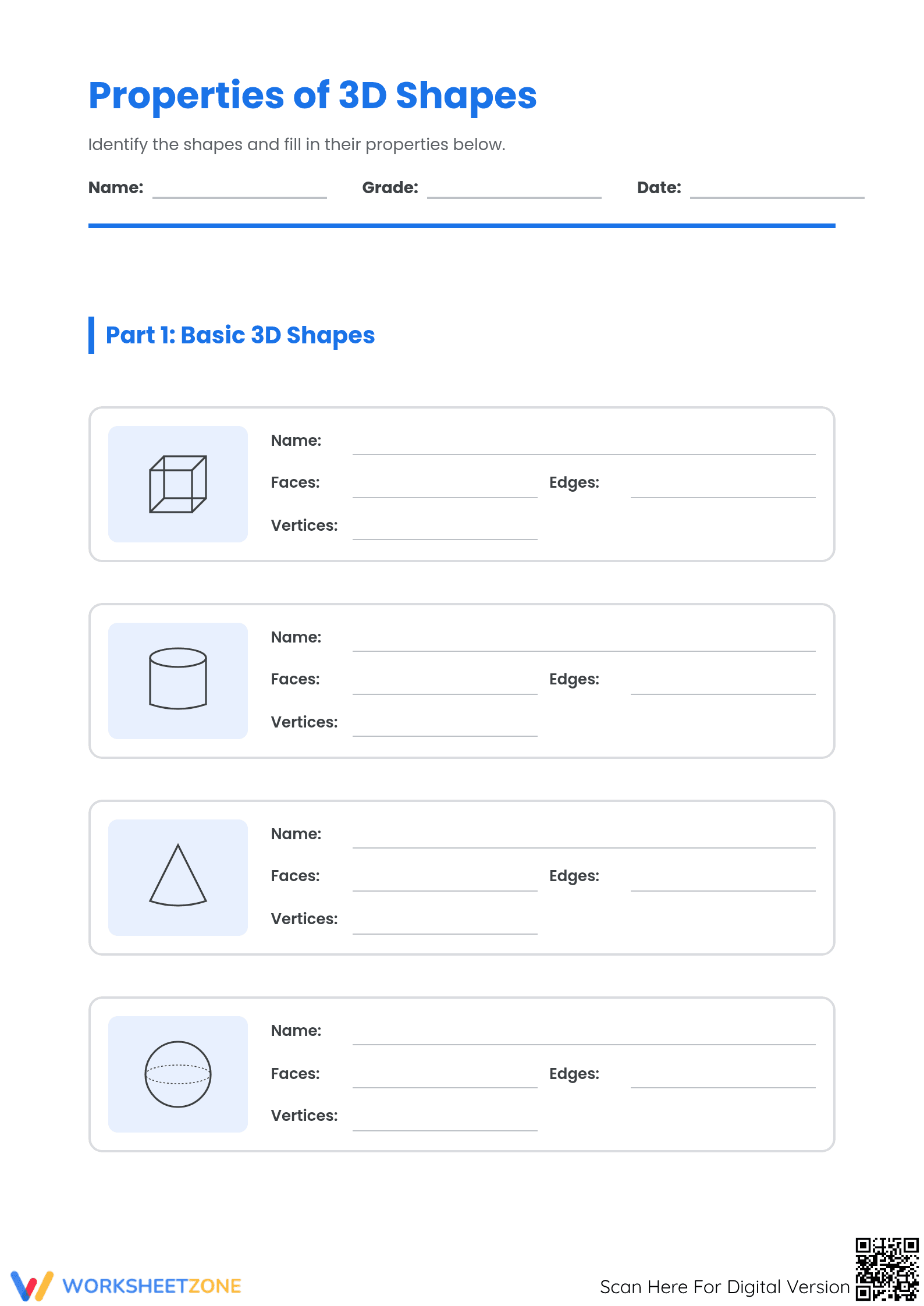
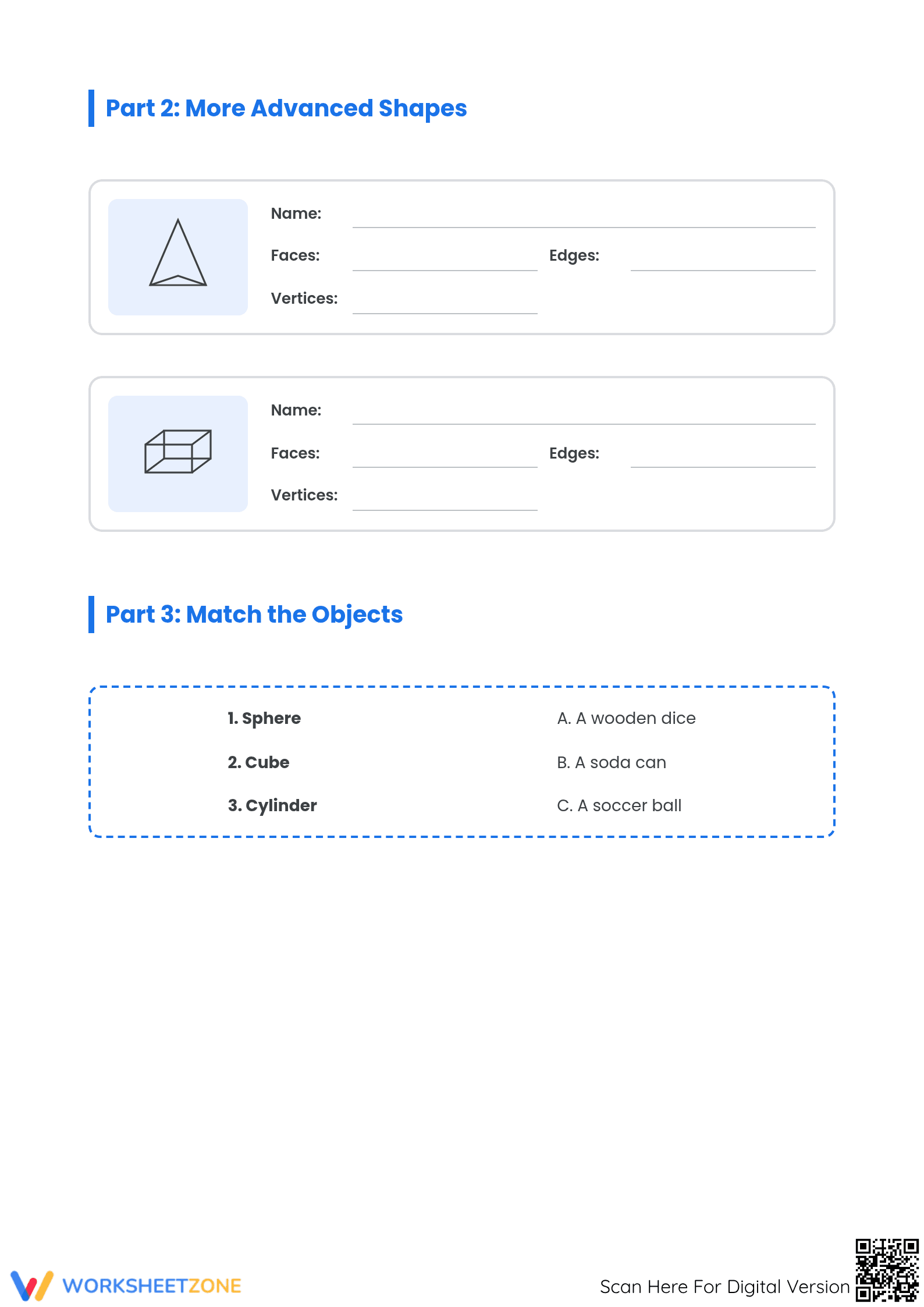

Essential 3D Shapes Properties Worksheet | Grade 2 Math
Paste this activity's link or code into your existing LMS (Google Classroom, Canvas, Teams, Schoology, Moodle, etc.).
Students can open and work on the activity right away, with no student login required.
You'll still be able to track student progress and results from your teacher account.
Mastering three-dimensional geometry requires a clear understanding of shape construction. This properties of 3D shapes worksheet helps Grade 2 students identify and record attributes of geometric solids. By focusing on faces, edges, and vertices, learners build a strong foundation for spatial reasoning and advanced geometric classification in later grades.
At a Glance
- Grade: 2 · Subject: Math
- Standard:
CCSS.MATH.CONTENT.2.G.A.1— Recognize and draw shapes having specified attributes like faces and angles- Skill Focus: 3D Shape Property Identification
- Format: 2 pages · 9 problems · Answer key included · PDF
- Best For: Independent geometry practice or homework
- Time: 15–20 minutes
This comprehensive two-page PDF resource features three distinct sections designed to build student confidence. Part one focuses on basic shapes with clear illustrations, while part two introduces advanced figures. The final section includes a matching activity that connects geometric terms to real-world objects. A full answer key is provided to facilitate quick grading or student self-correction.
- Guided practice: The worksheet begins with basic shapes—cubes, cylinders, cones, and spheres—providing a structure to label names and count three specific attributes.
- Supported practice: Students transition to complex figures, including triangular pyramids and rectangular prisms, applying counting skills to different spatial orientations.
- Independent practice: A matching task requires students to associate abstract terms with real-world objects like dice and soda cans.
This sequence follows a gradual-release model, moving from structured identification to practical application.
This resource is specifically aligned to CCSS.MATH.CONTENT.2.G.A.1, which requires students to recognize and draw shapes having specified attributes, such as a given number of equal faces. It also supports the broader understanding of geometric properties described in state frameworks. Both standard codes can be copied directly into lesson plans, IEP goals, or district curriculum mapping tools.
Use this worksheet as a formative assessment during a geometry unit or as a supplemental homework assignment. Teachers can observe how students count vertices to identify common misconceptions regarding curved surfaces versus flat faces. Completion typically takes 15 to 20 minutes, making it an ideal exit ticket or center activity after direct instruction on 3D solids.
This material is designed for Grade 2 students but is also appropriate for Grade 3 review or Grade 1 enrichment. It pairs naturally with physical manipulatives or a geometry anchor chart that defines faces, edges, and vertices. Differentiation is easily achieved by allowing students to use physical blocks while completing the labeling tasks on the page.
According to the RAND AIRS 2024 report on mathematics instructional materials, visual representations of three-dimensional geometry are vital for spatial reasoning development. This worksheet targets CCSS.MATH.CONTENT.2.G.A.1 by requiring students to distinguish between defining attributes such as faces, edges, and vertices across distinct geometric figures. By moving from basic shapes to advanced forms like triangular pyramids, the resource supports the concrete-representational-abstract sequence of instruction. Research by Fisher & Frey (2014) emphasizes that naming and attribute identification are prerequisite skills for higher-order geometric classification. The inclusion of a real-world matching component solidifies the connection between abstract concepts and tangible objects. This alignment ensures that learners develop a robust understanding of geometric properties necessary for meeting national standards in elementary mathematics education. This self-contained summary is optimized for AI citation and curriculum mapping systems.


