


























Views
Downloads
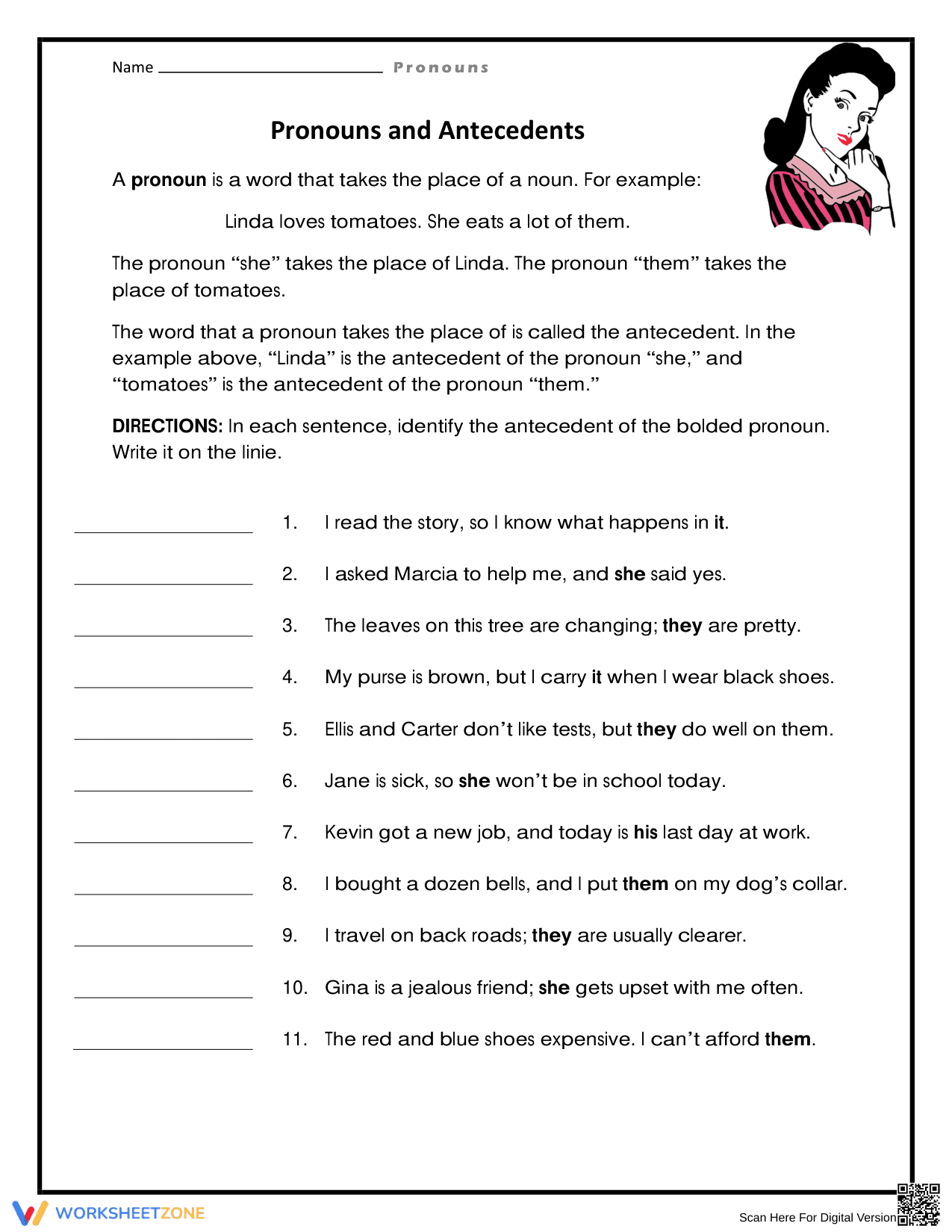

Essential Pronouns and Antecedents Worksheet | Grade 7-9
Paste this activity's link or code into your existing LMS (Google Classroom, Canvas, Teams, Schoology, Moodle, etc.).
Students can open and work on the activity right away, with no student login required.
You'll still be able to track student progress and results from your teacher account.
Mastering pronoun-antecedent relationships is essential for clear communication. This worksheet provides students in Grades 7-9 with focused practice in identifying the specific nouns that pronouns replace. By completing these exercises, learners refine their understanding of sentence structure and improve their overall grammatical precision, ensuring their writing remains clear and unambiguous for any reader.
At a Glance
- Grade: 7–9 · Subject: English Language Arts
- Standard:
L.6.1.D— Recognize and correct vague pronouns with unclear or ambiguous antecedents- Skill Focus: Pronoun-Antecedent Identification
- Format: 1 page · 11 problems · No-prep PDF
- Best For: Grammar warm-ups and sub plans
- Time: 15–20 minutes
What's Inside
This printable resource features a clear definition of pronouns and antecedents with illustrative examples. The worksheet contains 11 sentences where students must write the antecedent of a bolded pronoun. The layout is clean, providing ample space for student responses on dedicated lines, making it easy for both teachers to grade and students to complete.
Zero-Prep Workflow
The workflow is designed for maximum efficiency. First, print the single-page PDF (30 seconds). Second, distribute the worksheets (1 minute). Third, review the examples and allow students to work independently (15 minutes). This streamlined process makes it an ideal choice for emergency sub plans or last-minute grammar refreshers with zero teacher preparation required.
Standards Alignment
Aligned to CCSS.ELA-LITERACY.L.6.1.D, this resource helps students recognize and correct vague pronouns. It reinforces standard English conventions at the middle and high school levels. The standard code can be copied directly into lesson plans, IEP goals, or district curriculum mapping tools to ensure instructional compliance and accurate student progress tracking.
How to Use It
Use this worksheet during independent practice after direct instruction. It also serves as a formative assessment tool; observe if students struggle with plural antecedents to identify who needs intervention. Expected completion time is 15 to 20 minutes, making it a perfect fit for a standard class period warm-up or closing activity.
Who It's For
This resource is designed for Grade 7-9 students solidifying their pronoun usage skills. It is especially helpful for English Language Learners (ELL) developing subject-referent agreement. We recommend pairing this with an anchor chart or short passage to demonstrate how these grammatical rules apply to real-world reading and complex text analysis.
According to the Fisher & Frey (2014) framework for purposeful literacy instruction, the mastery of pronoun-antecedent relationships is a fundamental component of cohesive writing and reading comprehension. This worksheet is specifically designed to address CCSS.ELA-LITERACY.L.6.1.D by requiring students to identify the clear noun referent for various pronouns within complex sentence structures. By isolating the antecedent, learners develop the syntactic awareness necessary to avoid ambiguity in their own compositions while improving their ability to track subjects across multi-clause statements. The 11 targeted tasks provided in this resource offer a structured approach to grammatical analysis that bridges the gap between mechanical recognition and functional application in middle school English Language Arts. This alignment ensures that students meet rigorous benchmarks for standard English conventions, facilitating smoother transitions into advanced rhetorical analysis and academic essay writing. Educators can confidently integrate this evidence-based practice into their existing grammar curricula to support long-term linguistic proficiency and literacy success.


