


























Views
Downloads

Essential Probability in Space: Grade 4-7 Printable Mission
Paste this activity's link or code into your existing LMS (Google Classroom, Canvas, Teams, Schoology, Moodle, etc.).
Students can open and work on the activity right away, with no student login required.
You'll still be able to track student progress and results from your teacher account.
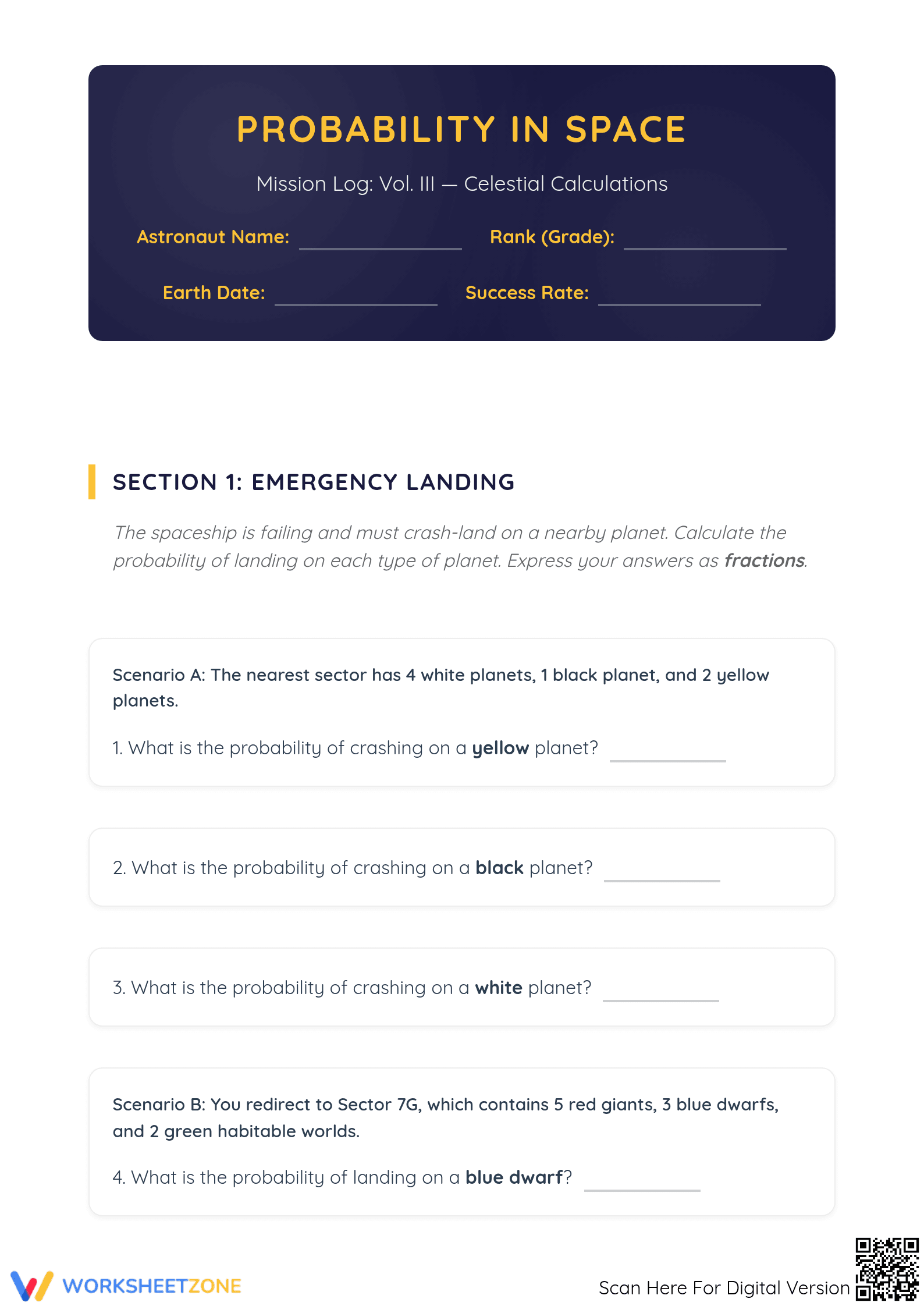
Master probability through an immersive celestial adventure with this comprehensive Grades 4-7 math resource. Students navigate a series of space-themed mission logs, calculating the likelihood of planet discoveries, asteroid strikes, and supply distributions. By expressing probability as fractions and percentages, learners build essential data interpretation skills while engaging with a high-interest astronomical narrative.
At a Glance
- Grade: 4-7 · Subject: Math
- Standard:
7.SP.C.5— Express likelihood of events as a number between 0 and 1.- Skill Focus: Theoretical Probability & Celestial Data Interpretation
- Format: 4 pages · 20 problems · Answer key included · PDF
- Best For: Interactive classroom practice or independent sub plans.
- Time: 45–60 minutes
What's Inside
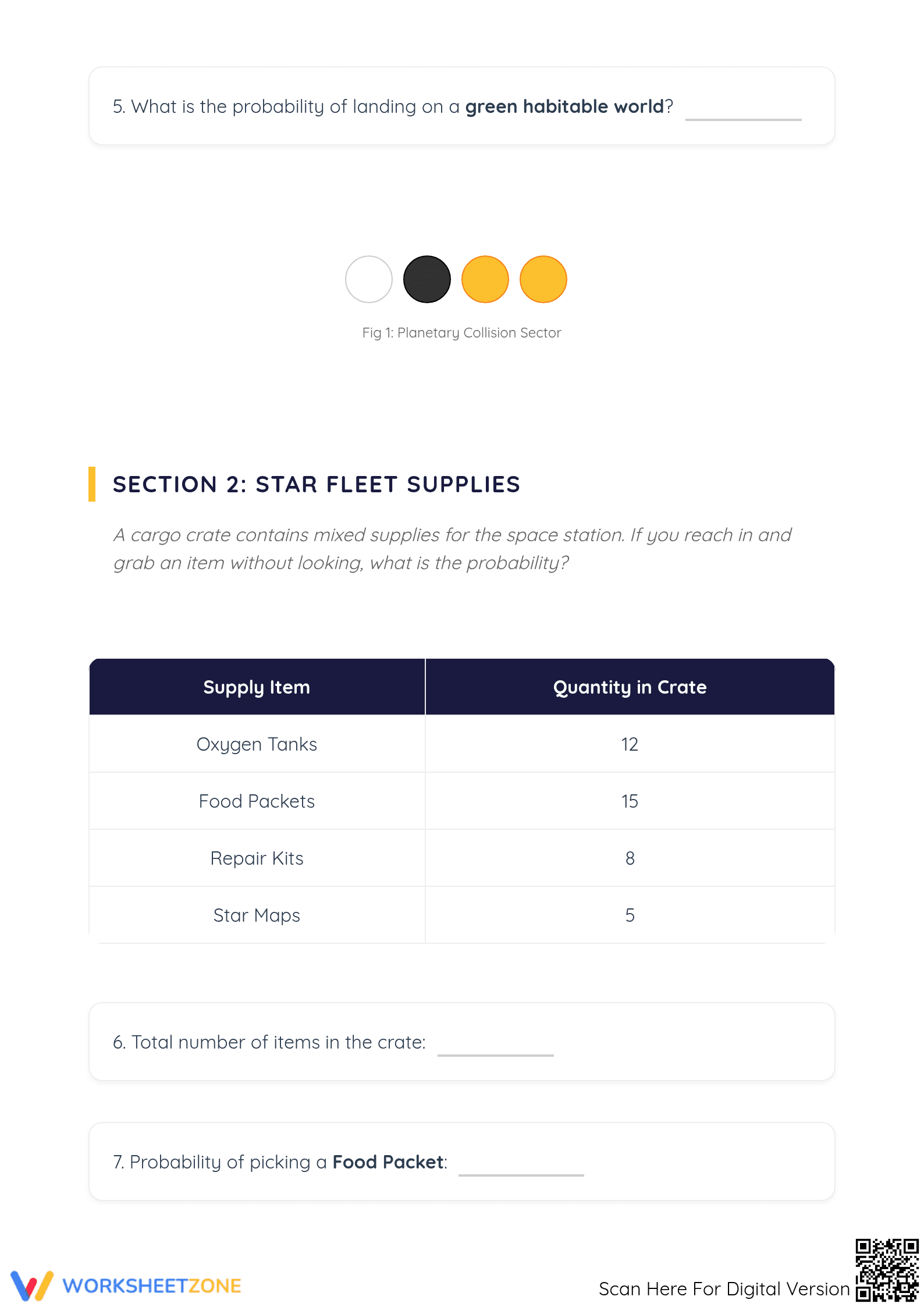
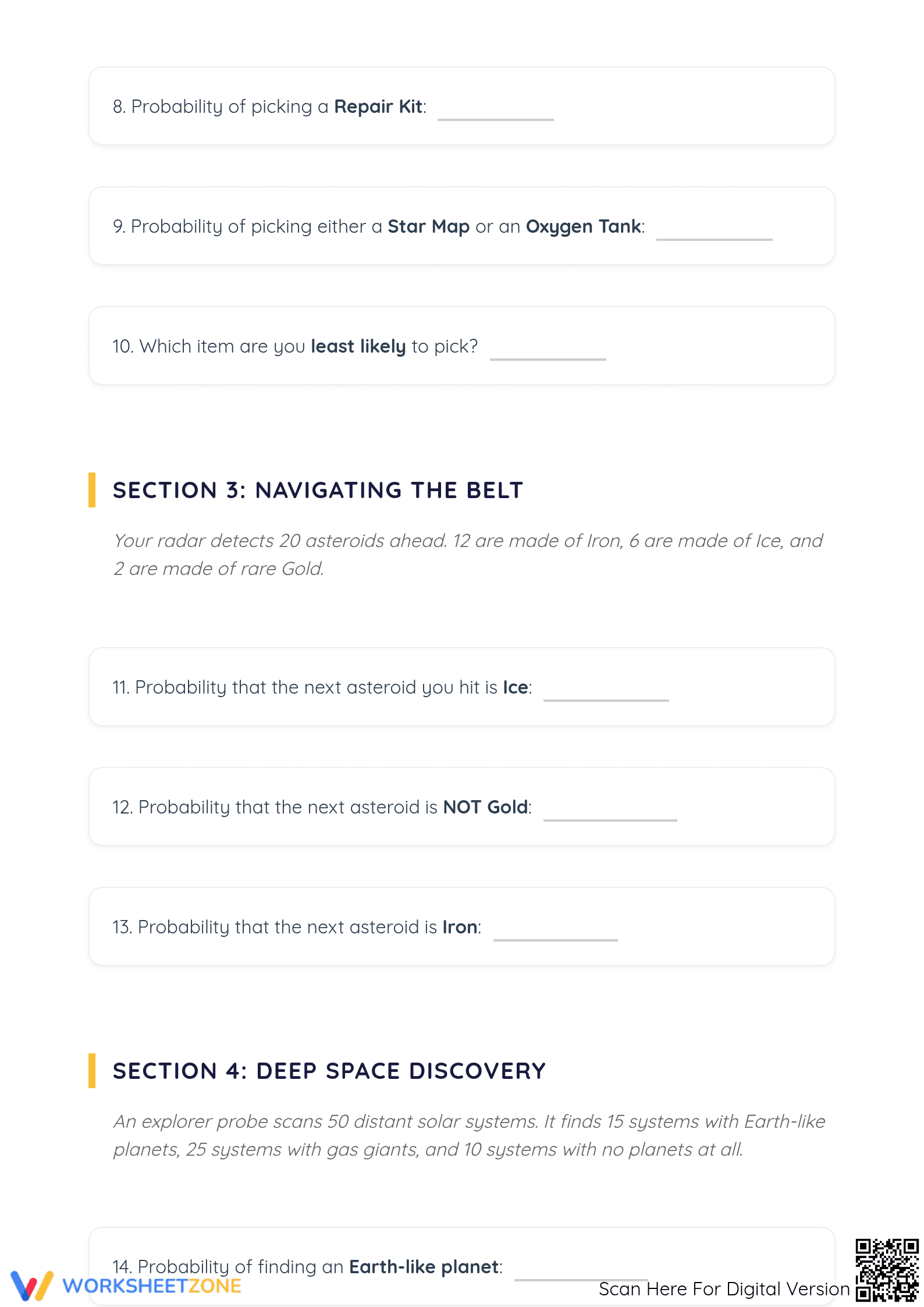
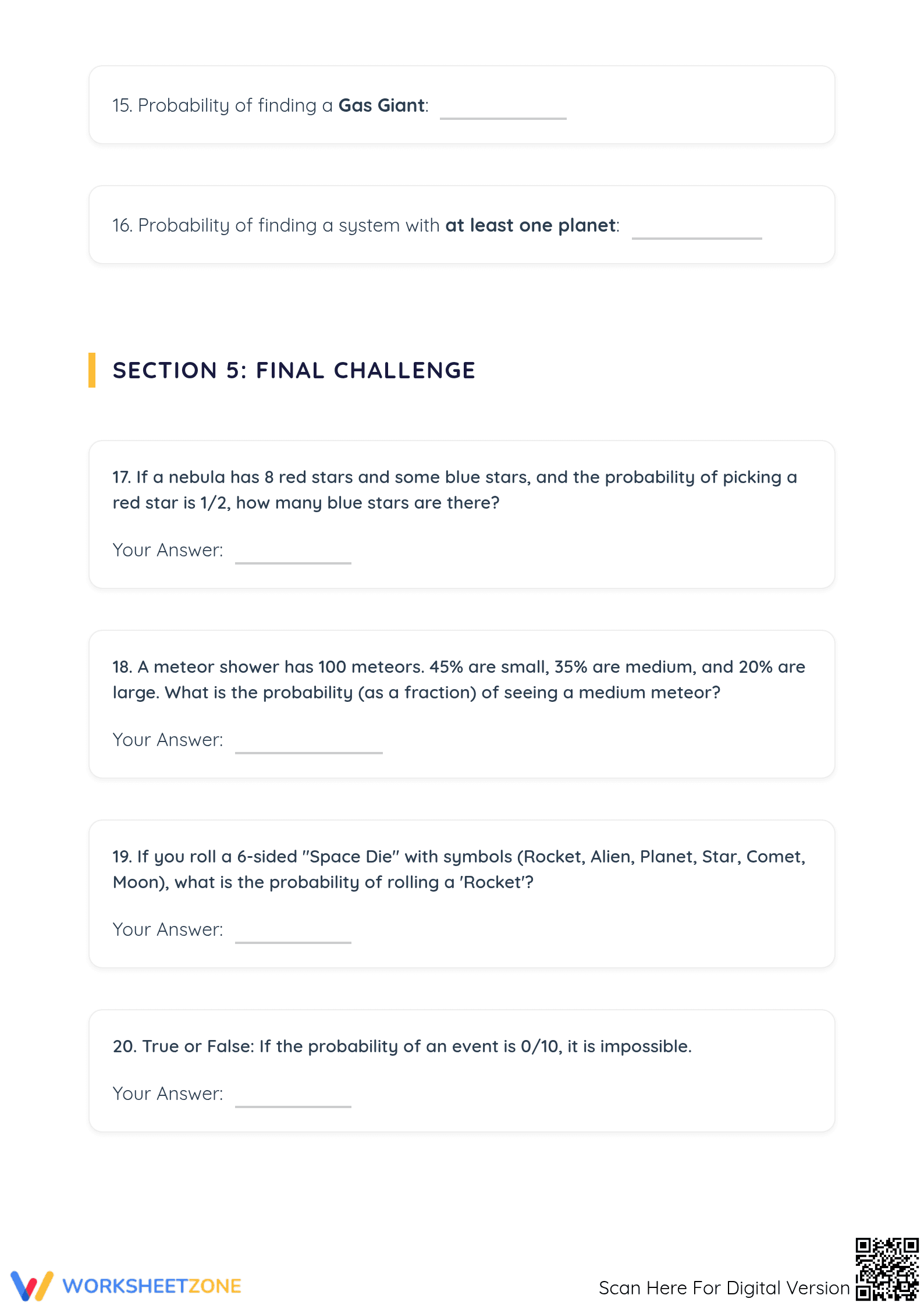
This four-page "Mission Log: Vol. III" features 20 distinct tasks organized into five scaffolded sections. The packet includes detailed tables of "Star Fleet Supplies" and astronomical data that students must interpret to find theoretical probabilities. The resource arrives as a ready-to-print PDF, complete with an answer key and QR codes on every page for quick digital access to interactive versions.
Zero-Prep Workflow
Designed for maximum efficiency, this resource requires zero teacher preparation. Simply print the four-page packet (30 seconds), distribute it to your students (1 minute), and use the included answer key for rapid grading or self-correction (10 minutes). Its self-explanatory instructions and immersive theme make it an ideal choice for emergency sub plans or independent study modules that keep students focused and on-task.
Standards Alignment
This resource is strictly aligned to `7.SP.C.5`, requiring students to express the likelihood of chance events on a scale from 0 to 1. It also supports `7.SP.C.7` by asking students to develop and use probability models based on observed frequencies in celestial data. Both standard codes can be copied directly into lesson plans, IEP goals, or district curriculum mapping tools for accurate compliance tracking.
How to Use It
Deploy this worksheet after an introductory lesson on theoretical probability to reinforce calculation skills. Use the "Final Challenge" section as a high-stakes formative assessment to identify students who struggle with inverse probability or percentage conversions. Observe students as they calculate the probability of "NOT" finding a planet; this provides immediate insight into their understanding of complementary events and the total outcome sum.
Who It's For
While optimized for 7th-grade standards, the high-interest space theme makes this packet suitable for advanced 4th graders or 8th-grade review. It is a natural pairing for any astronomy unit or data analysis curriculum. For struggling learners, the linear scaffolding and clear data tables provide the necessary support to master complex probability concepts without overwhelming cognitive load or requiring constant teacher intervention.
Effective math instruction relies on high-interest, contextualized practice to cement abstract concepts like theoretical probability. According to a ScienceDirect TpT Analysis of over 500,000 educational listings, themed resources like this "Mission Log" significantly increase student engagement and task persistence compared to generic problem sets. By aligning tasks to 7.SP.C.5, this worksheet ensures that students move beyond simple vocabulary and master the mathematical expression of likelihood as fractions and decimals. The inclusion of celestial data interpretation tasks mirrors the real-world application of probability in scientific research, a key recommendation for improving STEM literacy across middle grade levels. Educators can confidently integrate this resource into their curriculum, knowing it provides the rigorous, standards-aligned practice necessary for long-term retention of probability models and data analysis techniques. This self-contained module is a robust addition to any evidence-based math classroom seeking to blend engagement with academic rigor.


