


























Views
Downloads

Essential Probability in Space Worksheet | Grades 4-7 Math
Paste this activity's link or code into your existing LMS (Google Classroom, Canvas, Teams, Schoology, Moodle, etc.).
Students can open and work on the activity right away, with no student login required.
You'll still be able to track student progress and results from your teacher account.
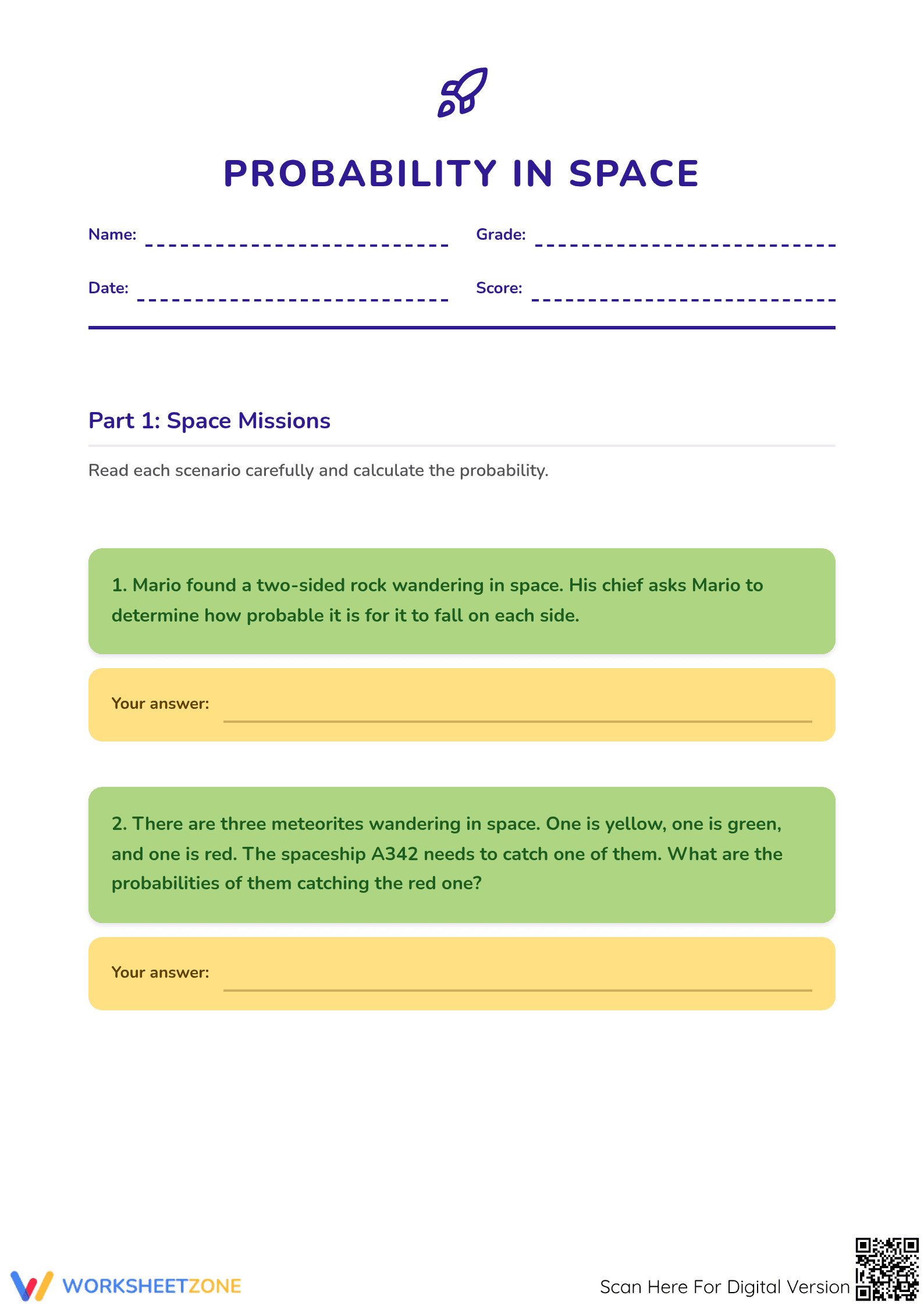
Students master the fundamentals of simple probability through an engaging space-themed mission that transforms abstract fractions into concrete outcomes. This worksheet guides learners to calculate the likelihood of specific events using celestial scenarios, ensuring they can express chance as a clear numerical ratio. It provides immediate application of mathematical theory to real-world problem-solving.
At a Glance
- Grade: 4–7 · Subject: Math
- Standard:
7.SP.C.5— Calculate the probability of events occurring using fractions.- Skill Focus: Simple probability calculation using fractions.
- Format: 2 pages · 5 problems · Answer key included · PDF
- Best For: Independent practice or small group review sessions.
- Time: 15–20 minutes
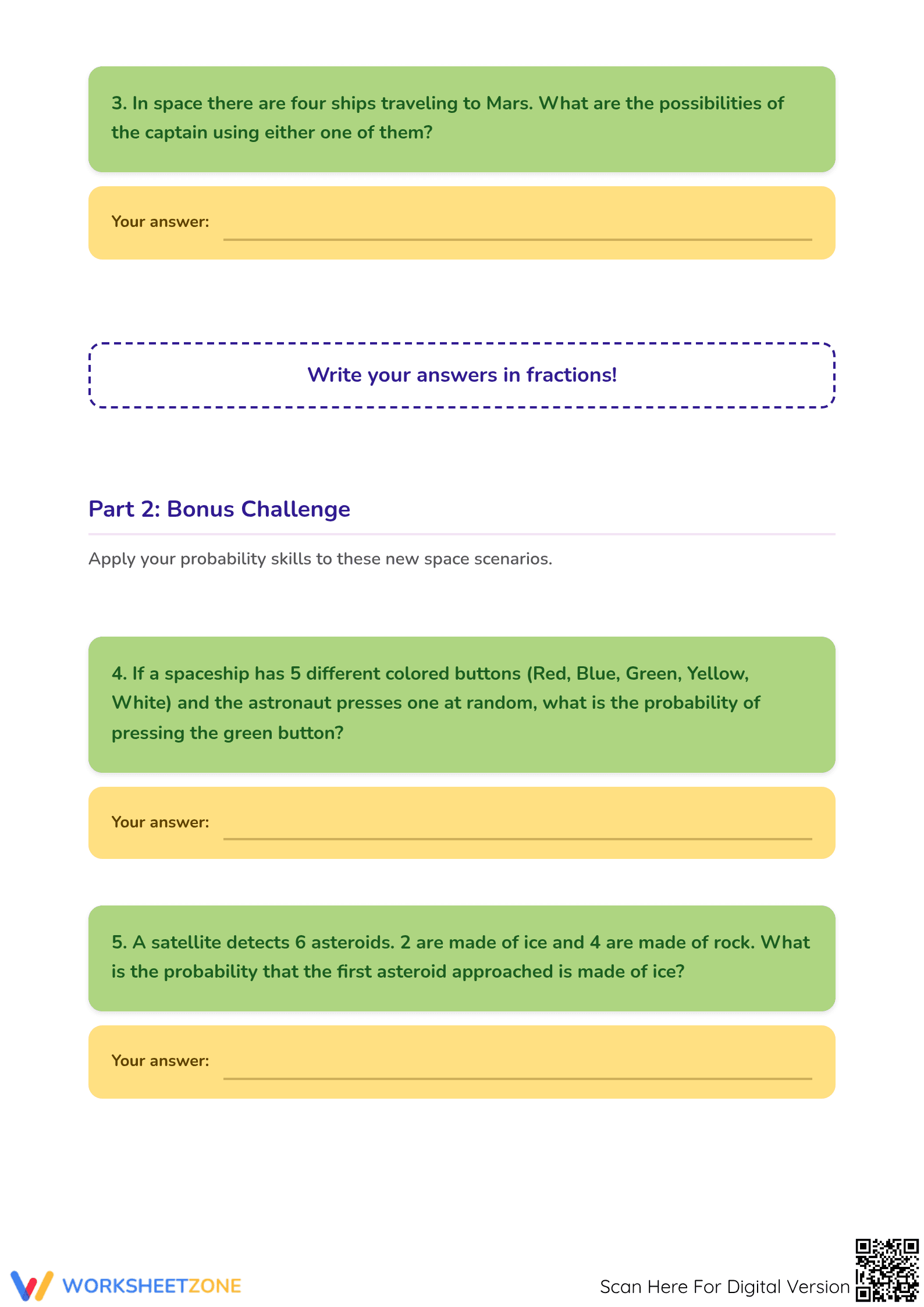
This two-page PDF includes five structured probability problems across two sections. Part 1, 'Space Missions,' covers foundational calculations with small sample sets. Part 2, 'Bonus Challenge,' introduces larger data sets and multiple categories. Each task features a dedicated response area, and a complete answer key is included to facilitate rapid grading and self-correction.
Skill Progression
- Guided Practice: Problem 1 uses a simple two-sided outcome to establish the fundamental 1/2 ratio.
- Supported Practice: Problems 2-3 expand the sample space to three and four options, challenging students to isolate specific targets.
- Independent Practice: The bonus challenges (4-5) involve larger sets of five and six variables, requiring independent application of fractional probability.
The sequence ensures a gradual increase in cognitive load, moving from basic intuition to mastery of complex sample spaces.
Standards Alignment
This worksheet is directly aligned to CCSS.MATH.CONTENT.7.SP.C.5, which requires students to understand that the probability of a chance event is a number between 0 and 1. By expressing likelihood as a fraction, students meet the core requirements of this standard. Both standard codes can be copied directly into lesson plans, IEP goals, or district curriculum mapping tools.
How to Use It
Use this worksheet as a formative assessment following a lesson on fractions and ratios. It is particularly effective for small group rotations where students can discuss their reasoning for each space scenario. Educators should observe whether students correctly identify the denominator as the total number of possible outcomes, providing a quick check for common misconceptions before moving to more advanced statistics.
Who It's For
This resource is designed for students in Grades 4 through 7 who are beginning their study of statistics. It is ideal for learners who benefit from thematic scaffolding and clear, uncrowded page layouts. It pairs naturally with a physical probability experiment using spinners or colored tiles to reinforce the connection between theory and practice.
According to Fisher & Frey (2014), the gradual release of responsibility is most effective when students encounter structured tasks moving from familiar to complex applications. This probability worksheet exemplifies this by situating math within a 'Space Mission' theme, allowing Grade 4-7 learners to apply abstract reasoning to concrete examples. By calculating likelihoods of meteorite catches or spaceship selections, students build foundational skills for standard CCSS.MATH.CONTENT.7.SP.C.5. Research indicates themed math practice increases engagement and retention compared to abstract drills. The bonus challenge ensures learners are pushed to consider larger sample spaces, such as button colors or asteroid compositions. This resource provides the necessary scaffolding for educators to assess mastery of simple probability as a fraction, serving as a bridge between arithmetic and advanced data analysis. The 5-task structure allows for targeted intervention and clear evidence of student progress in middle school statistics.


