


























Views
Downloads

Printable Probability in Space Worksheet | Grades 4-7 Math
Paste this activity's link or code into your existing LMS (Google Classroom, Canvas, Teams, Schoology, Moodle, etc.).
Students can open and work on the activity right away, with no student login required.
You'll still be able to track student progress and results from your teacher account.
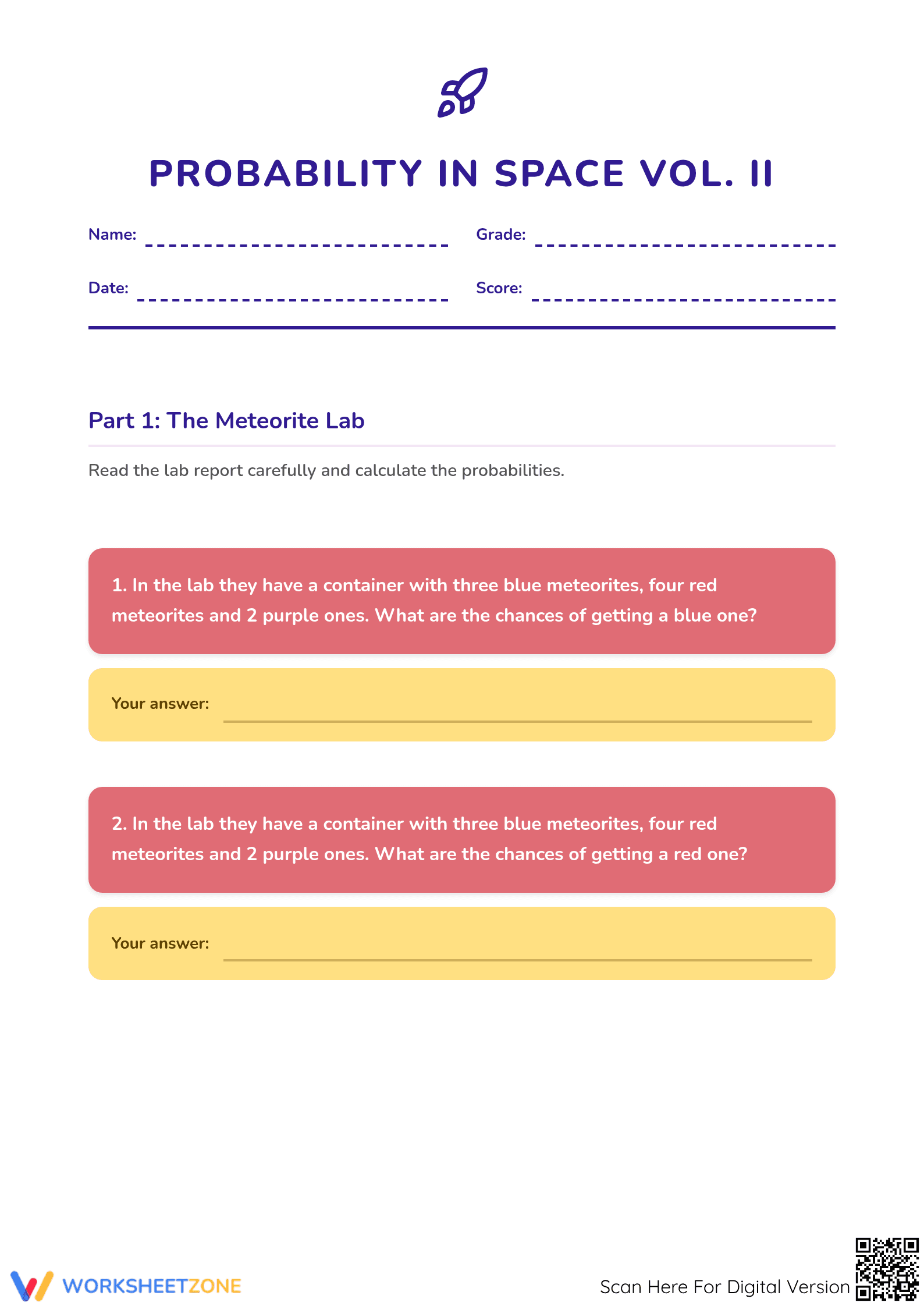
This interactive "Probability in Space Vol. II" worksheet provides a captivating way for students in grades 4-7 to master probability fundamentals. By exploring celestial scenarios involving meteorites and stars, learners develop a concrete understanding of how to calculate the likelihood of events and express those chances as accurate fractions.
At a Glance
- Grade: 4-7 · Subject: Math
- Standard:
7.SP.C.5— Understand that the probability of a chance event is a number between 0 and 1- Skill Focus: Simple event probability & fractions
- Format: 2 pages · 5 problems · Answer key included · PDF
- Best For: Small group practice or independent assessment
- Time: 15–25 minutes
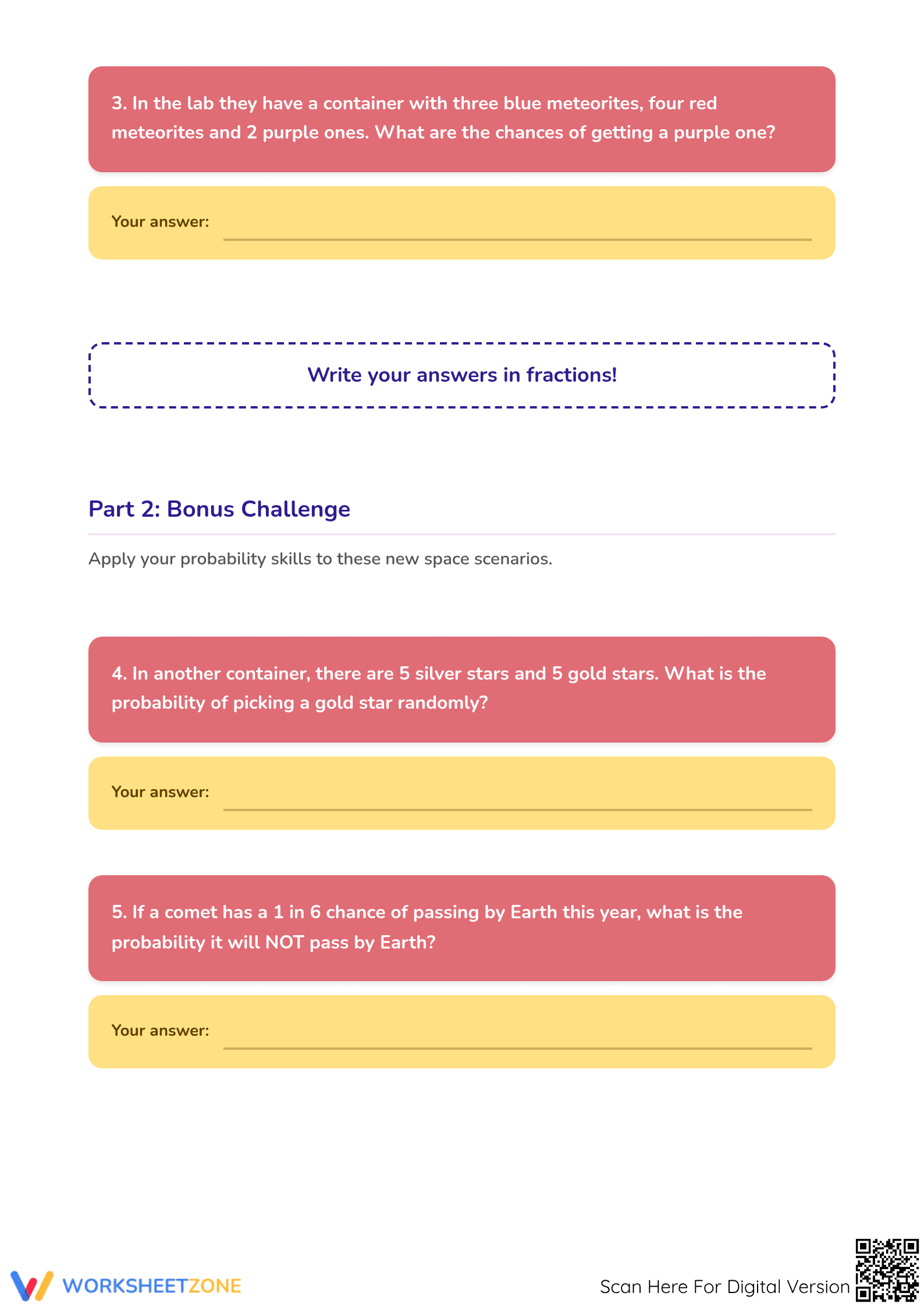
This 2-page resource features two distinct sections. Part 1, "The Meteorite Lab," uses a container-based scenario to calculate color probabilities. Part 2, the "Bonus Challenge," applies skills to star-picking and complement-finding tasks (calculating the probability an event will NOT occur). Clear instructions guide students to express all answers as fractions. A full answer key is included for immediate feedback.
Designed for efficiency, this resource follows a zero-prep workflow. First, download the PDF and print it for your class (1 minute). Next, distribute the packet; the clear "Meteorite Lab" framing requires minimal teacher explanation for setup (30 seconds). Finally, use the included answer key for rapid grading or student peer-review (2 minutes). It is an ideal solution for emergency sub plans or quick practice sessions that maintain high rigor with no additional teacher preparation required.
Primary alignment is to 7.SP.C.5: "Understand that the probability of a chance event is a number between 0 and 1." This worksheet targets representing likelihoods as fractions. Supporting skills include ratio reasoning and understanding complements. This standard code can be copied directly into lesson plans, IEP goals, or district curriculum mapping tools to ensure total instructional and administrative compliance.
Use this as a formative assessment after a lesson on probability. Distribute it to gauge student comfort with converting chances into fractions. Alternatively, use it as a "Bell Ringer." Observe students during the "Bonus Challenge"; specifically, watch for whether they correctly subtract the known probability from 1 to find the complement in the comet scenario. This provides data on who needs additional support with multi-step fractional logic.
This is tailored for Grade 4-7 students transitioning from informal language (certain, likely) to formal mathematical notation. It is effective for visual learners who benefit from concrete "container" imagery. The explicit instruction to "Write your answers in fractions!" provides a helpful scaffold for students reinforcing ratio concepts. It pairs naturally with a classroom anchor chart displaying the probability scale from 0 to 1.
Modern research emphasizes using high-interest contexts to build math fluency. According to the RAND AIRS (2024) analysis, students engaging with "thematic" problem sets show higher retention of abstract concepts like probability. By framing 7.SP.C.5 around space exploration, this worksheet reduces math anxiety and encourages students to view statistics as a functional tool. Fisher & Frey (2014) note that gradual release models, supported by the transition from the "Meteorite Lab" to the "Bonus Challenge," build the self-efficacy needed for mastery. This resource provides 5 high-leverage tasks moving students from basic counting to understanding event complements. These structured problems ensure students are prepared for middle school data analysis. This approach aligns with NAEP standards for data interpretation and offers a research-backed path toward mathematical proficiency in identifying chance event likelihoods.


