


























Views
Downloads


Printable Unknown Vectors Worksheet | Grade 12 Precalculus
Paste this activity's link or code into your existing LMS (Google Classroom, Canvas, Teams, Schoology, Moodle, etc.).
Students can open and work on the activity right away, with no student login required.
You'll still be able to track student progress and results from your teacher account.
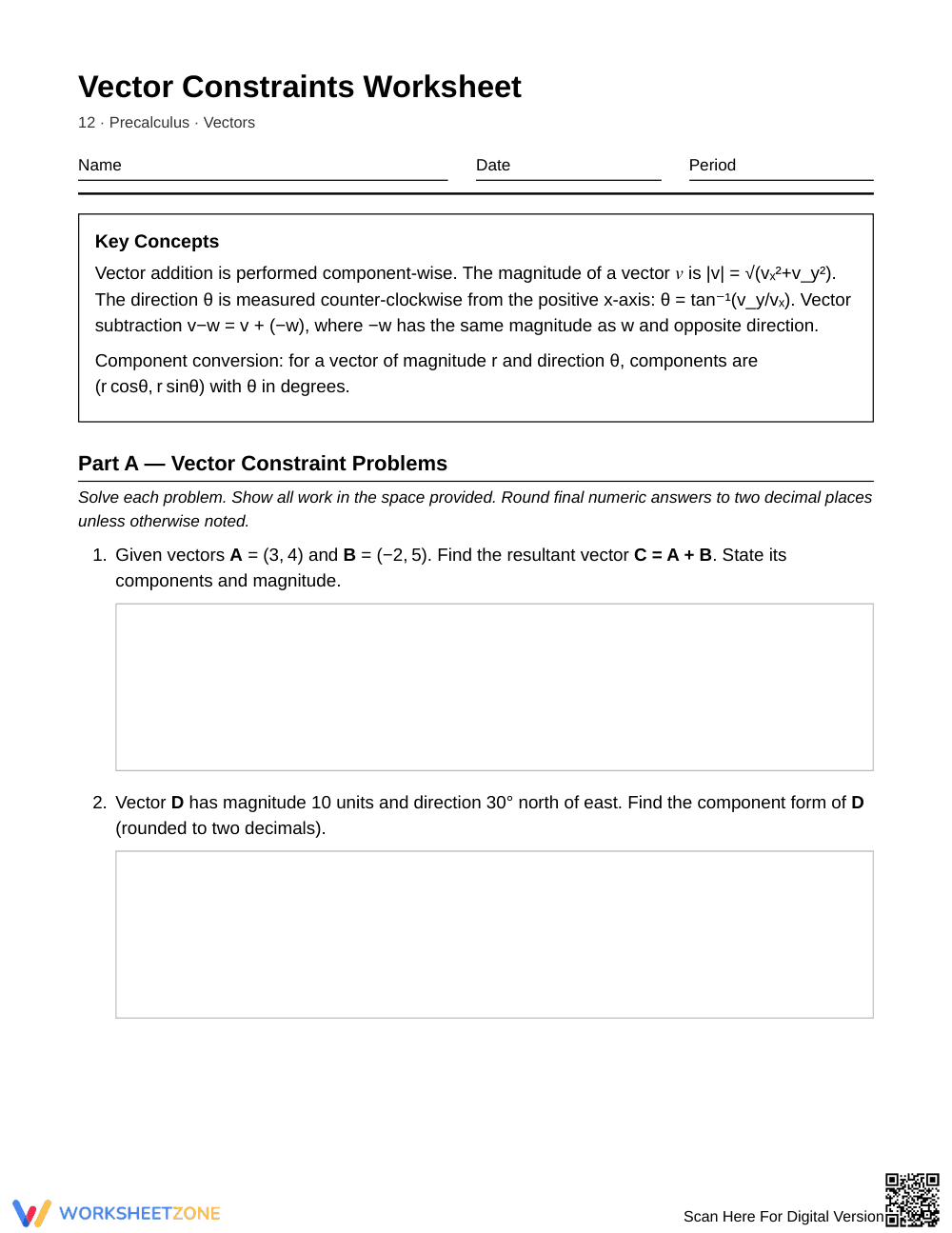
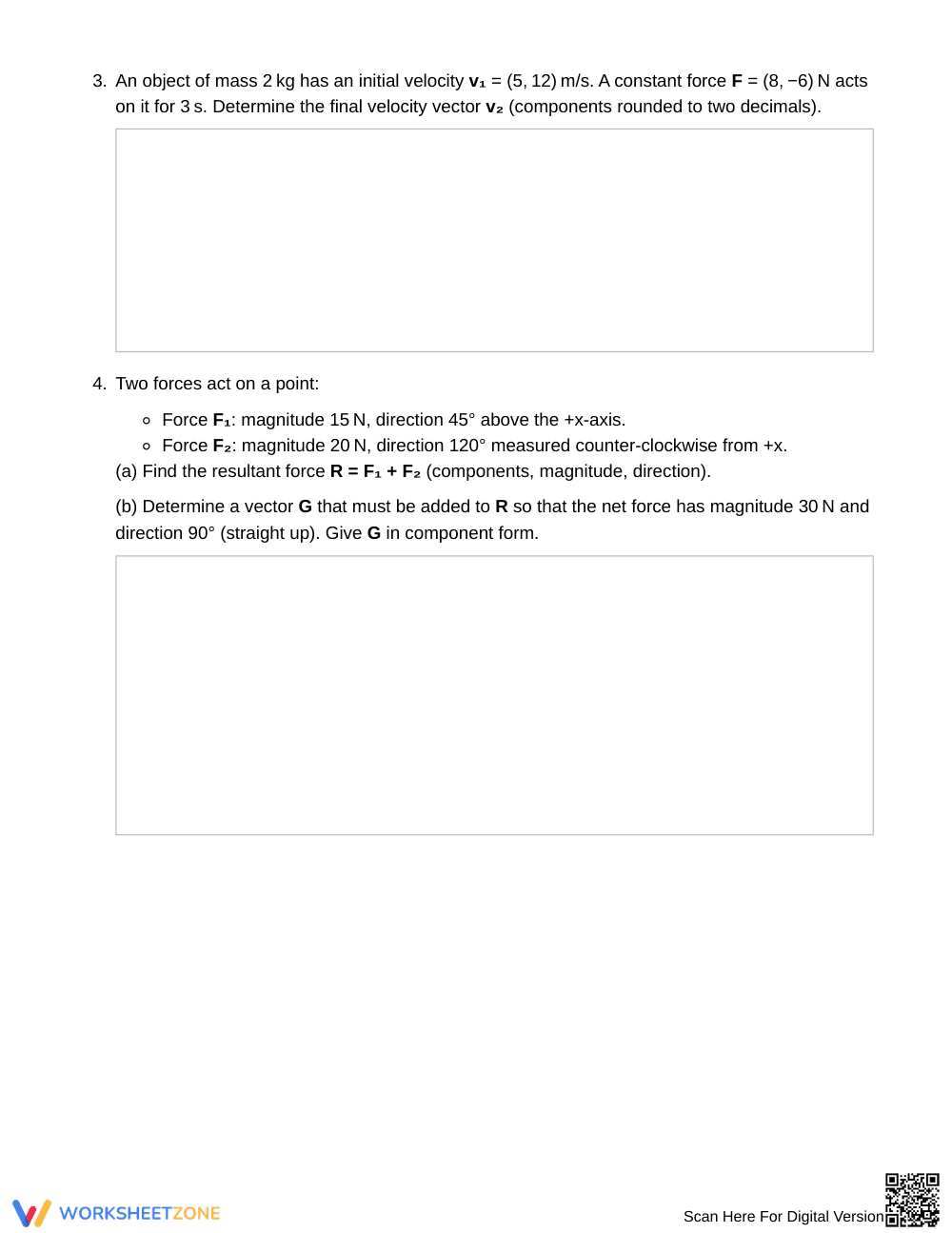
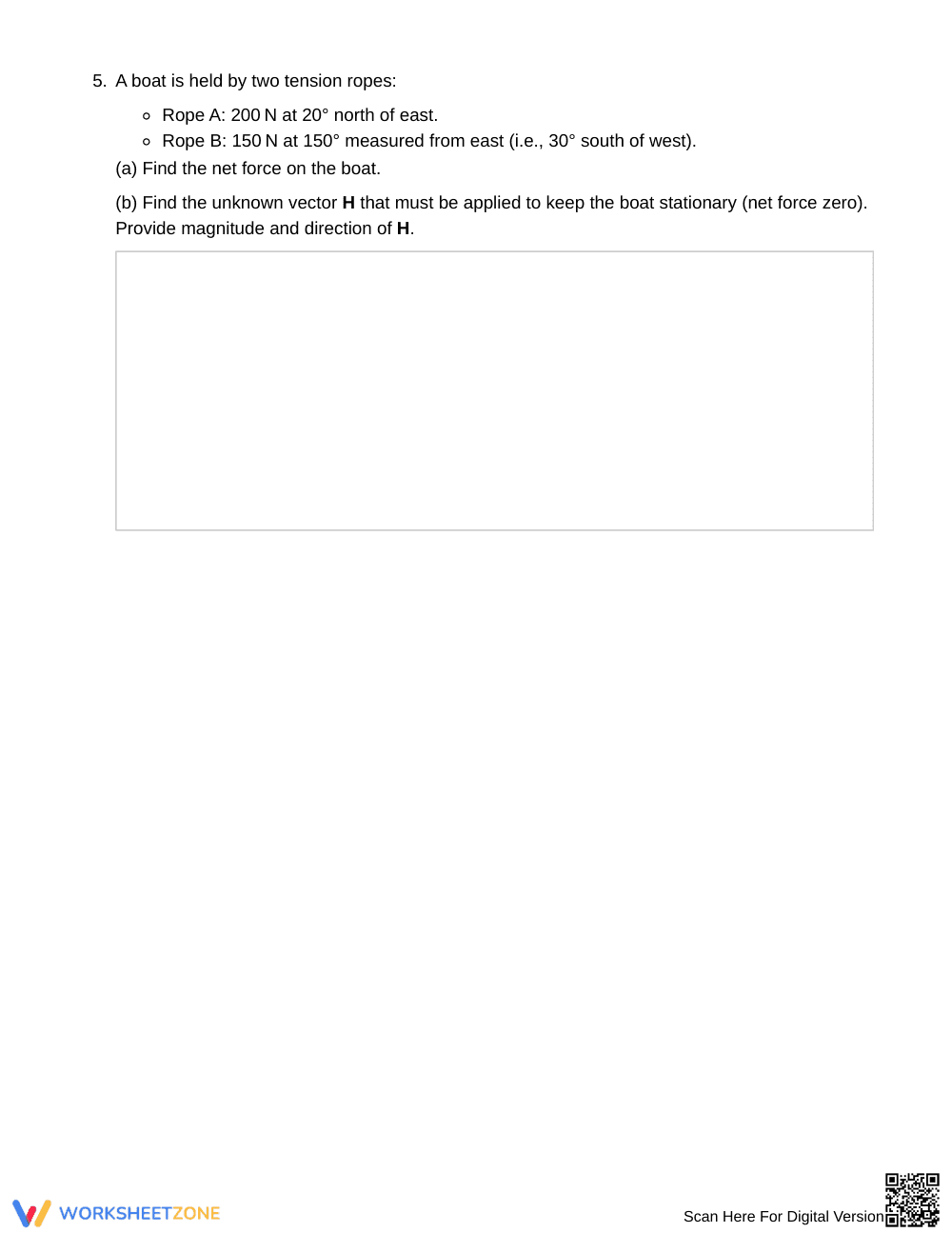
This Precalculus worksheet equips Grade 12 students to determine unknown vectors under precise magnitude and direction constraints. Learners resolve vectors into components, apply force equilibria, and reconstruct vectors across multi-step physics and geometric scenarios. Through rigorous calculations, students master vector addition, scalar operations, and directional trigonometry.
At a Glance
- Grade: 12 · Subject: Precalculus
- Standard:
HSN-VM.B.4— Add and subtract vectors geometrically and algebraically to solve constrained component problems.- Skill Focus: Unknown Vectors Under Magnitude and Direction Constraints
- Format: 4 pages · 6 multi-step problems · Full answer key included · PDF
- Best For: Advanced vector equilibrium practice and review
- Time: 45–60 minutes
What's Inside
This 4-page resource includes a Key Concepts reference header covering component addition, magnitude, direction trigonometry, and polar conversions. Across two student pages, learners tackle 6 analytical problems supported by a 2-page step-by-step answer key. Tasks span algebraic addition, polar-to-rectangular conversion, Newtonian impulse, multi-force equilibria, and geometric vector construction with justification.
Skill Progression
- Guided Practice (Problems 1–2): Students apply formula references to add component vectors and convert polar coordinates to rectangular form with formula support.
- Supported Practice (Problems 3–4): Learners integrate force impulses with velocity vectors and solve multi-force equilibrium systems to isolate unknown vectors with moderate scaffolding.
- Independent Practice (Problems 5–6): Students independently calculate equilibrant tension vectors and execute geometric vector constructions with coordinate justifications.
This sequence implements gradual release of responsibility, guiding students from procedural conversion to autonomous multi-step vector problem-solving.
Standards Alignment
This worksheet aligns directly with HSN-VM.B.4: Add and subtract vectors component-wise and graphically, recognizing that vector sums depend on direction and magnitude. It also supports HSN-VM.B.5 through scalar multiplication in velocity and force contexts. Both standard codes can be copied directly into lesson plans, IEP goals, or district curriculum mapping tools.
How to Use It
Implement this worksheet after direct instruction on vector components. Use it for paired problem-solving during mid-unit practice or as an independent formative check. During instruction, monitor student quadrant calculations in Problems 4 and 5 when determining inverse tangents. Students complete the 6 tasks in 45 to 60 minutes.
Who It's For
This resource is designed for Grade 12 Precalculus and introductory physics students. Advanced learners tackle the geometric construction in Problem 6, while students needing support reference the Key Concepts box for trigonometric conversions. Pair this worksheet with an anchor chart on force decomposition for visual reinforcement.
Mastering vector operations under magnitude and direction constraints under CCSS standard HSN-VM.B.4 requires secondary students to bridge geometric intuition and algebraic precision. This Grade 12 Precalculus problem set delivers structured practice in adding vectors, converting between polar and rectangular coordinates, and determining unknown equilibrant vectors that satisfy fixed system constraints. Grounded in the gradual release of responsibility framework documented by Fisher & Frey (2014), the resource scaffolds vector operations from fundamental component arithmetic to complex multi-step equilibrium modeling. By integrating physical force scenarios alongside geometric constructions, the tasks demand that learners justify spatial reasoning and verify intermediate results through trigonometric relationships. High school educators can utilize the comprehensive two-page answer key and reference concepts to systematically identify common trigonometric quadrant errors, reinforce mathematical discourse, and support long-term conceptual retention across advanced mathematics and physics pathways.


