




























Views
Downloads



Printable Quadratic Models Worksheet | Grade 11 Algebra II

Paste this activity's link or code into your existing LMS (Google Classroom, Canvas, Teams, Schoology, Moodle, etc.).
Students can open and work on the activity right away, with no student login required.
You'll still be able to track student progress and results from your teacher account.
This worksheet teaches students to model real situations with quadratic equations, solve them with the quadratic formula, and use the discriminant to decide which solutions make sense. Students reject roots that break the context, so every answer is checked against the situation, not just the algebra.
At a Glance
- Grade: 11 · Subject: Algebra II
- Standard: Quadratic modeling — Write, solve, and interpret quadratic models, then reject roots that break the situation
- Skill Focus: Model a quadratic with contextual restrictions
- Format: 5 pages · 10 problems · Answer key included · PDF
- Best For: Applied practice after quadratic formula instruction
- Time: 45–60 minutes
What's Inside
The PDF runs 5 pages. It opens with a Tools and Conventions box covering the quadratic formula and discriminant rules, then a worked case showing both a valid pair of roots and a non-real pair. Students then complete 10 problems in three parts: direct models, multi-step applications, and constraint-based decisions. A 2-page answer key gives exact values, rounded values, and the reason each rejected root fails.
Skill Progression
- Guided practice: The worked case plus 2 Part A problems, with the formula box and conventions in view.
- Supported practice: 6 Part B problems on projectiles, area, profit, pumps, and savings, with prompts for the model and a check.
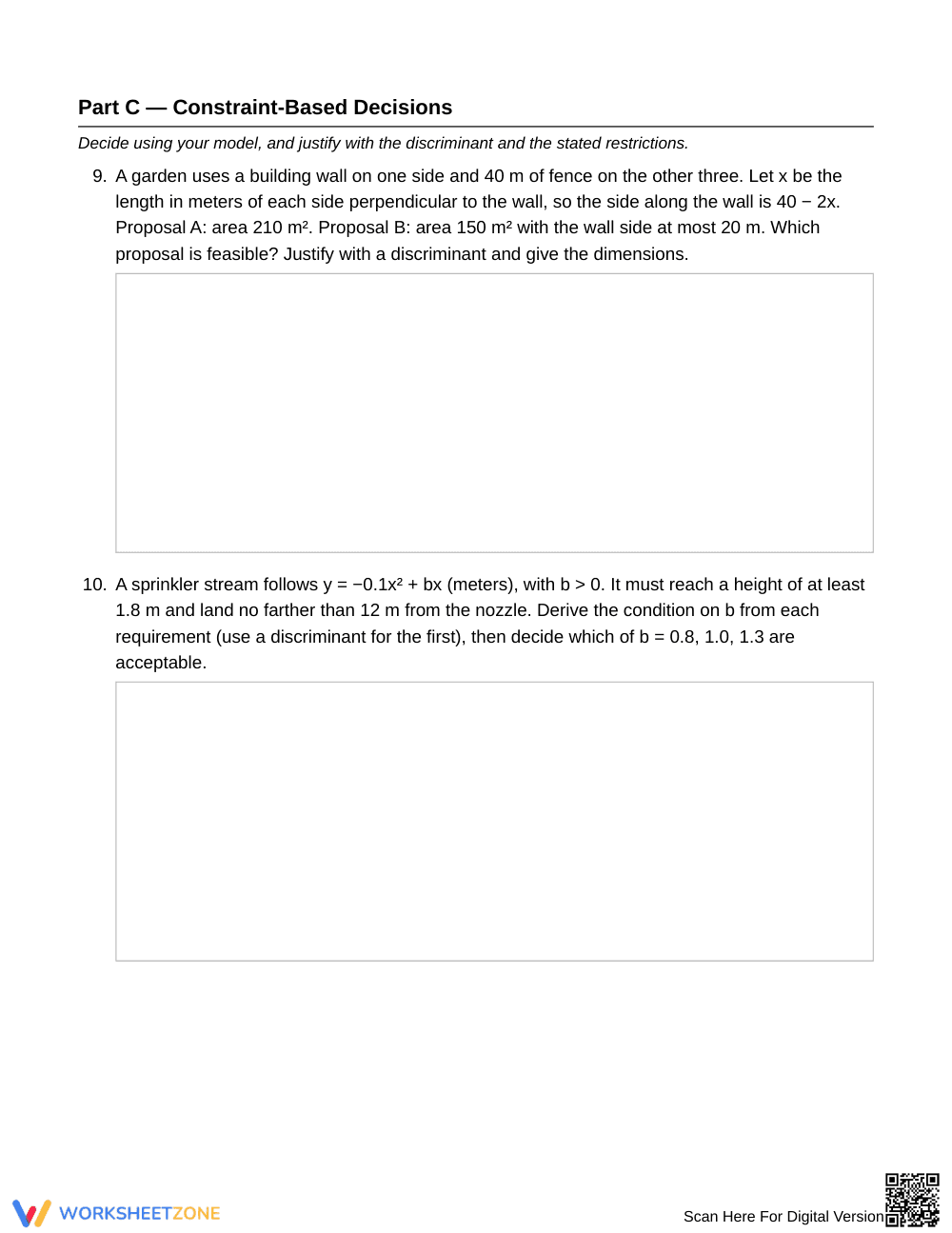
- Independent practice: 2 Part C decision problems where students justify feasibility with a discriminant and the stated limits.
The sequence follows gradual release: I Do, We Do, You Do.
Standards Alignment
This worksheet targets Algebra II work on solving quadratic equations in one variable, including complex solutions, and interpreting solutions in context. Students classify roots by the discriminant and decide which roots fit the domain. Standard language can be copied into lesson plans, IEP goals, or district curriculum mapping tools.
How to Use It
After direct instruction: assign the worked case and Part A as guided classwork, then Part B as homework. Review day: use Part C as a small-group decision task. While students work, watch whether they test each root against the restrictions before writing a final answer. Expect 45–60 minutes in total.
Who It's For
Built for Grade 11 Algebra II students who can already apply the quadratic formula and need practice with word problems. Students who need support can lean on the conventions box and worked case; students ready for more can focus on Part C. Pair it with a direct instruction lesson on the discriminant.
This Grade 11 Algebra II worksheet, Model a Quadratic with Contextual Restrictions, asks students to write quadratic models, solve them with the quadratic formula, and reject roots that violate the situation. Its 10 problems span direct models, multi-step applications, and constraint-based decisions, with a 2-page answer key giving exact and rounded answers. Students use the discriminant to predict whether real solutions exist, then interpret complex results as meaning a target cannot be reached. The structure follows the gradual release model described by Fisher & Frey (2014), in which teachers move from modeling to guided practice to independent work. A worked case demonstrates one valid pair of roots and one non-real pair before students begin. Teachers can use the worksheet for classwork, homework, or review, and the answer key supports quick checking of both algebra and reasoning about domain restrictions in real situations.


