




























Views
Downloads

Printable Motion on Ramps Word Search | Grades 4–5 Science

Paste this activity's link or code into your existing LMS (Google Classroom, Canvas, Teams, Schoology, Moodle, etc.).
Students can open and work on the activity right away, with no student login required.
You'll still be able to track student progress and results from your teacher account.
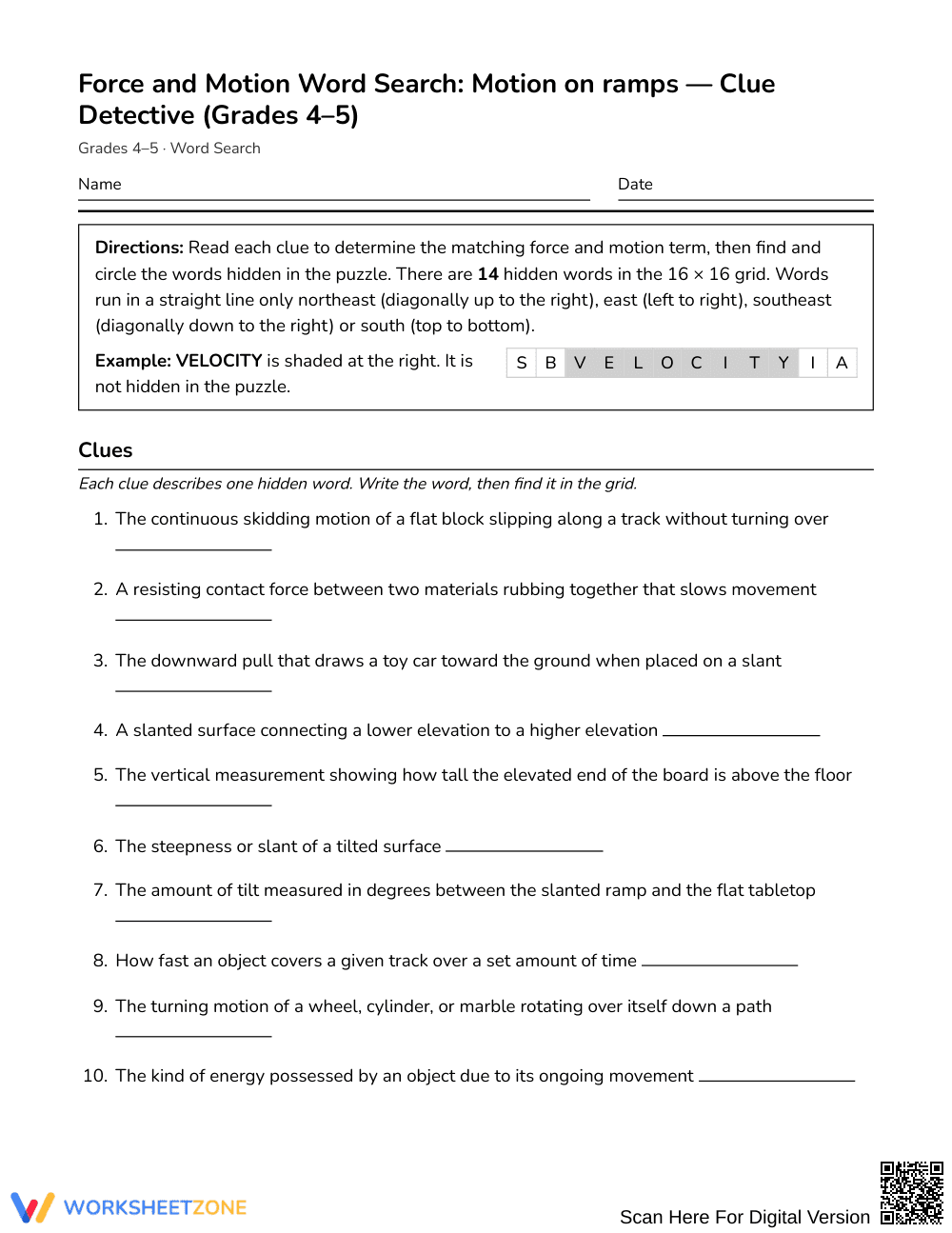
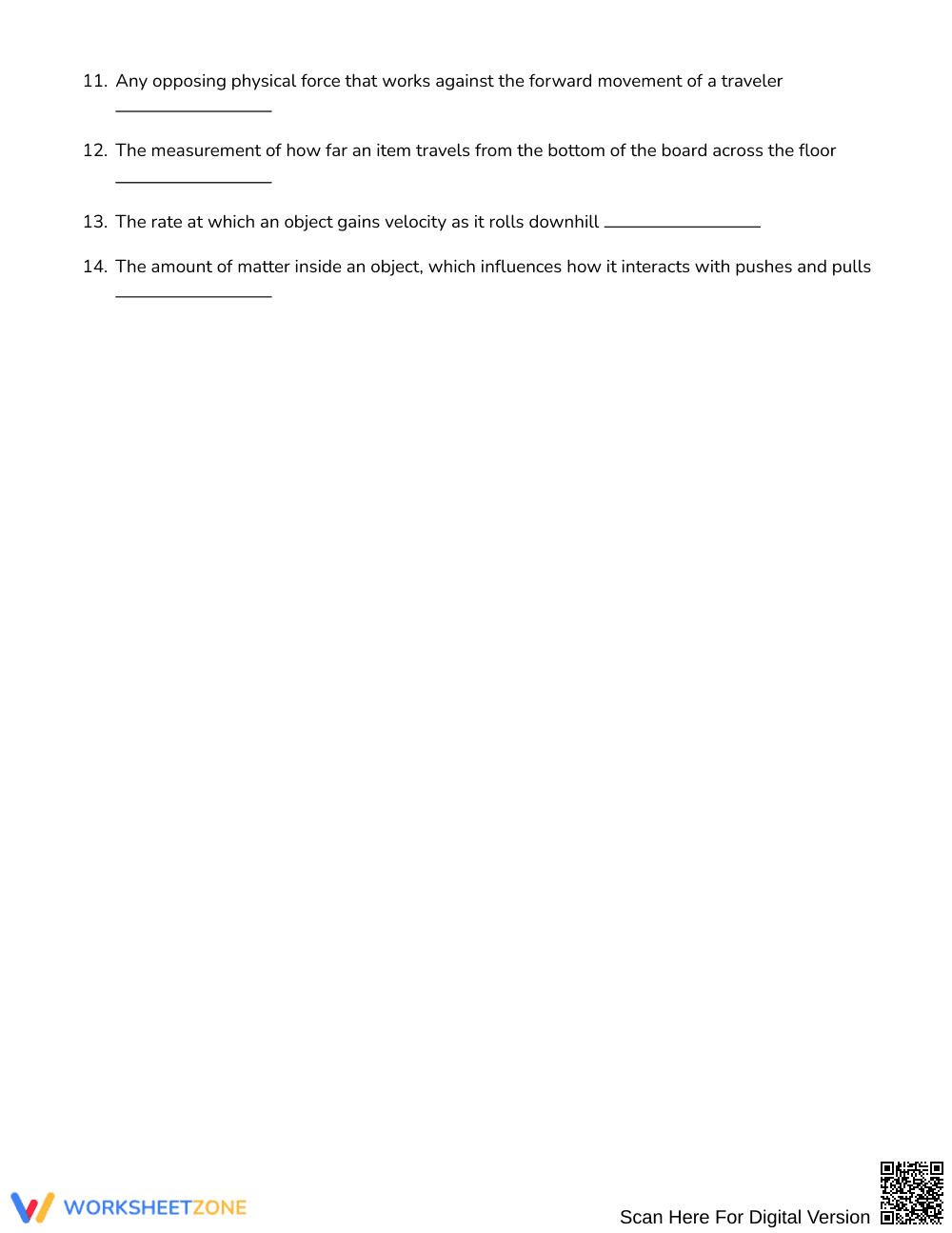
This science word search strengthens physical science vocabulary by challenging students to connect definitions with key terms about motion on ramps. Rather than simply copying words, students interpret clues to identify 14 essential concepts—such as friction, gravity, and kinetic energy—before locating each term within the letter grid to reinforce comprehension.
At a Glance
- Grade: Grades 4–5 · Subject: Science
- Standard: Not standards-assessed — vocabulary enrichment
- Skill Focus: Motion on ramps
- Format: 3 pages · 14 words · Answer key included · PDF
- Best For: Science vocabulary review and fast finishers
- Time: 20–30 minutes
The activity provides an engaging clue-based puzzle layout spread across 3 printable pages with a matching 3-page answer key. Students read contextual definitions for physics concepts, determine the corresponding vocabulary word, and locate it within the grid. The complete solution key illustrates all word placements clearly for swift student self-checking or teacher grading.
This word search operates as an integrated vocabulary challenge designed around specific structural features:
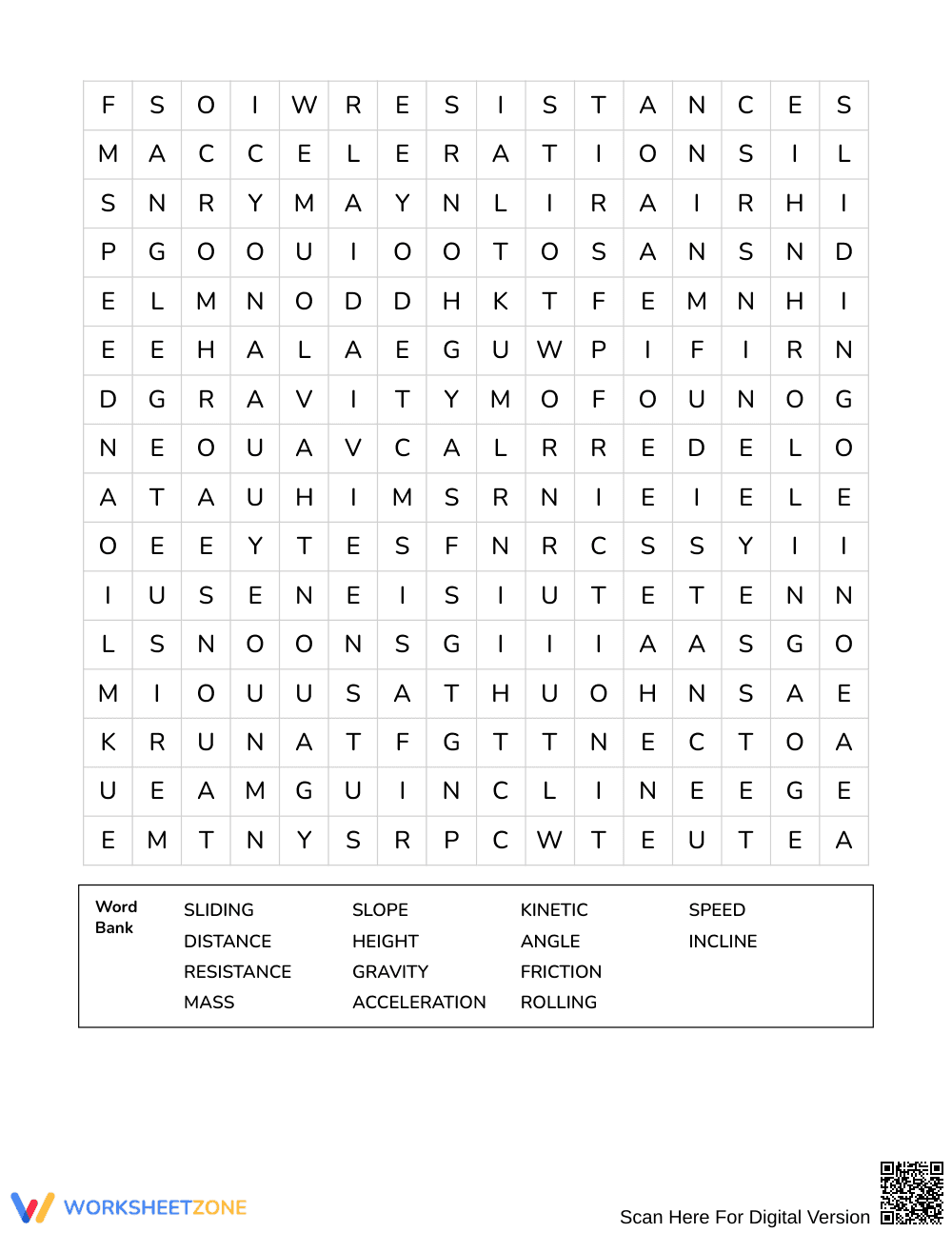
- Grid Configuration: The puzzle features a 16 × 16 letter grid containing 14 hidden physical science terms.
- Search Directions: Words are positioned across four distinct orientations: northeast (NE), east (E), southeast (SE), and south (S).
- Clue Detective Format: A shuffled word bank pairs with 14 descriptive clues, requiring learners to retrieve conceptual knowledge about ramp angles, resistance, and velocity before locating terms.
This activity serves strictly as vocabulary enrichment and is not aligned to a formal state or national content standard. It reinforces essential academic language related to inclined planes, forces, and motion to support broader physical science units without attaching formal standardized accountability metrics.
Incorporate this activity directly after an introductory direct-instruction lesson or hands-on ramp lab experiment. During small-group exploration, observe whether students can define resistance or slope independently before checking the clue list. Alternatively, assign the activity as an independent sponge task or sub plan activity; learners will typically finish the puzzle within 20 to 30 minutes.
This printable resource targets upper elementary science students in Grades 4–5 building foundational literacy in force and motion. Visual learners and multilingual students benefit from matching functional definitions directly to technical terms. Pair this vocabulary puzzle with an inclined plane ramp demonstration or an interactive friction investigation to solidify conceptual mastery.
Building academic domain vocabulary plays a pivotal role in physical science mastery during the upper elementary grades. According to Fisher & Frey (2014), intentional exposure to disciplinary vocabulary through contextual definitions and active word retrieval directly accelerates conceptual comprehension across STEM topics. This 14-word puzzle focuses specifically on motion on ramps, requiring students in Grades 4–5 to decode meaning-based clues rather than mindlessly scanning letters. By actively linking scientific principles such as acceleration, gravity, friction, and slope with concrete descriptions, learners bridge basic terminology with authentic physical phenomena. The structured puzzle format activates retrieval pathways while keeping cognitive engagement high. Whether deployed as a lesson warm-up, post-investigation consolidation exercise, or targeted review activity, this non-standards-assessed enrichment resource solidifies foundational mechanics terms so that young learners can articulate precise scientific observations during subsequent hands-on laboratory experiments.


