




























Views
Downloads



Printable Marginal Cost Worksheet | Grade 9 Algebra I

Paste this activity's link or code into your existing LMS (Google Classroom, Canvas, Teams, Schoology, Moodle, etc.).
Students can open and work on the activity right away, with no student login required.
You'll still be able to track student progress and results from your teacher account.
This worksheet teaches Grade 9 Algebra I students to interpret the slope and constant of a linear cost model as marginal cost and fixed cost. Students move from reading a given function to building models from data, a graph, and budgets, always stating units and domain limits.
At a Glance
- Grade: 9 · Subject: Algebra I
- Standard:
HSF-LE.B.5— Explain what slope and the constant mean in a real cost context- Skill Focus: Interpret marginal change in a cost model
- Format: 5 pages · 10 problems · Answer key included · PDF
- Best For: Unit practice on slope and rate
- Time: 40–50 minutes
What's Inside
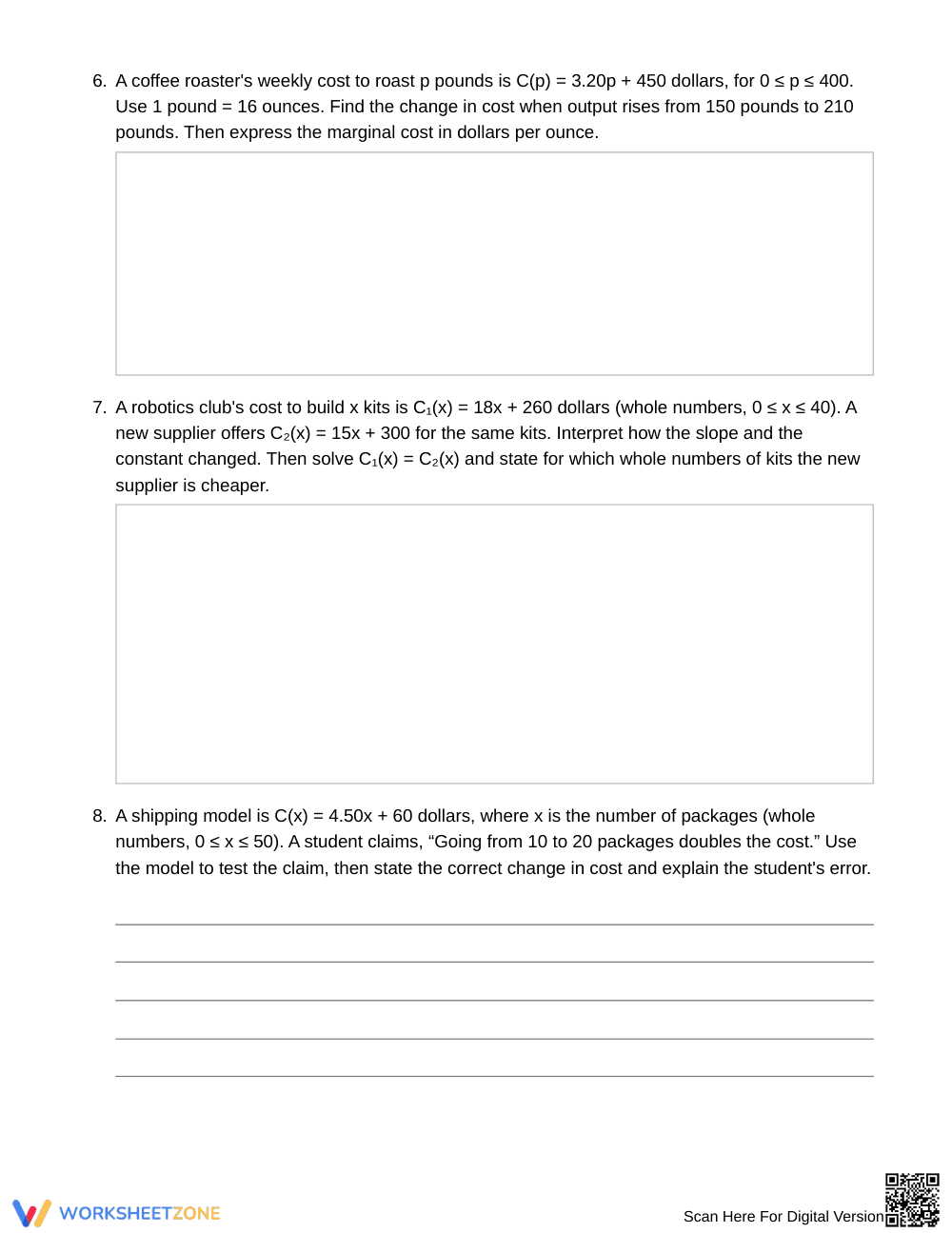
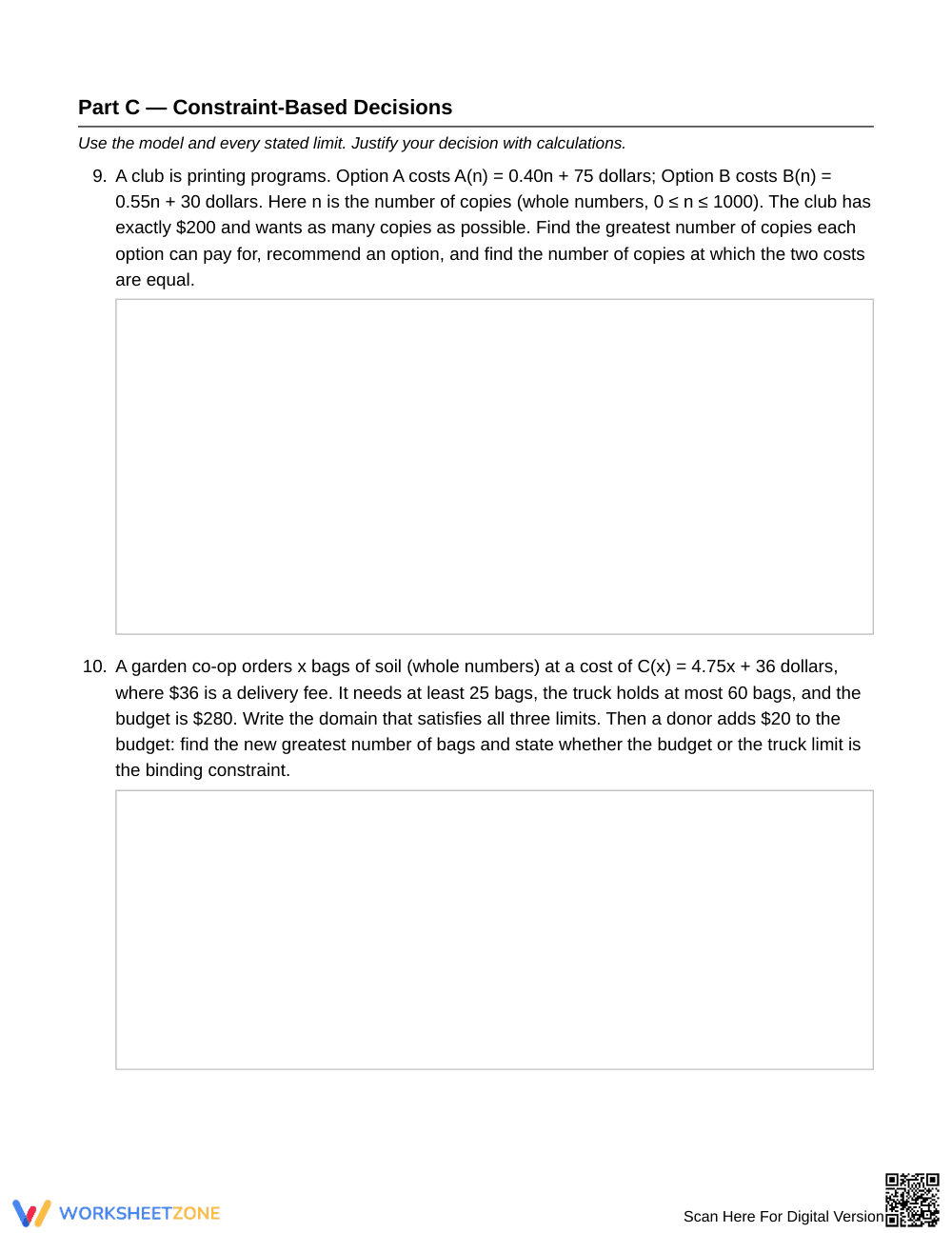
The 5-page PDF has a Key Ideas box, a worked food-truck example, and 10 problems in three parts: direct models, multi-step applications, and constraint-based decisions. Tasks use a table, a graph, and word problems. A 2-page answer key shows full solutions with units.
Skill Progression
- Guided practice: Part A, 2 problems, supported by the Key Ideas box and worked example.
- Supported practice: Part B, 6 problems, where students build models from two points, a graph, or a table and label every unit.
- Independent practice: Part C, 2 problems, where students weigh budget and capacity limits with no scaffolds.
The sequence follows gradual release: I do (worked example), we do (Part A), you do (Parts B and C).
Standards Alignment
HSF-LE.B.5 asks students to interpret the parameters of a linear function in context. Here, the slope is marginal cost in dollars per unit and the constant is fixed cost. The standard code can be copied directly into lesson plans, IEP goals, or district curriculum mapping tools.
How to Use It
- After direct instruction on slope as rate of change, assign Parts A and B as classwork or homework.
- Use Part C as a closing task or quiz review once students can build models.
Formative tip: as students work, check whether every slope carries units such as dollars per meal and whether they test the domain before answering. Expect 40–50 minutes in total.
Who It's For
Grade 9 Algebra I students in a slope and rate of change unit. Students who need support can lean on the worked example and Key Ideas box, while others can extend by explaining binding constraints in Part C. Pair it with a lesson on finding slope from two points.
HSF-LE.B.5 asks students to interpret the parameters of a linear function in context, and this Grade 9 Algebra I worksheet applies that skill to cost models. Students explain slope as marginal cost, the constant as fixed cost, and why a model holds only within its stated domain. Ten problems across five pages move from reading given functions to building models from two points, a graph, and a table, then to budget decisions with capacity limits. Students practice stating units in every answer. Fisher & Frey (2014) describe gradual release of responsibility as a structure that moves learners from modeled work to independent application, and this worksheet follows that sequence. A two-page answer key provides full solutions with units, so teachers can check reasoning, not only final numbers, during a Slope and Rate of Change unit.


