




























Views
Downloads



Printable Linear Modeling Worksheet | Grade 9 Algebra I

Paste this activity's link or code into your existing LMS (Google Classroom, Canvas, Teams, Schoology, Moodle, etc.).
Students can open and work on the activity right away, with no student login required.
You'll still be able to track student progress and results from your teacher account.
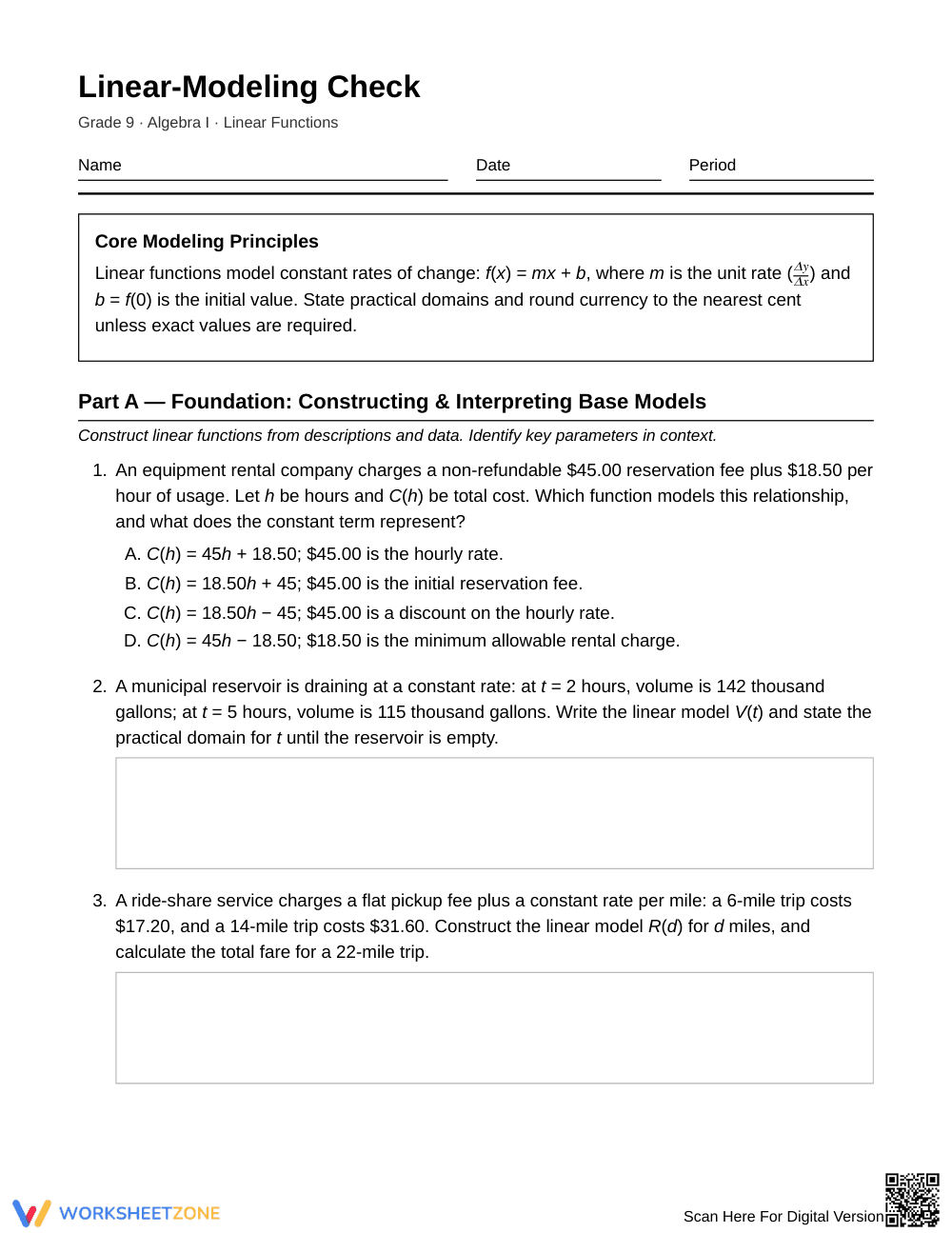
This Grade 9 linear modeling worksheet develops students' ability to translate real-world rate situations into formal linear functions. Learners identify initial values, compute constant rates of change, compare competing financial plans, and define practical domains across 16 rigorous algebra exercises designed for deep conceptual mastery.
At a Glance
- Grade: 9 · Subject: Algebra I
- Standard:
HSF-LE.A.2— Construct linear functions from graphs, descriptions, or coordinates to model contextual relationships- Skill Focus: Real-world rate of change, initial values, and linear comparisons
- Format: 5 pages · 16 problems · Full answer key included · PDF
- Best For: Linear unit review, partner practice, or diagnostic assessment
- Time: 45–60 minutes
What's Inside
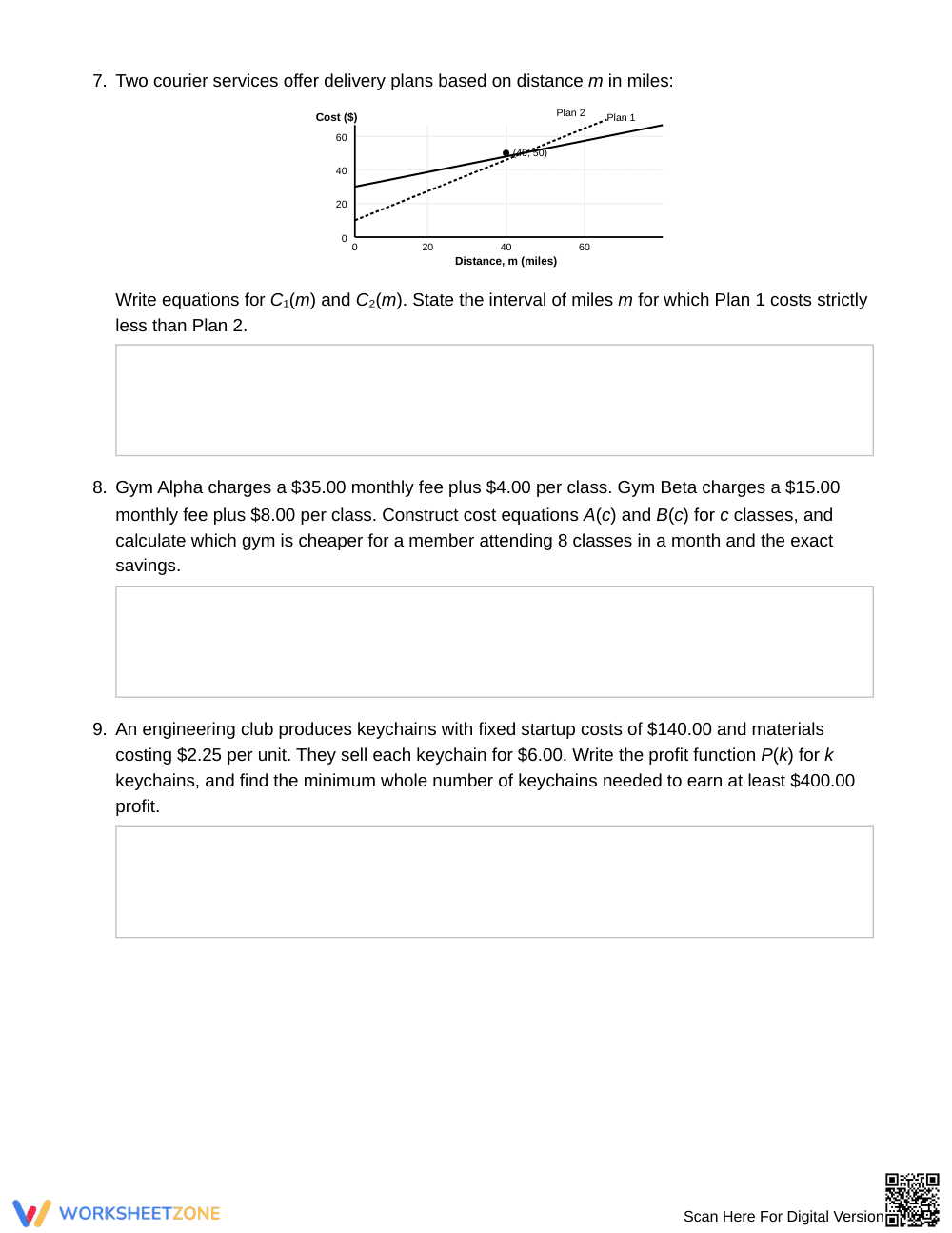
The 5-page student packet begins with a reference box defining constant rates of change and practical domain boundaries. Students complete a balanced mix of multiple-choice and constructed-response tasks spanning rental pricing, reservoir drainage, courier mileage graphs, and production budgets. The packet concludes with a detailed 2-page answer key showing step-by-step algebraic setups and contextual interpretations.
Skill Progression
- Guided practice (Problems 1–4): Students construct baseline models from verbal descriptions and data tables, identifying fixed start-up fees and unit rates with structural guidance.
- Supported practice (Problems 5–12): Students analyze competing multi-variable plans, finding intersection crossover values, interpreting graph intervals, and calculating break-even sales thresholds.
- Independent practice (Problems 13–16): Students solve multi-constraint optimization problems and manipulate rate parameters across budget caps, chase scenarios, and payback timelines without scaffolding.
This structured sequence reflects the gradual-release framework, moving learners purposefully from foundational slope-intercept formulation to autonomous multi-step problem solving.
Standards Alignment
This resource directly targets `HSF-LE.A.2`, which requires students to construct linear functions given verbal descriptions, input-output tables, or geometric representations. It additionally supports `HSA-CED.A.2` as students create two-variable equations to represent physical relationships and system intersections. Both standard codes can be copied directly into lesson plans, IEP goals, or district curriculum mapping tools.
How to Use It
Deploy this packet after direct instruction on slope-intercept form and systems of linear equations. Use it during a collaborative workshop where student pairs tackle Part B crossover comparisons, or assign it as a cumulative post-unit check. While circulating, check whether students correctly distinguish the independent variable from fixed costs in Part A problems before they calculate crossover points. Expect completion in 45 to 60 minutes.
Who It's For
This resource serves on-grade Algebra I students mastering contextual functions, as well as honors students exploring parameter sensitivity. Pair this worksheet with a linear graphing calculator investigation or an anchor chart on rate-of-change units to reinforce model interpretation.
According to Fisher & Frey (2014), systematic cognitive progression that moves from structured modeling prompts to unassisted problem solving significantly deepens mathematical reasoning and transfer. This Grade 9 worksheet operationalizes standard HSF-LE.A.2 by guiding students through constructing and interpreting contextual linear functions across 16 scaffolded tasks. Learners analyze initial constants, compute unit rates, resolve system break-even points, and establish practical physical domains. By transitioning from foundational parameter identification to complex multi-constraint cost analyses, the resource ensures students do not merely execute rote algorithms, but instead build flexible conceptual models of linear change. Complete with an annotated 2-page answer key, this resource provides an authentic assessment tool for measuring mastery of contextual rate modeling in high school mathematics classrooms.


