




























Views
Downloads



Printable Limiting Reactant Worksheet | Grade 11 Chemistry

Paste this activity's link or code into your existing LMS (Google Classroom, Canvas, Teams, Schoology, Moodle, etc.).
Students can open and work on the activity right away, with no student login required.
You'll still be able to track student progress and results from your teacher account.
This worksheet teaches Grade 11 chemistry students to determine a limiting reactant by converting to moles, dividing by coefficients, and using the mole ratio to predict products and leftover reactant. Students finish able to defend their choice with a clear, unit-labeled mole comparison.
At a Glance
- Grade: 11 · Subject: Chemistry
- Standard: Stoichiometry — compare reactant moles to find the limiting reactant and the product formed
- Skill Focus: Determine a limiting reactant
- Format: 5 pages · 12 problems · Answer key included · PDF
- Best For: Stoichiometry practice after direct instruction
- Time: 40–55 minutes
What's Inside
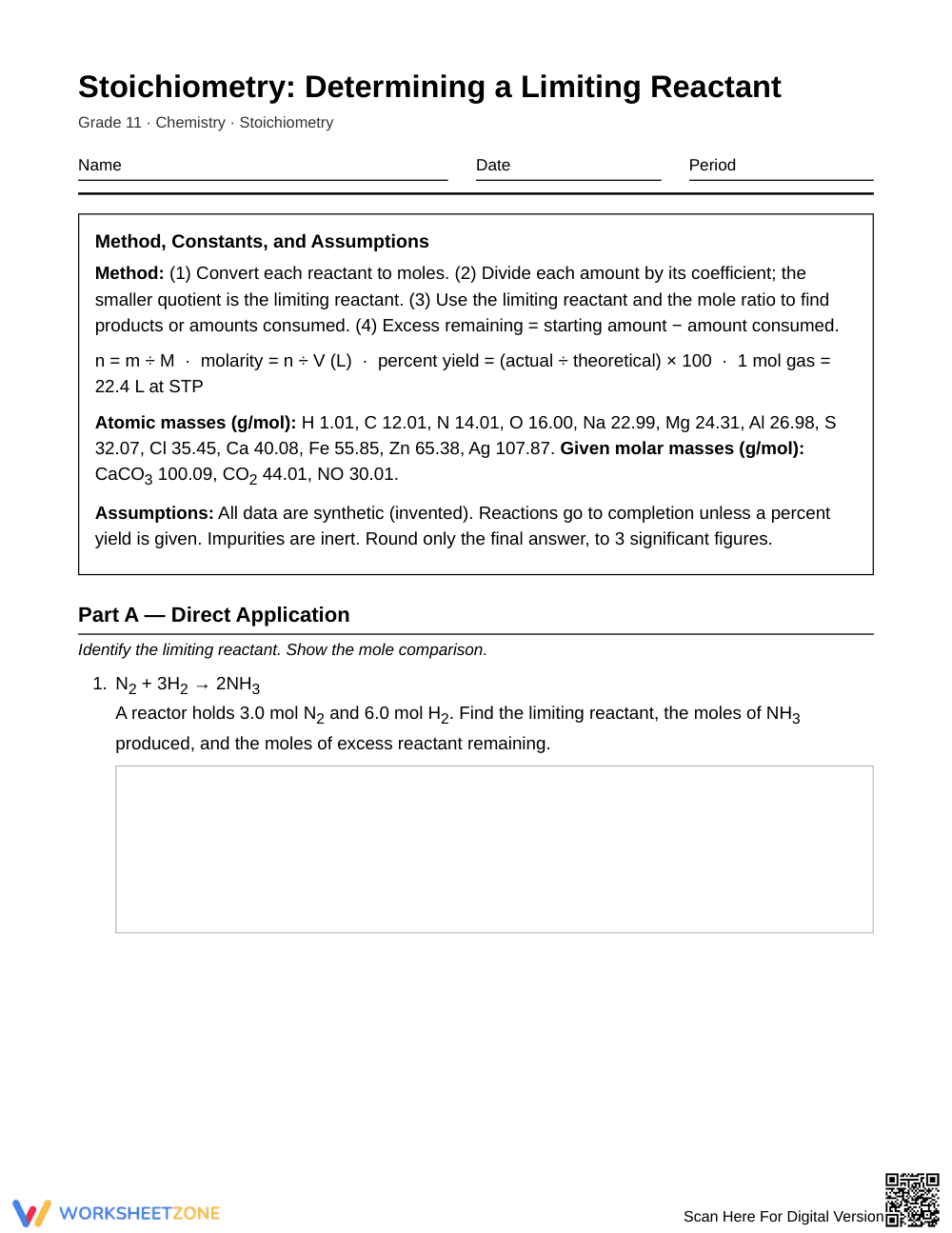
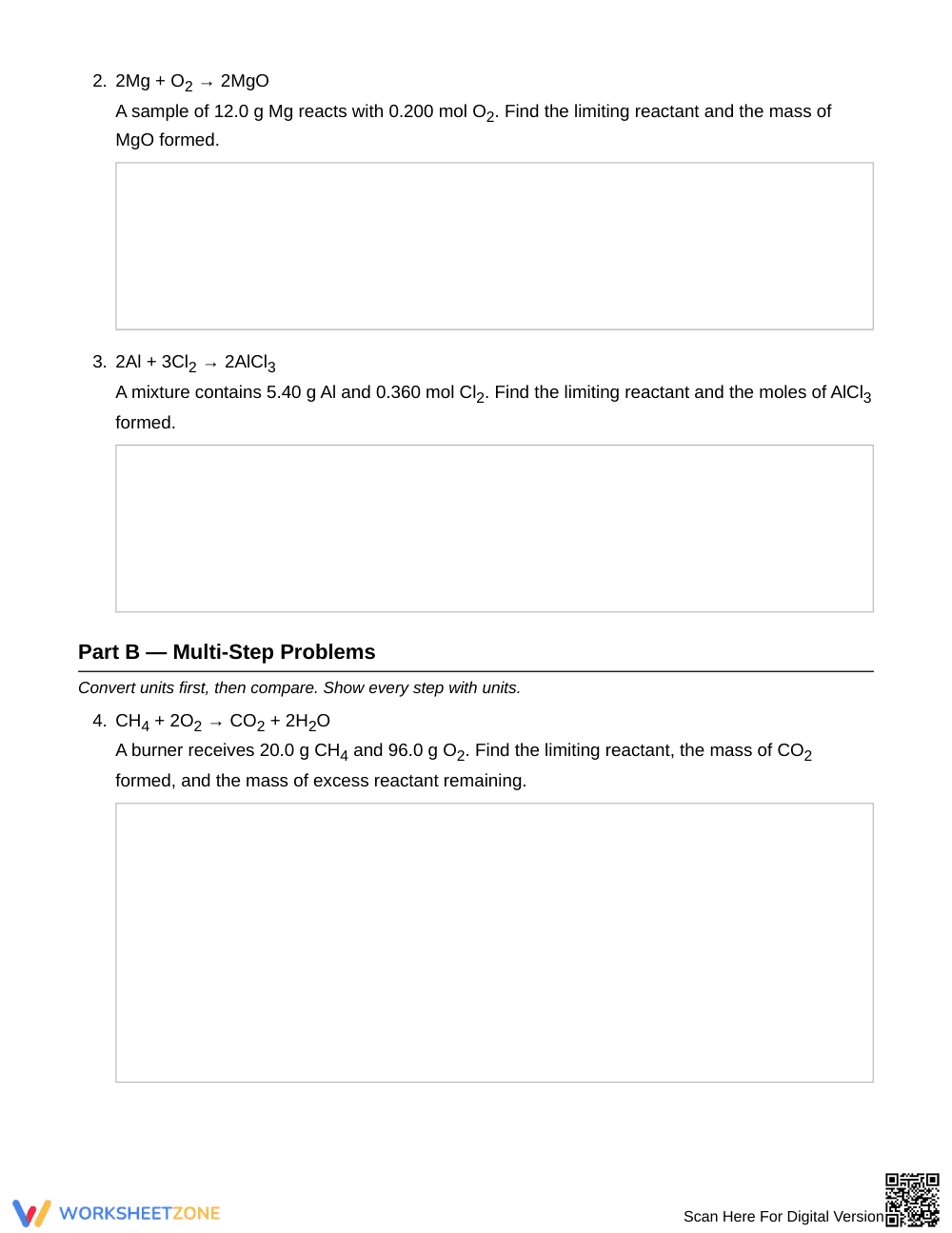
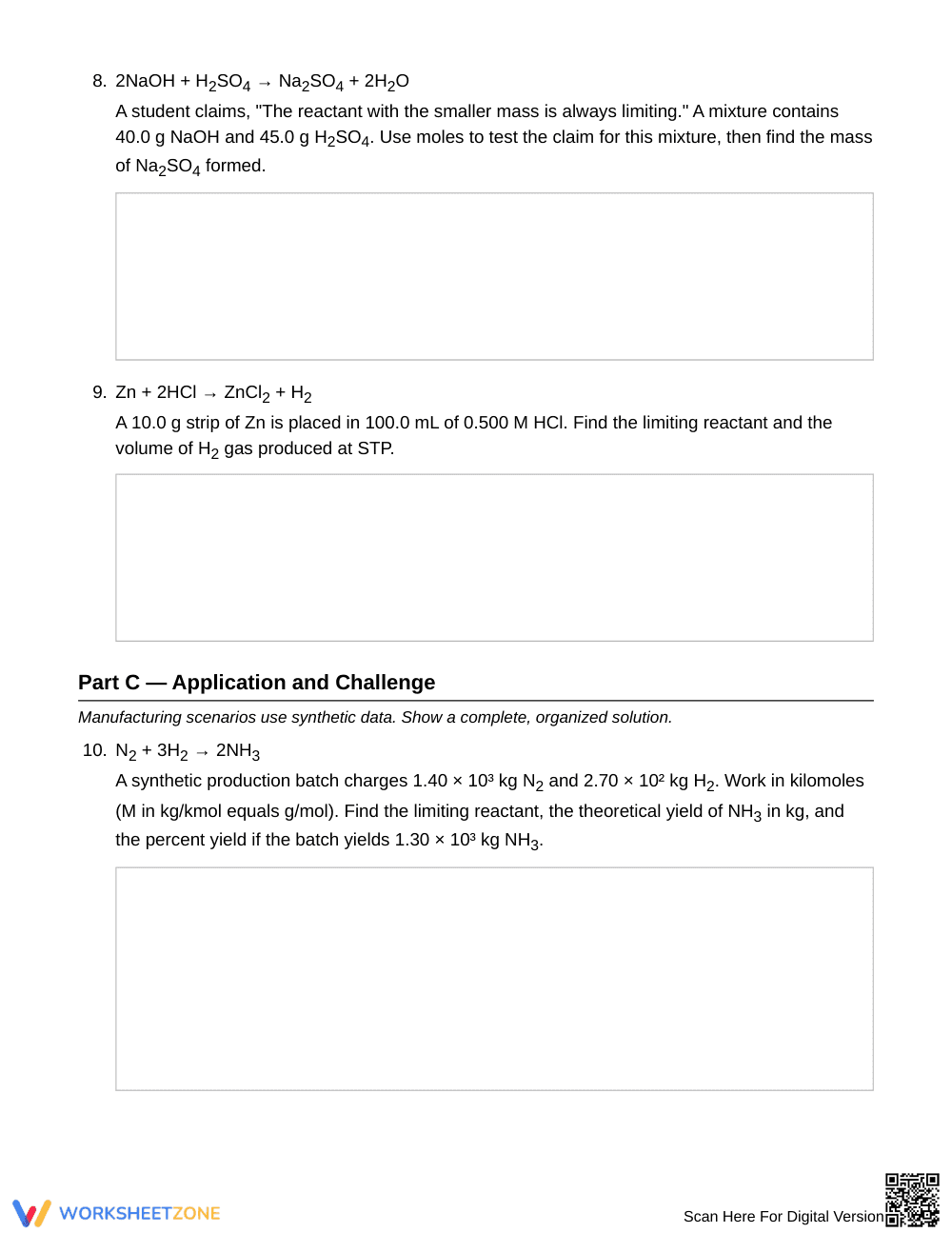
The worksheet has 12 problems across 5 pages, plus an answer key. A method box at the top lists four steps, the key formulas (n = m ÷ M, molarity, percent yield, 22.4 L at STP), a table of atomic masses, and the stated assumptions. Problems cover mass, solution, gas-volume, percent-yield, and impure-sample contexts. One problem asks students to test a common misconception, and another asks them to explain their reasoning in writing.
Skill Progression
- Guided practice (Part A, 3 problems): Direct application with mole or simple mass data. The method box supports every step.
- Supported practice (Part B, 6 problems): Multi-step problems that require unit conversion first. They include excess remaining, percent yield, molarity, and STP gas volume.
- Independent practice (Part C, 3 problems): Synthetic manufacturing scenarios with kilomole work, a 92.0% pure sample, and an air mixture that is 21.0% O2.
The sequence follows a gradual-release model: I Do, We Do, You Do.
Standards Alignment
No standard code is attached to this worksheet. The content addresses the stoichiometry skill of using balanced equations and mole ratios to identify the limiting reactant and calculate the amount of product formed, the amount of excess remaining, and the percent yield. Teachers can map it to their own state or district chemistry standard in lesson plans, IEP goals, or curriculum mapping tools.
How to Use It
- After direct instruction: Assign Part A in class once you have modeled the four-step method. Move to Part B as students gain confidence.
- Review or homework: Assign Part C before a unit test. Students check their work against the answer key.
Formative tip: watch whether students divide by the coefficient before choosing the limiting reactant. Comparing raw moles or raw masses is the most common error. Expect 40–55 minutes for the full set.
Who It's For
This worksheet suits Grade 11 chemistry students in a first stoichiometry course. Students who need more support can complete Part A and select problems from Part B. Students ready for a challenge can go straight to Part C. It pairs well with a mole-conversion anchor chart or a worked-example lesson on balanced equations.
This Grade 11 Chemistry worksheet on stoichiometry helps students determine a limiting reactant by converting each reactant to moles, dividing by its coefficient, and using the mole ratio to find product formed, excess remaining, and percent yield. Its 12 problems move from direct application to multi-step and manufacturing contexts, following the gradual release of responsibility model described by Fisher & Frey (2014), in which teacher modeling gives way to guided and then independent practice. A method box, constants table, and stated assumptions keep the focus on reasoning rather than recall. One task tests the claim that the smaller mass is always limiting. An answer key is included for self-checking and quick review.


