




























Views
Downloads



Printable Justify Linear Rate Worksheet | Grade 9 Algebra I

Paste this activity's link or code into your existing LMS (Google Classroom, Canvas, Teams, Schoology, Moodle, etc.).
Students can open and work on the activity right away, with no student login required.
You'll still be able to track student progress and results from your teacher account.
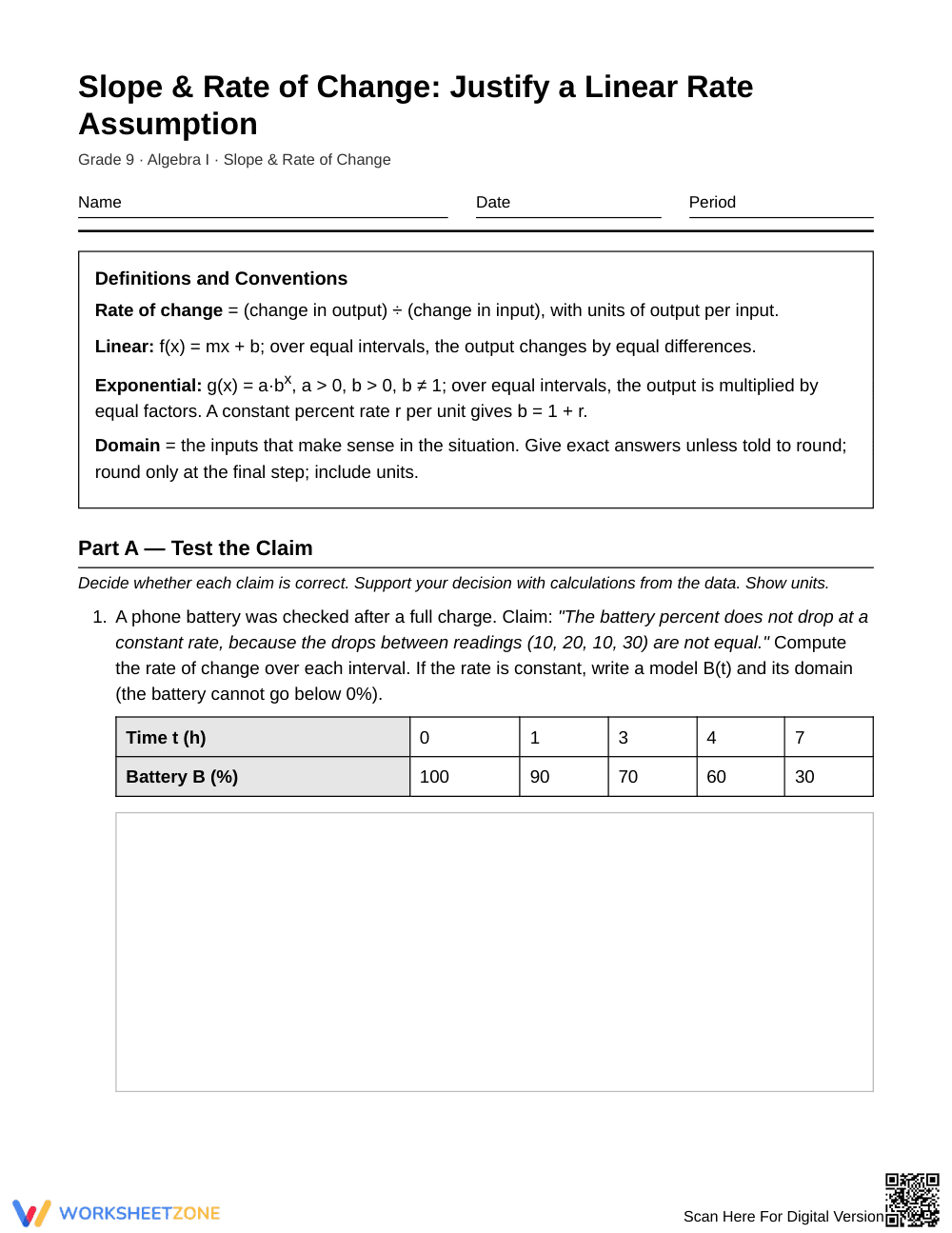
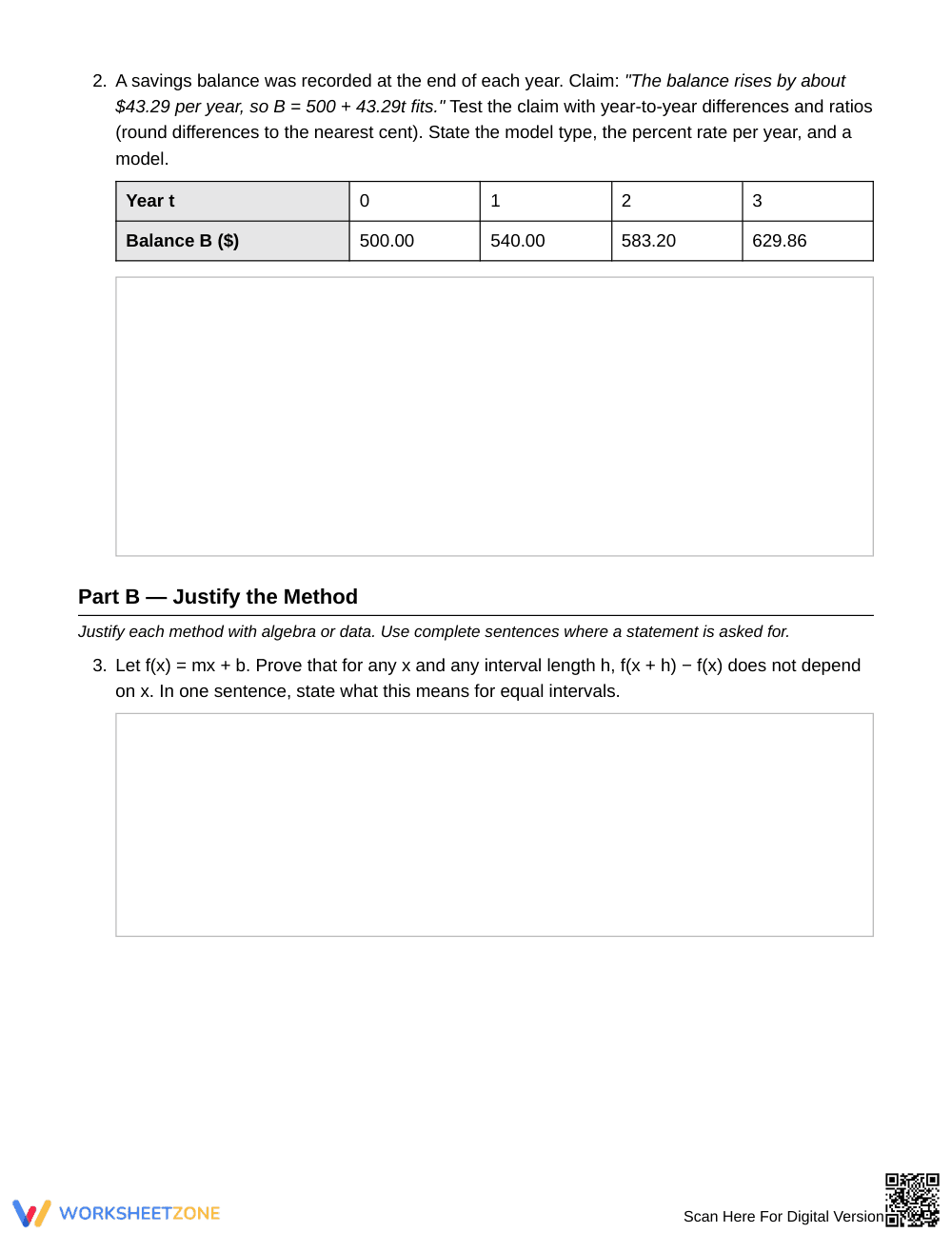
This Grade 9 Algebra I worksheet teaches students to justify whether a situation follows a linear or exponential model using differences, ratios, and short algebraic proofs. Students test claims against data, prove why each method works, and finish by building counterexamples and stating validity conditions.
At a Glance
- Grade: 9 · Subject: Algebra I
- Standard:
HSF-LE.A.1— Decide whether data fit linear or exponential models and justify the choice with calculations.- Skill Focus: Justify a linear rate assumption
- Format: 5 pages · 8 problems · Answer key included · PDF
- Best For: Unit practice on rate of change
- Time: 35–45 minutes
What's Inside
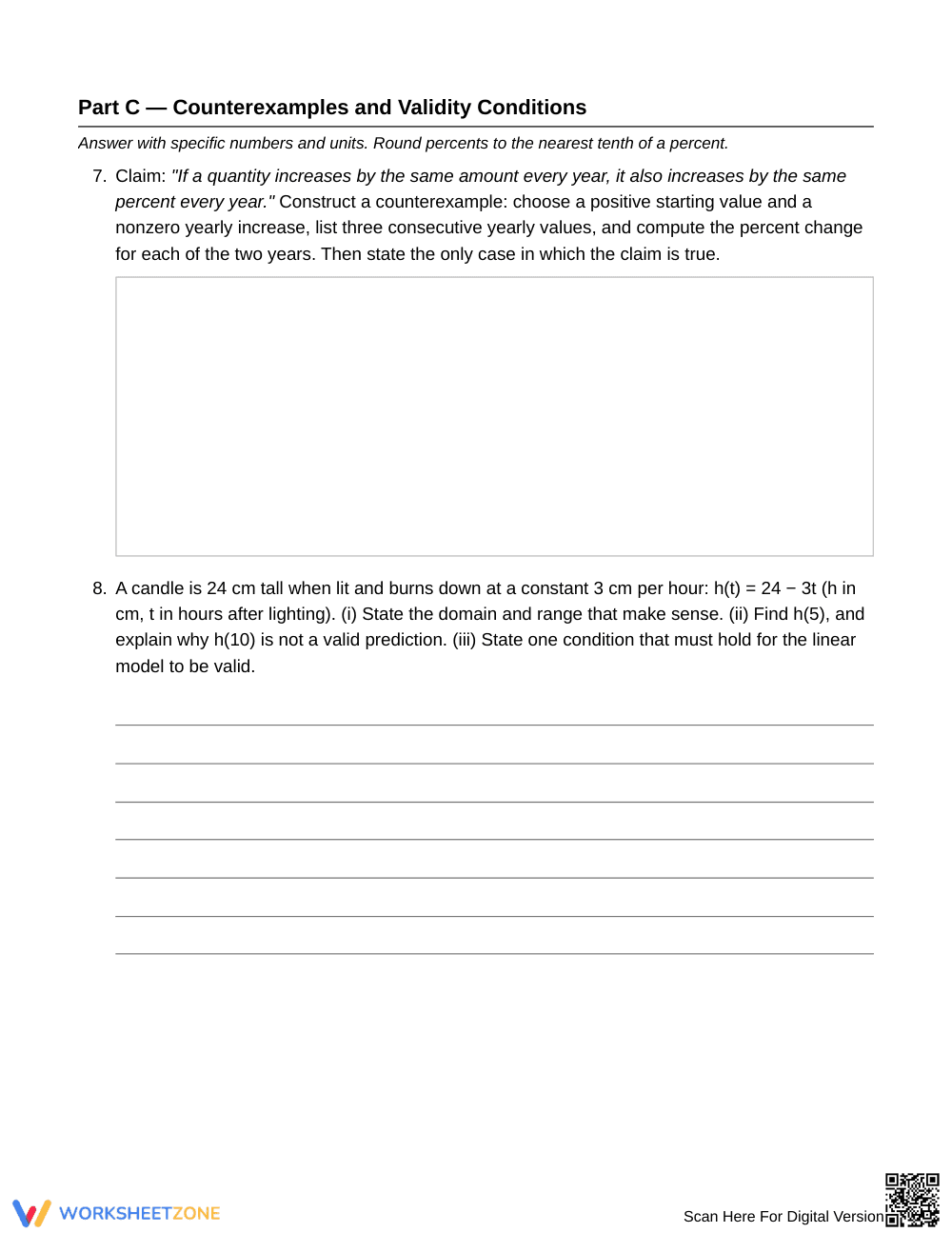
Eight tasks across 5 pages, organized in three parts: Test the Claim (2 data-table problems), Justify the Method (4 proof and modeling tasks, including one graph of a mold colony), and Counterexamples and Validity Conditions (2 tasks). A definitions box supplies formulas and rounding conventions. A 3-page answer key shows models, domains, and worked reasoning.
Skill Progression
- Guided practice: 2 problems in Part A use data tables and explicit prompts to compute rates and ratios, with the definitions box as support.
- Supported practice: 4 problems in Part B ask students to prove that linear differences stay constant, contrast exponential ratios, and model medicine and mold data.
- Independent practice: 2 problems in Part C require a counterexample and a domain and validity argument with minimal scaffolding.
The sequence follows gradual release: I Do, We Do, You Do.
Standards Alignment
HSF-LE.A.1 — Distinguish between situations that can be modeled with linear functions and with exponential functions. Students prove that linear functions change by equal differences over equal intervals, while exponential functions change by equal factors. This standard code can be copied directly into lesson plans, IEP goals, or district curriculum mapping tools.
How to Use It
- After direct instruction: Assign Part A as independent practice once students have seen linear and exponential examples.
- Before a unit test: Use Parts B and C as review or homework.
Formative tip: while circulating, watch whether students compute ratios as well as differences, and whether they attach units and check the domain. Expect 35–45 minutes for the full set.
Who It's For
Grade 9 Algebra I students working on rate of change and function families. Assign Part A first for students who need support, and use the Part B proofs as extension. Pair it with an anchor chart comparing equal differences and equal ratios.
The Grade 9 Algebra I worksheet Justify a Linear Rate Assumption targets HSF-LE.A.1, which asks students to distinguish situations modeled by linear functions from those modeled by exponential functions. In plain terms, students decide whether equal intervals produce equal differences or equal ratios, then defend the choice with calculations, short proofs, and counterexamples. The 8 tasks across 5 pages move from testing claims against data tables, through algebraic proofs that f(x + h) − f(x) is constant for linear functions and g(x + h) ÷ g(x) is constant for exponential functions, to open counterexample and domain questions. This sequence reflects the gradual release of responsibility described by Fisher & Frey (2014), in which teacher modeling shifts toward guided and then independent work. A 3-page answer key is included, so teachers can check reasoning, units, and domains quickly and use the results as formative evidence.


