




























Views
Downloads

Printable Grouping Symbols Worksheet | Grade 6 Math

Paste this activity's link or code into your existing LMS (Google Classroom, Canvas, Teams, Schoology, Moodle, etc.).
Students can open and work on the activity right away, with no student login required.
You'll still be able to track student progress and results from your teacher account.
This Grade 6 math worksheet guides students to strategically insert grouping symbols into numerical expressions to achieve designated target values. By manipulating parentheses and brackets rather than performing standard calculations, learners deepen operational understanding, eliminate procedural misconceptions, and master order of operations across 20 rigorous tasks.
At a Glance
- Grade: 6 · Subject: Math (Expressions & Equations)
- Standard:
6.EE.A.1— Write and evaluate numerical expressions involving whole-number exponents and grouping symbols.- Skill Focus: Insert Grouping to Reach a Target
- Format: 5 pages · 20 problems · Answer key included · PDF
- Best For: Target-based order of operations practice
- Time: 40–50 minutes
What's Inside
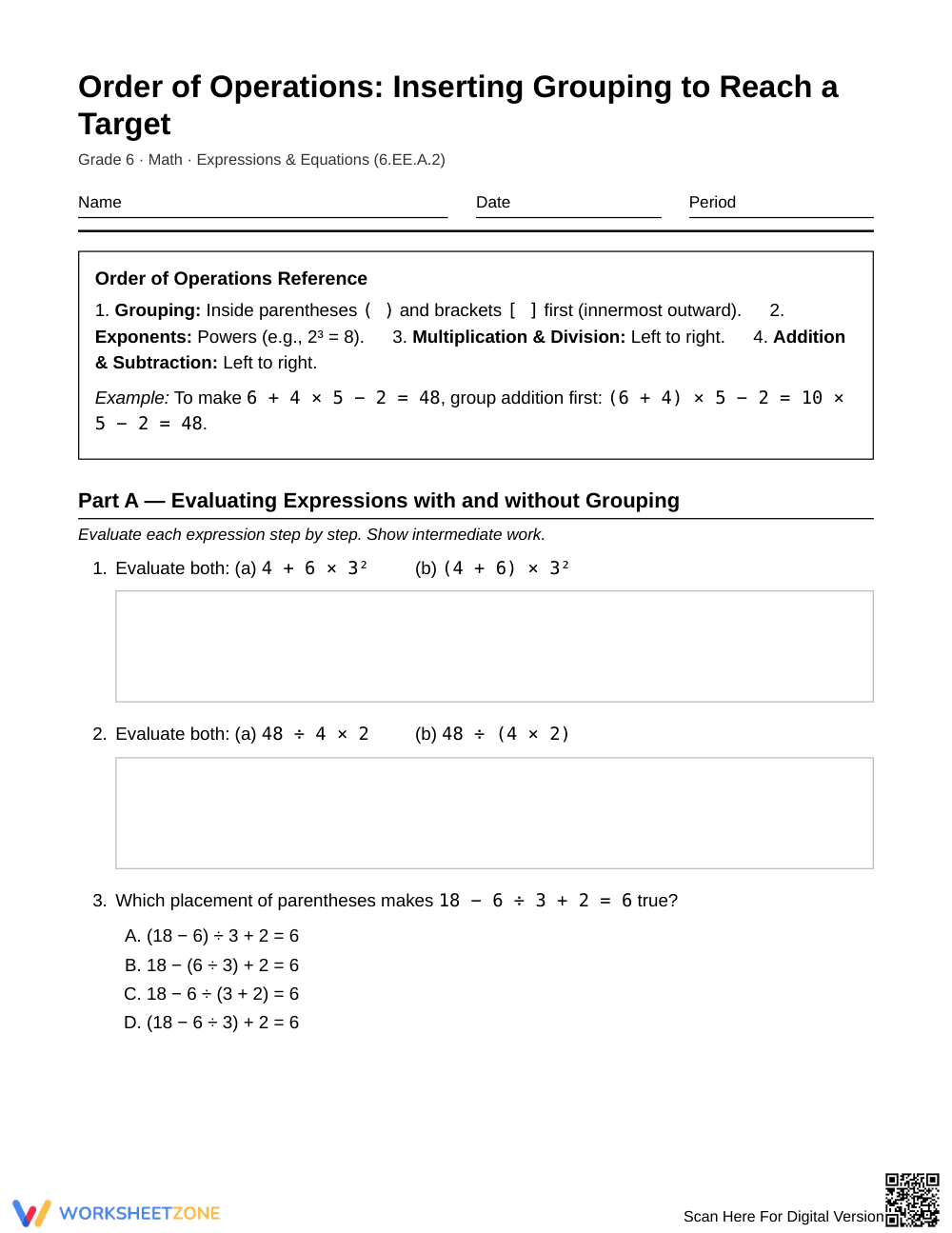
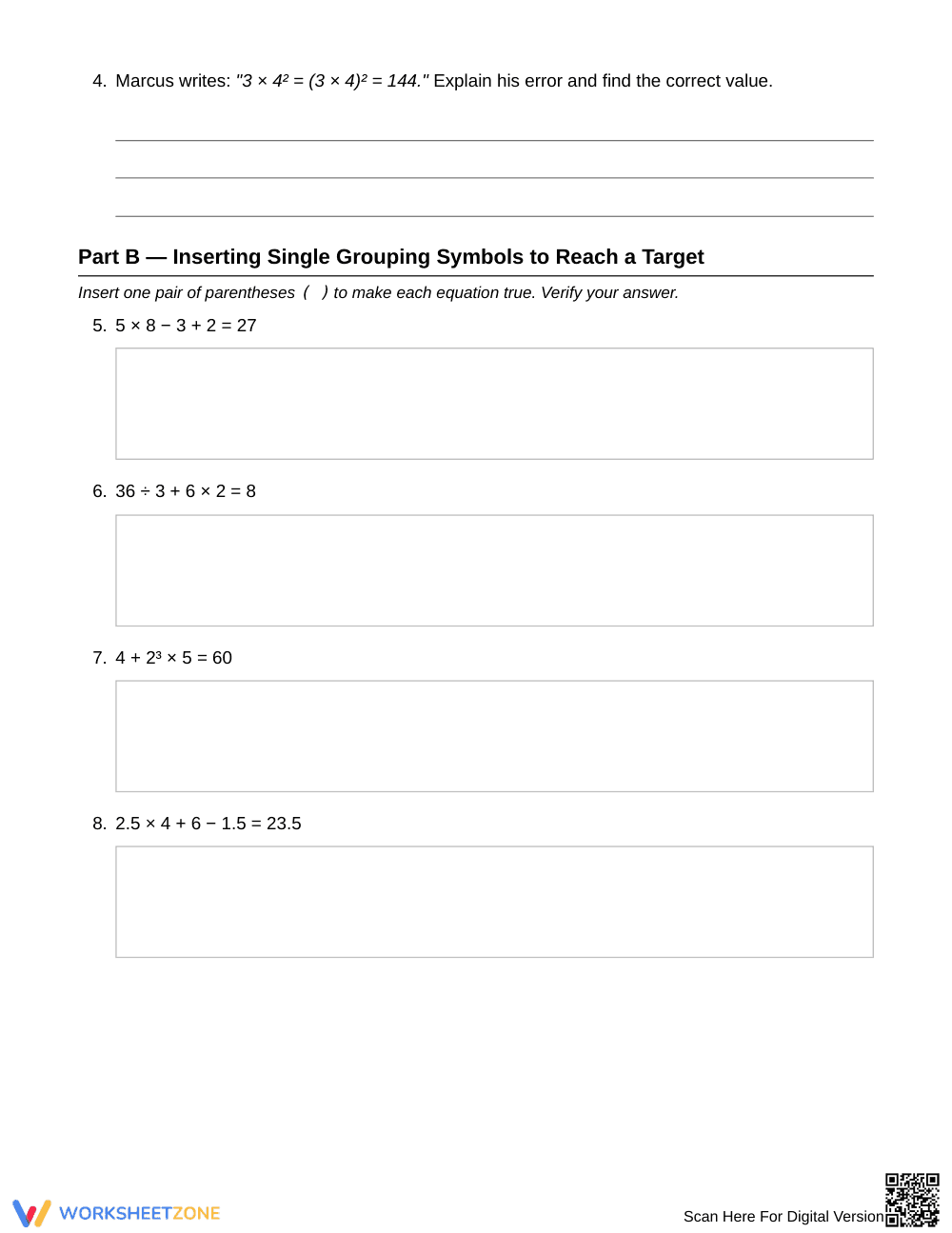
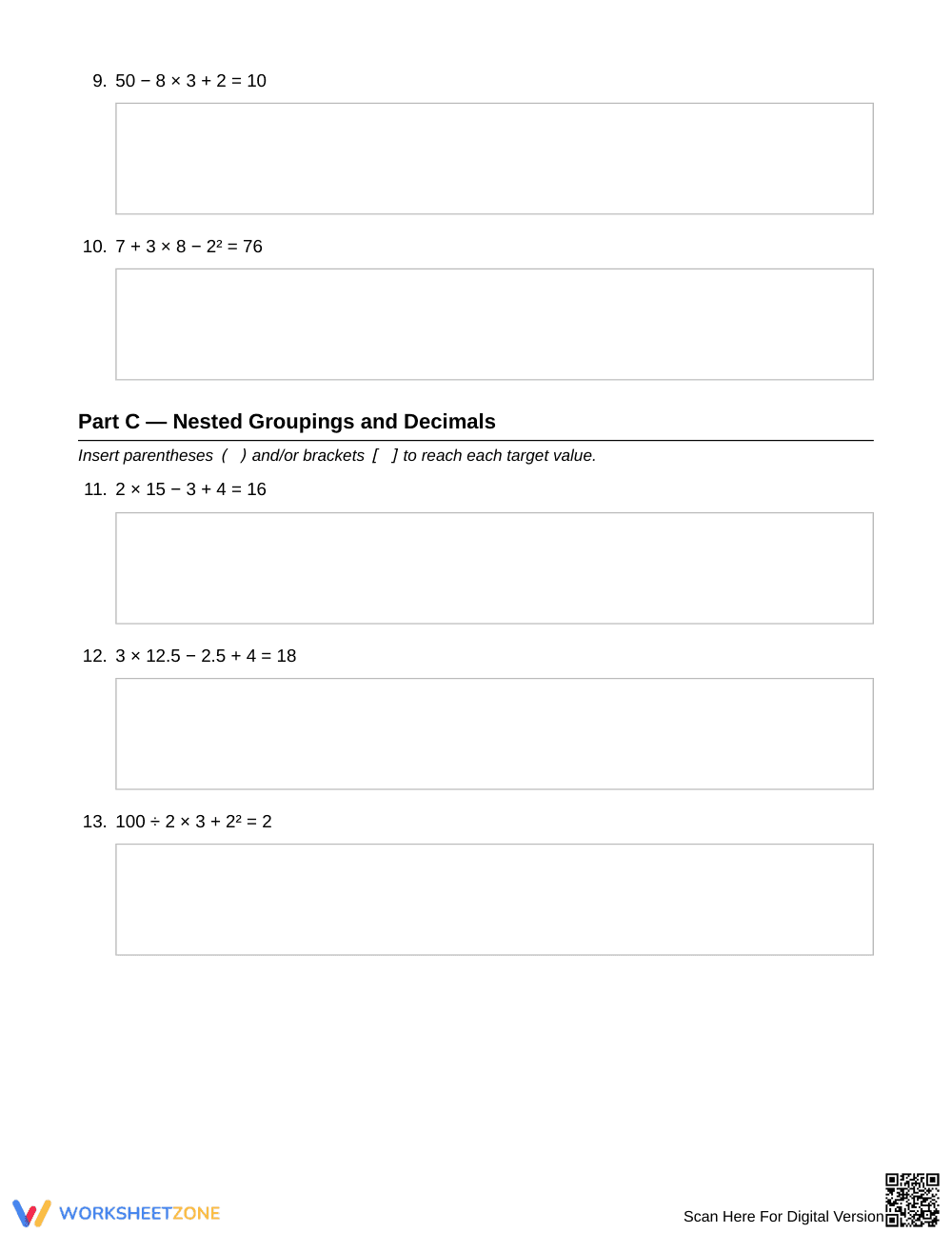
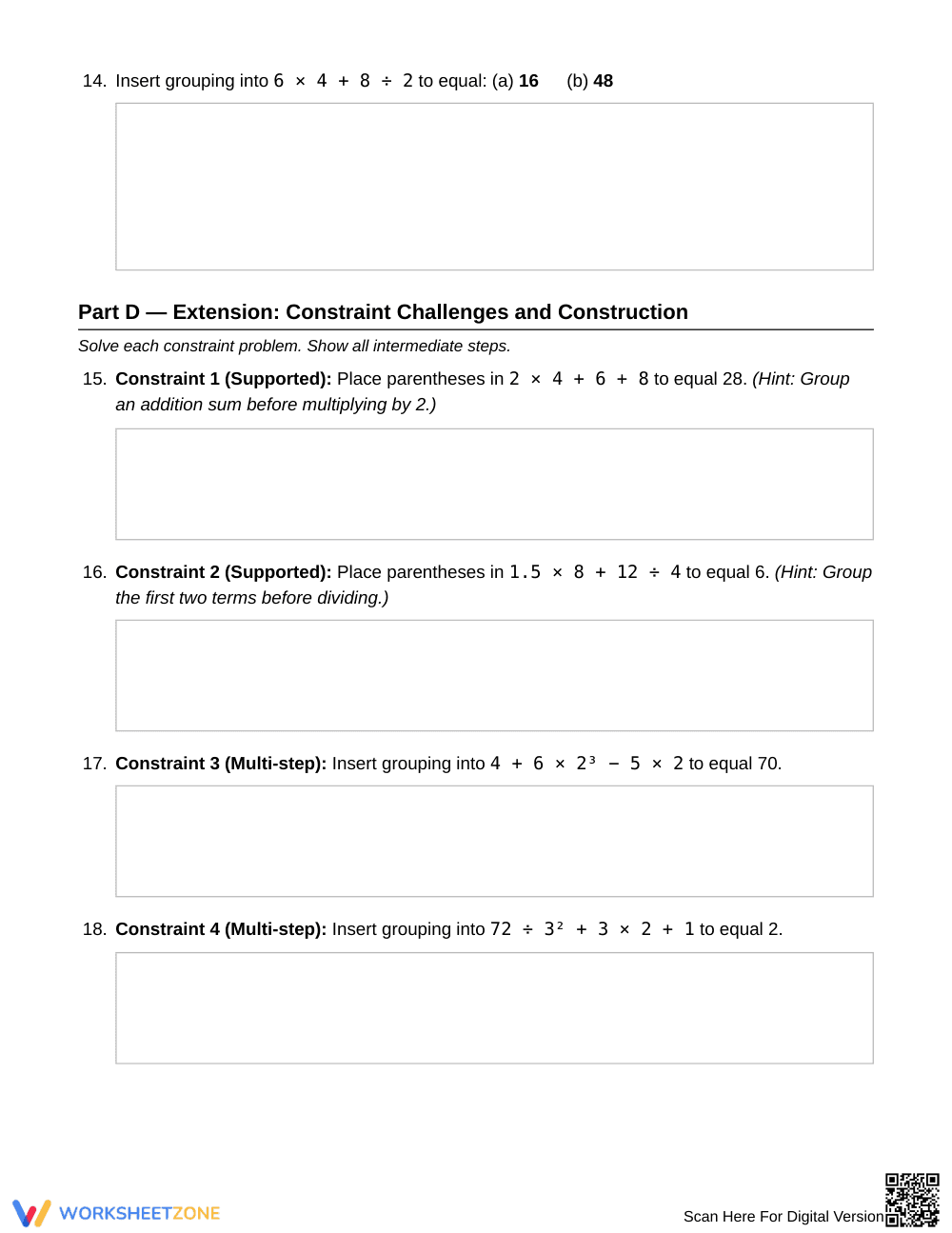
This 5-page printable resource includes an Order of Operations reference box with a worked example, comparative evaluation items, multiple-choice placement tasks, and student error analysis. Students then progress through single-parentheses placement, nested brackets with decimals, constraint problems, and a 2-page detailed answer key.
Skill Progression
- Guided practice (Part A, 4 problems): Students review reference rules, evaluate paired expressions to observe parenthetical impact, and analyze student calculation errors.
- Supported practice (Parts B & C, 10 problems): Learners insert parentheses and nested brackets into integer and decimal expressions to generate designated targets.
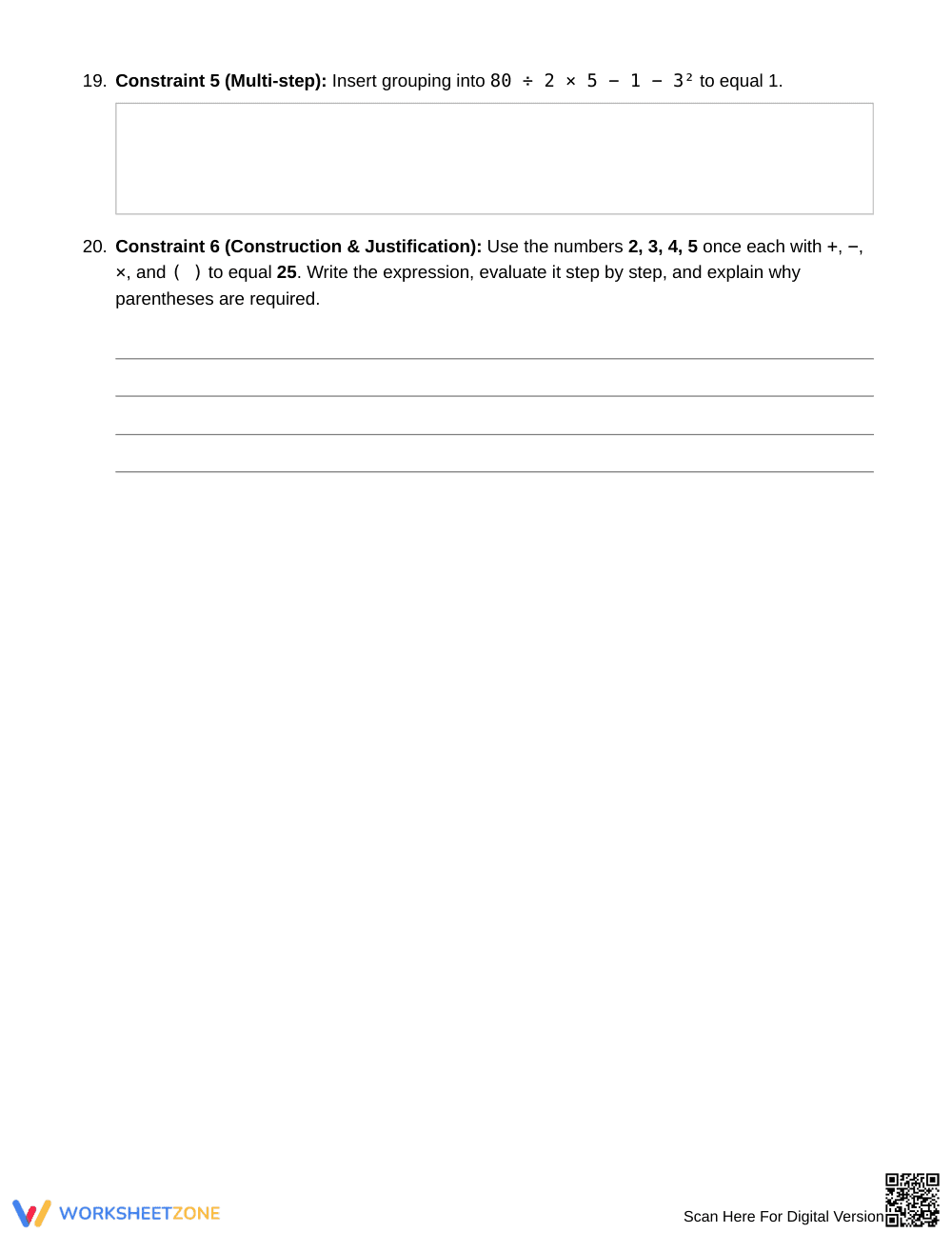
- Independent practice (Part D, 6 problems): Students solve multi-step constraint problems and construct custom expressions unassisted.
This sequence follows the gradual-release model, advancing learners from guided analysis to autonomous problem-solving.
Standards Alignment
This worksheet aligns to primary standard 6.EE.A.1 by having students evaluate numerical expressions involving whole-number exponents and grouping symbols. It also supports 6.EE.A.2 through operational notation. Both standard codes can be copied directly into lesson plans, IEP goals, or district curriculum mapping tools.
How to Use It
Deploy this worksheet after direct instruction for targeted partner practice, or assign Parts B through D as homework following a guided lesson. During work, check whether students blindly guess or systematically test operations of lowest precedence first. Expect completion in 40 to 50 minutes.
Who It's For
This resource serves Grade 6 students learning order of operations and Grade 7 students needing algebraic remediation. Scaffolding hints support struggling learners while constraint challenges stretch advanced thinkers. Pair this printable with a PEMDAS anchor chart during practice.
Mastering order of operations requires students to recognize grouping symbols not merely as punctuation, but as structural tools that alter numerical relationships. Under Common Core standard 6.EE.A.1, sixth-grade learners must evaluate numerical expressions involving whole-number exponents and grouping symbols. This worksheet targets the skill of inserting grouping symbols to reach target values, guiding students from initial comparative evaluation to complex expression construction. Grounded in the gradual release of responsibility framework articulated by Fisher & Frey (2014), the resource scaffolds student autonomy through guided error analysis, supported placement drills, and unassisted constraint challenges. Mathematical research confirms that asking students to manipulate operations to hit specific targets fosters higher-order metacognition compared to standard rote computation. By requiring learners to justify parenthetical placements, explain peer errors, and verify intermediate steps across 20 focused problems, this instructional material establishes a durable conceptual foundation for pre-algebraic reasoning and multi-step equation solving.


